
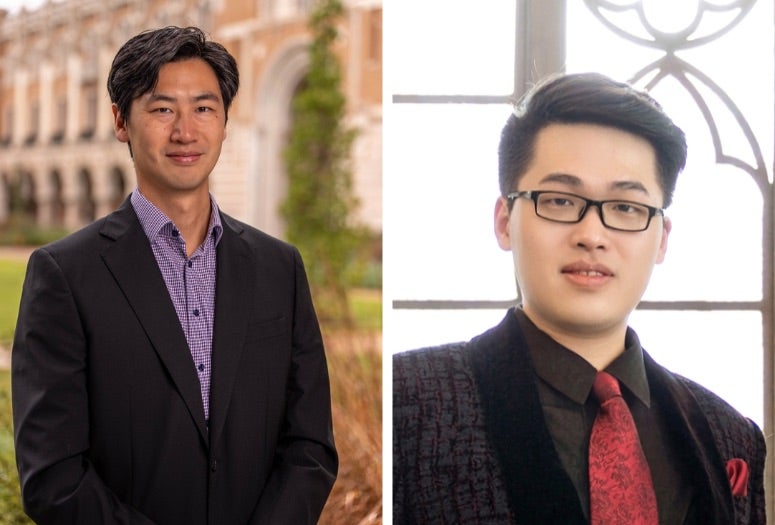
Two Rice University professors have received a Department of Energy Early Career Award, which supports outstanding early-career scientists. Each professor will receive approximately $875,000 over a five-year period.
“The energy and creativity of early-career scientists is crucial for propelling scientific discovery forward. The Department of Energy is committed to nurturing this talent through programs like the Early Career Research Program,” said Darío Gil, DOE under secretary for science. “These awards provide essential resources and opportunities for collaboration, enabling these researchers to explore novel concepts and accelerate the development of solutions for our nation’s energy and scientific landscape.”
Programmable chemical networks for a sustainable future
James Shee, assistant professor of chemistry, is a theoretical quantum chemist whose research expertise involves the development of high-accuracy electronic structure theories to understand how correlated electrons in molecular systems give rise to unique chemical phenomena. This award will support the advancement of a first principles platform to simulate the quantum dynamics of chemical systems of relevance to sustainable energy consumption and generation, which are beyond the reach of existing computational methodologies. In addition to featuring prominent many-electron correlation effects, the target systems interact strongly with external fields and vibrational degrees of freedom. The ability to accurately model such complex systems will enable Shee’s team to explore new ways to realize energy-efficient molecular computation leveraging the laws of quantum mechanics and will open the door to material-specific simulations of multi-excitonic energy transduction pathways that have the potential to increase the efficiency of solar energy harvesting.
“This award recognizes the contributions that my group has made during the early stages of my independent career and moreover highlights the doors that we’ve opened — the exciting new research directions that are of both fundamental and mission-driven relevance,” Shee said. “Support from the Department of Energy will enable my group to pursue the ambitious quantum chemistry development required to simulate the dynamics of transition metal-based molecular computing paradigms and multi-excitonic processes in a purely ab initio manner.”
Next-generation physical AI with ultralow energy costs

Tony Geng, assistant professor of electrical and computer engineering, will use his award to develop next-generation physical AI that revolutionizes real-time digital twins for scientific systems. The team will design microchips that function as trainable electronic dynamical systems, computing through natural, continuous evolution rather than digital instructions. By training the chips to mirror physical systems in real time, the team creates operational twins that deliver accurate prediction, control and optimization at ultralow energy costs while dismantling computing barriers to scientific discovery.
“I am deeply grateful to the Department of Energy for this award, and to the Advanced Scientific Computing Research program within DOE’s Office of Science for recognizing our vision and recommending our project for funding,” Geng said. “This recognition highlights the impact of dynamical-system AI, a new physical AI paradigm designed to accelerate scientific discovery. The technology creates real-time digital twins that optimize scientific systems while they operate. Rice has played an indispensable role in nurturing and shaping our vision for physical AI. The Department of Electrical and Computer Engineering, the Rice Brain Institute and the broader research community bring together the expertise this work demands, spanning microelectronics, computer systems, AI, dynamical systems theory, neuroscience and neuroengineering. The award gives us the sustained support to realize a vision my students and I have believed in and worked toward for years and to put it to the test on real-world scientific challenges.”