
Around half of the LGBTQ+ Houstonians who participated in a new Rice University survey reported making over $100,000 annually, at the same time that nearly 6 in 10 believe invisible barriers slow career advancement and one-third say they have felt the need to hide their identity at work to be accepted.
As LGBTQ+ History Month draws to a close, the findings from Rice’s Kinder Institute for Urban Research offer a closer look at the opportunities and challenges facing LGBTQ+ residents across Greater Houston, revealing both successes and disparities in economic security, workplace experiences, neighborhood belonging and access to health care.
The Houston Area LGBTQ+ Opinions, Voices and Experiences (L.O.V.E.) Survey gathered responses from more than 1,000 residents. Developed in partnership with the Montrose Center and the Greater Houston LGBTQ+ Chamber of Commerce, the pilot study provides new insight into a community historically underrepresented in local data.
“Houston is home to one of the largest LGBTQ+ populations in the entire country, but we know very little about this population and the contributions they make to our broader community,” said Dan Potter, director of the Kinder Institute’s Houston Population Research Center and lead researcher on the project. “The Houston Area LOVE Survey provides us with novel insights about the many successes as well as ongoing challenges faced by our LGBTQ+ neighbors, friends and family members.”
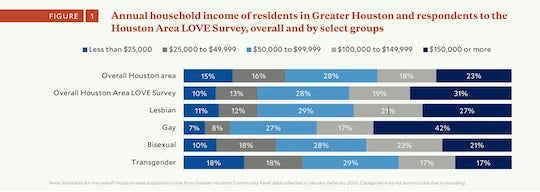
Despite the overall economic success of many respondents, the survey also revealed disparities and additional challenges in the workplace. Although nearly half reported making over $100,000, that ranged from 34% of transgender respondents to 59% of gay respondents. More than 4 in 10 respondents said they had experienced hurtful jokes or comments related to their LGBTQ+ identity at work. Another 44% believed LGBTQ+ employees did not have the same promotion opportunities as similarly qualified colleagues.
Economic security also varied across groups. While 63% of gay respondents reported having enough savings to cover at least three months of expenses, just 29% of transgender respondents said the same.
For Tammi Wallace, co-founder, president and CEO of the Greater Houston LGBTQ+ Chamber of Commerce, the findings underscore the importance of ensuring economic opportunity extends beyond employment.
“Economic inclusion means having access to a good job, the opportunity to build and grow a business, a workplace where people can thrive, and the resources to create lasting financial security,” Wallace said. “We want these findings to inform how employers recruit and support LGBTQ+ talent, how institutions invest in our community, and how policymakers address barriers to opportunity across the region.”
Those differences extended beyond the workplace and into the neighborhoods respondents call home.
Overall, 62% said they felt a sense of belonging in their neighborhood. That figure climbed to 71% among gay respondents but dropped to 41% among transgender respondents. Similarly, 57% of all respondents believed their neighborhoods were accepting of LGBTQ+ people, compared with 40% of transgender respondents.
Access to health care presented additional challenges. Among respondents who needed specialty medical care, 67% said they could always obtain it compared with 43% of transgender respondents. Less than half of those seeking gender-affirming care reported always being able to access those services.
Cost was the most commonly reported obstacle among respondents who had difficulty obtaining needed health care with 56% citing expenses as a barrier. Others pointed to limited appointments, insurance coverage and difficulty finding providers supportive of the LGBTQ+ community.
Avery Belyeu, CEO of the Montrose Center, said the findings reflect challenges the organization sees firsthand, particularly among transgender residents seeking culturally responsive care.
“What I hope this encourages our ecosystem to do in Houston is to get curious about why these numbers exist, and then secondarily to ask questions about what we’re going to do to fix that together,” Belyeu said. “Houston deserves better than what we’re seeing in the survey, particularly as it relates to health and well-being.”
The survey also highlighted the lasting effects of negative experiences in school. Nearly two-thirds of respondents reported frequently hearing anti-LGBTQ+ remarks during middle and high school, while one-third said negative school experiences prevented them from achieving all of their educational goals.
Conducted between February and June 2026, the pilot survey included 1,193 participants who completed at least part of the questionnaire with 1,010 completing it in full. Respondents represented more than 100 ZIP codes across Greater Houston.
Because participation was voluntary, researchers caution that the findings should not be considered representative of the region’s entire LGBTQ+ population. However, the results offer a starting point for understanding residents’ experiences and identifying areas where additional research is needed.
“We are at the beginning,” Potter said. “More data are needed, more voices need to be heard. Working with our partners at the Montrose Center and Greater Houston LGBTQ+ Chamber, we know this is a great start to help community organizations and local leaders shape policies and priorities to close some of the gaps already identified. And we will also be looking to the community to help us make sense of what we’ve learned and know what direction to go in next with this study.”
Click here to read the full report, “Houston Area LOVE Survey: Results From a Pilot Study of Houston’s LGBTQ+ Communities.”