
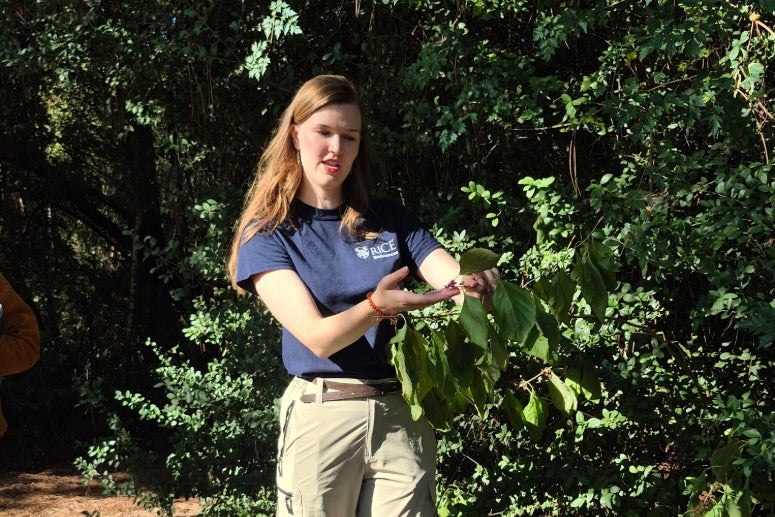
It turns out there’s a name for the turning of the leaves in the fall, the blooms of wildflowers in spring and the appearance of berries in the summer: phenology. Phenology is the study of the yearly cycle of nature, the features and behaviors of plants and animals that occur at specific times in the seasons. While seasonal shifts can sometimes feel subtle in Houston’s subtropical climate, Rice University graduate students Lydia Cox, Aimi Kōchi and Hailey Smith, in collaboration with the Houston Arboretum and Nature Center, are leading monthly walks to highlight how much plants here change over the course of every year. These free walks happen on the fourth Saturday of every month, meeting at 9 a.m. in front of the Nature Center in Memorial Park.
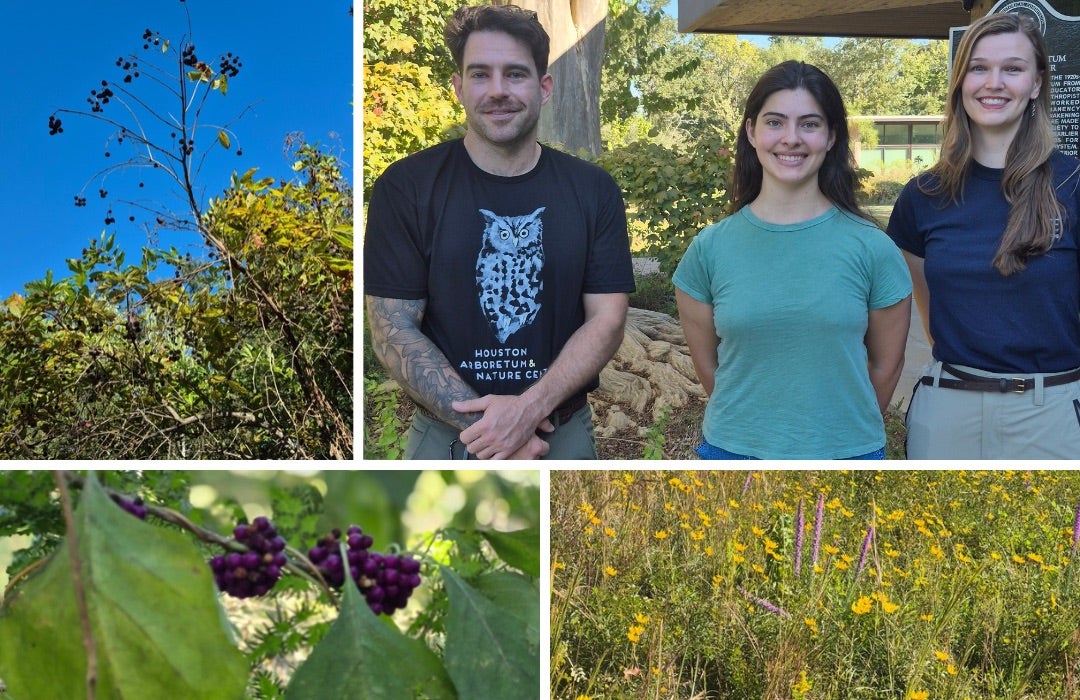
“Phenology is nature’s calendar,” said Kōchi, who is studying ecology and evolutionary biology. “These walks are about what you see in nature, why it’s important and what you can do with that information.”
Arboretum staff and volunteers who join every walk mingle in the crowd, answering questions about plants and pointing out species of interest. Attendees on the walk may recognize common local plants like elderberry, pickerel plants, prairie blazing star and Mexican plum.
Phenological changes in these plants can have huge impacts on Houston’s ecology. Berries that ripen too early, in response to a changing climate, may miss the migrating birds that eat the berries and spread the seeds to a new location. Plants blooming earlier than normal may be out of sync with the insects that pollinate them. Tracking these changes is critical to understanding and mitigating the impacts of climate change on local ecosystems.
“Our research is about phenology changes and their ecological consequences,” said Volker Rudolf, a professor of biosciences who is funding this work through the outreach funds in a National Science Foundation grant. “These walks provide an open-air classroom that allow us to bridge the gap between our research and the public. Every participant isn’t just learning about nature; they also learn how to track real seasonal shifts in local ecosystems, actively contributing vital data used by scientists worldwide. Our community scientists are the first-line observers of environmental change.”
The phenology walk, which winds through a mostly shaded path meandering through meadow, swamp and forest ecosystems, takes between one and two hours. It intentionally takes the same path and stops at the same plants every time to reveal the striking seasonal changes of the natural communities. A beautyberry’s purple berries catch all eyes in September; by January, its berryless branches fade into the scenery. In October, the purple pickerel plants and prairie blazing stars bloom. Rain turns leaves green; short periods of drought edge them with brown.
“In three months, this will be a totally different walk,” said Cox, an ecology and evolutionary biology doctoral student who ends every walk by sharing community science apps, like Nature’s Notebook and iNaturalist, that attendees can use to record and share phenology observed in their own backyards and parks. “The phenology of a plant can completely change every season.”
While the walks begin every fourth Saturday at 9 a.m., latecomers can join the group by asking the Nature Center desk for its location. Due to holiday conflicts, the next walk will be Jan. 23, 2027.
This work was funded by the National Science Foundation grant (DEB-2445952).