
The Center for Energy Studies (CES) at Rice University’s Baker Institute for Public Policy and the University of Houston Energy Transition Institute (UH-ETI) are launching a strategic partnership to advance scalable, real-world solutions for plastics circularity by integrating policy, economics, science and engineering. This collaboration marks the beginning of a broader effort that aligns research, technology innovation and cross-sector engagement to address systemic challenges. This effort will work across materials, energy and industrial systems, positioning Houston and the Gulf Coast as a global leader in circular carbon and resource innovation.
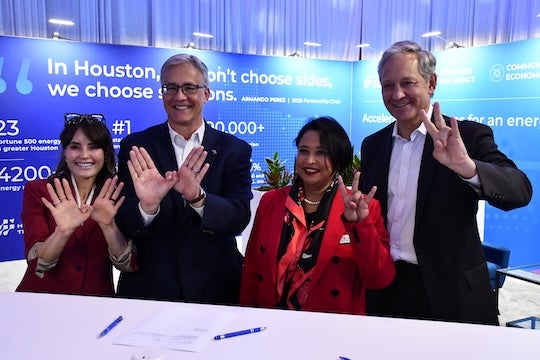
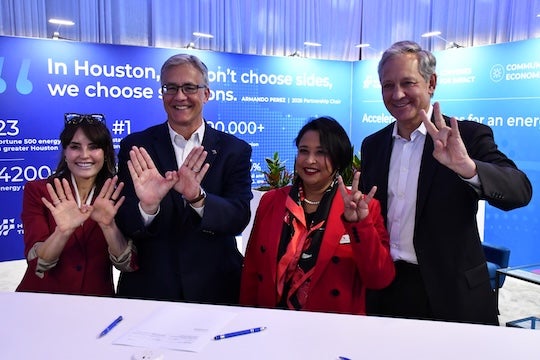
The memorandum of understanding was signed March 25 at CERAWeek, the annual energy industry conference held in Houston that gathers executives and leaders from energy, technology and financial sectors.
“Houston sits at the center of the global plastics and petrochemical value chain, which makes it uniquely positioned to lead in circular solutions,” said Rachel Meidl, deputy director of CES. “This partnership is about moving beyond theory and bringing together data, policy and industry insight to accelerate technologies and frameworks that can scale.”
“Our research has shown that a uniform approach may be the best way for the U.S. to tackle plastic waste,” said Ramanan Krishnamoorti, vice president of energy and innovation at UH. “By partnering with Rice’s Baker Institute for Public Policy, we will be better positioned to deliver real-world solutions that advance a circular plastics economy.”
CES at the Baker Institute consistently provides new insights on the role of economics, policy and regulation in the performance and evolution of energy markets through data-driven research, programs and initiatives. Fellows and scholars regularly investigate drivers of energy market evolution, including market design, policy and regulation, technology and innovation, sustainability and resilience and the intersections of infrastructure, local politics and geopolitics.
UH-ETI is dedicated to helping communities, industries and governments meet rising global energy demands through a broader, more resilient energy portfolio. The institute focuses on practical, scalable innovations — such as circularity, energy systems and carbon management — that complement existing systems while accelerating the shift toward a more sustainable and secure energy future.
Together, the two powerhouse institutes will share data, insights, networks and connections to advance global work in protecting the environment, economy and society. Initial efforts will focus on evaluating scalable advanced recycling pathways, developing policy frameworks to improve plastics circularity, analyzing emerging technology and convening industry stakeholders to accelerate deployment.
The first event from this collaboration takes place April 22 at the Baker Institute, the Annual Sustainability Summit: Innovations and Collaborations in Circularity & Supply Chain Resilience. The second annual summit will convene researchers, industry leaders, policymakers and students to examine sustainability challenges through a systems-level perspective.