
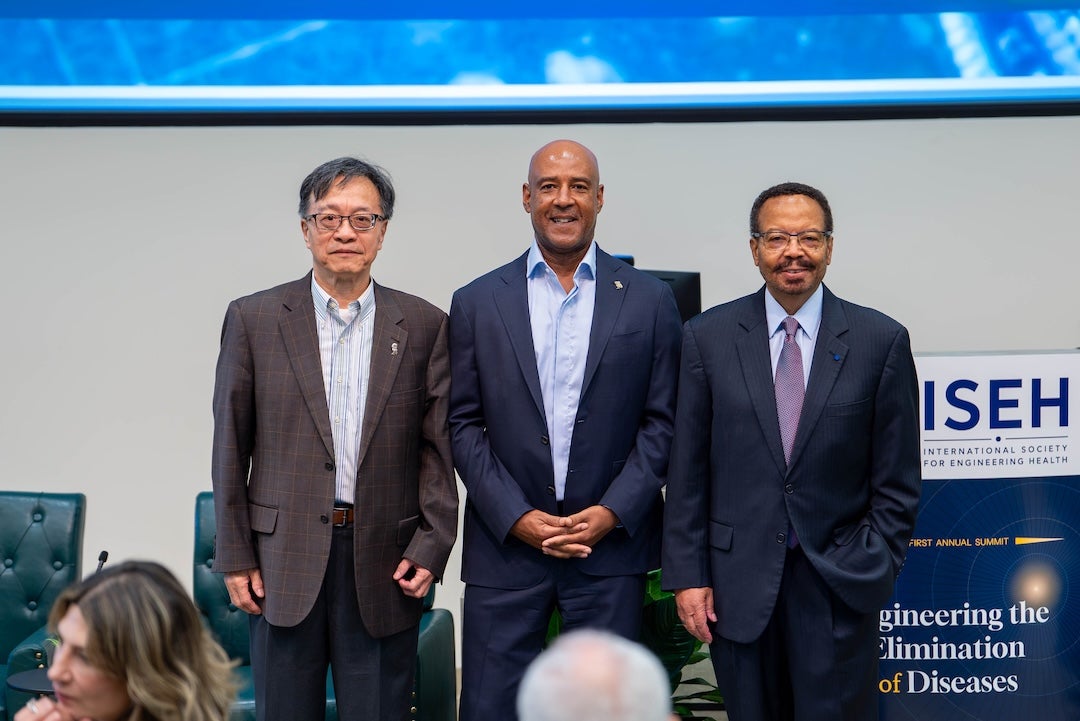
Nearly 64 years after President John F. Kennedy challenged the nation from the Rice University campus to pursue a moon landing, researchers and health leaders gathered nearby for a two-day summit focused on another ambitious goal: eliminating some of the world’s most challenging diseases.
The International Society for Engineering Health (ISEH) held its inaugural summit Sept. 10-11 at Rice, bringing together experts in medicine, engineering, science, industry, government, philanthropy and patient advocacy.
Sessions examined stroke, pancreatic cancer, schizophrenia, monogenic disorders, Alzheimer’s disease and sepsis, while participants also discussed emerging technologies and the process for establishing ISEH’s initial research priorities.
“The summit moved us from a broad vision of disease elimination toward identifying where a coordinated research effort could make the greatest difference,” said Gang Bao, conference co-organizer and the Foyt Family Professor of Bioengineering at Rice.
Bao’s research includes gene editing, which allows scientists to make targeted changes to DNA, and nanomedicine, the use of extremely small materials and devices in medical research, diagnosis and treatment.
A moonshot for human health
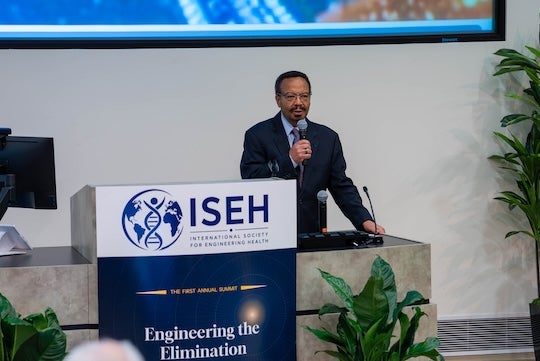
Roderic Pettigrew, president of ISEH, opened the first day with a vision of a world free from stroke, deaths from pancreatic cancer or sepsis, Alzheimer’s disease, schizophrenia and painful genetic diseases such as sickle cell disease.
“Eliminating any of these diseases from human experience is the driving vision for this summit, and achieving this vision is the ultimate goal of our new society, the International Society for Engineering Health,” Pettigrew said.
ISEH, he said, was created to unite engineering, biomedicine, technological innovation, education and team science around that goal.
Pettigrew pointed to Kennedy’s Sept. 12, 1962, speech at Rice as an example of how an ambitious goal can organize people, skills and resources around a daunting challenge.
“Despite the advances in modern health care, too many people suffer from illnesses and die from some rather challenging diseases that are simply beyond the reach of current medicine,” Pettigrew said.
Moving beyond treatment
Following Pettigrew’s remarks, Phillip Sharp, a Massachusetts Institute of Technology professor emeritus who shared the 1993 Nobel Prize in physiology or medicine, and Francis Collins, former director of the National Institutes of Health and former leader of the Human Genome Project, addressed the audience. Collins joined virtually.
“Engineering the elimination of disease is an audacious objective,” Sharp said.
Achieving that goal could involve preventing a condition or identifying it early enough to interrupt its development, Sharp said. Putting new approaches into practice throughout the health care system would also present a significant challenge.
Collins encouraged participants to think boldly about new approaches to diseases that have challenged researchers for decades. “Some might say it’s an odd time to be talking about bold initiatives to cure diseases that have vexed us for many decades, but maybe that’s the best time for us to be thinking boldly,” he said.
The day continued with four disease-focused sessions on stroke, pancreatic cancer, schizophrenia and monogenic diseases, which are disorders caused primarily by a change in a single gene.
Engineering’s role in medicine
The second day of the summit focused on Alzheimer’s disease, sepsis, emerging technologies and the selection of ISEH’s initial disease targets. Rice President Reginald DesRoches delivered the opening remarks.
“The most persistent challenges in health will not be solved by any single discipline, institution or nation,” he said.
DesRoches shared his experience with Wolff-Parkinson-White syndrome, a congenital heart condition caused by an extra electrical pathway that can lead to an abnormally rapid heartbeat.
After taking medication for two years, he underwent catheter ablation in 1991, a procedure that uses a thin, flexible tube to apply energy to the heart tissue causing the abnormal electrical signals.
“I am living proof that engineering can truly impact medicine,” DesRoches said.
Leading innovations in health is one of three research imperatives in Rice’s Momentous strategic plan. The university's location next to the Texas Medical Center provides an opportunity to integrate engineering, science and medicine to improve lives, DesRoches said.
The program later turned to sepsis with virtual remarks from Dr. Anthony Fauci, former director of the National Institute of Allergy and Infectious Diseases.
“Sepsis is certainly worthy of the society’s focused pursuit, and success would be a profound gift to humanity, improving our world for generations to come,” Fauci said.
The summit concluded with a workshop focused on selecting ISEH’s initial disease targets and developing a 10-year plan to advance its goals.
Other notable researchers and health leaders featured at the summit included Michael King from Rice, physician-scientist Huda Zoghbi at Baylor College of Medicine, gene-editing pioneer David Liu at Harvard University and Walter Koroshetz, a longtime leader at the National Institute of Neurological Disorders and Stroke.
Rice served as the academic host and lead sponsor of this National Academy of Engineering and National Academy of Medicine member-led event. The event was also sponsored by the University of Illinois and The University of Texas MD Anderson Cancer Center.