
Wires and pipes. Fish and chips. Fast food.
The familiar word combinations helped Kathy Conklin illustrate how experience shapes the way people process language as she joined three other new Rice University faculty members Sept. 14 for the School of Social Sciences’ latest Research Relay.
Conklin began with a simple experiment, repeatedly using the phrase “wires and pipes” before asking the audience to anticipate which word would come next. The exercise offered a quick glimpse into research she has pursued for more than 20 years: how repeated experience with language creates expectations that can make processing faster and more efficient.
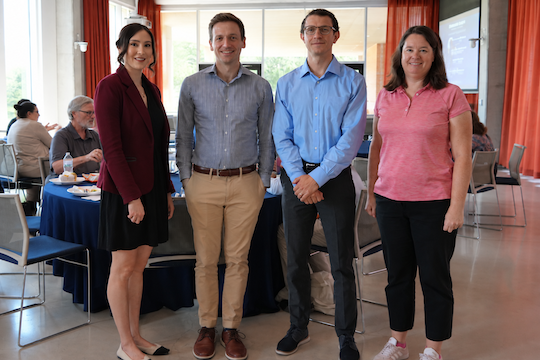
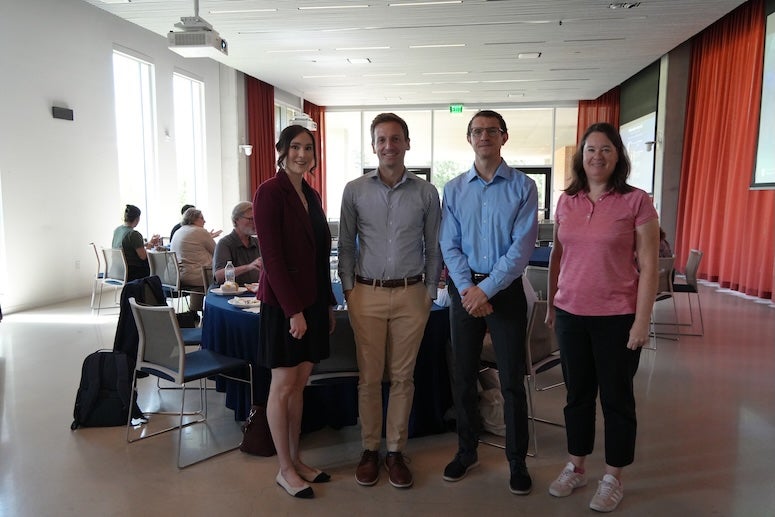
The informal Research Relays series gives faculty just four minutes each to introduce their work, giving colleagues a quick glimpse into research happening across the school and opening the door to conversations and potential collaborations. This edition put four of the school’s newest faculty members in the spotlight: Conklin of linguistics, Kenneth Lowande and Oren Samet of political science and Allie Sinclair of psychological sciences.
“Our new faculty bring exciting ideas and expertise to Rice, while also creating new possibilities for collaboration across disciplines,” Dean Rachel Kimbro said. “Research Relays give us a chance to welcome them into our community and begin making those connections.”
Patricia DeLucia, associate dean for research, said the relays also help new faculty learn about the research community and resources available to support their work.
“We want our new faculty to know that they have a community here and resources available to help their research grow,” DeLucia said. “Research Relays give them an opportunity to share their work, make connections and begin conversations that can lead to new collaborations.”
Using tools such as eye tracking and EEG, Conklin examines what makes words and phrases easier or more difficult to process. She is also putting that research to work on a practical challenge: making complicated documents easier to understand.
Conklin and her collaborators have developed ComCheck, an automated readability assistant that uses data from real readers to identify where people may struggle with a document and offer evidence-based suggestions for improving it.
“Our goal is very simple: to make communication more accessible, because understanding shouldn’t be a privilege,” Conklin said.
Lowande turned the conversation from language to political power. His research examines executive action and what happens after presidents, governors and other executives use it to shape policy.
“I try to understand what the consequences of these actions are, whether they’re effective, and I try to convince other people to ask the same kind of question,” Lowande said.
As one example, he discussed his research on the federal 1033 program, which transfers excess military equipment to law enforcement agencies. His work examines whether executive actions intended to reform the program achieved their public safety goals, as well as unintended political consequences that followed.
Samet brought a global perspective to the relay. His research focuses broadly on the future of democracy and the international forces that can shape political change, including the strategies opposition parties and movements use to challenge authoritarian or backsliding governments.
One area of his work examines what he calls “opposition diplomacy,” when opposition politicians engage policymakers in other countries in hopes of influencing foreign policies that could affect politics back home. His work is global in scope with a particular focus on Southeast Asia, including Myanmar, Thailand and Cambodia.
Samet is also exploring what the United States can learn from democratic practices elsewhere. He pointed to citizen election observation, in which nonpartisan observers monitor and report on elections, as one example of a practice common in other countries but less so in the U.S.
Sinclair rounded out the relay with a question that touches everything from education to health and misinformation: How do people update their memories, beliefs and behaviors?
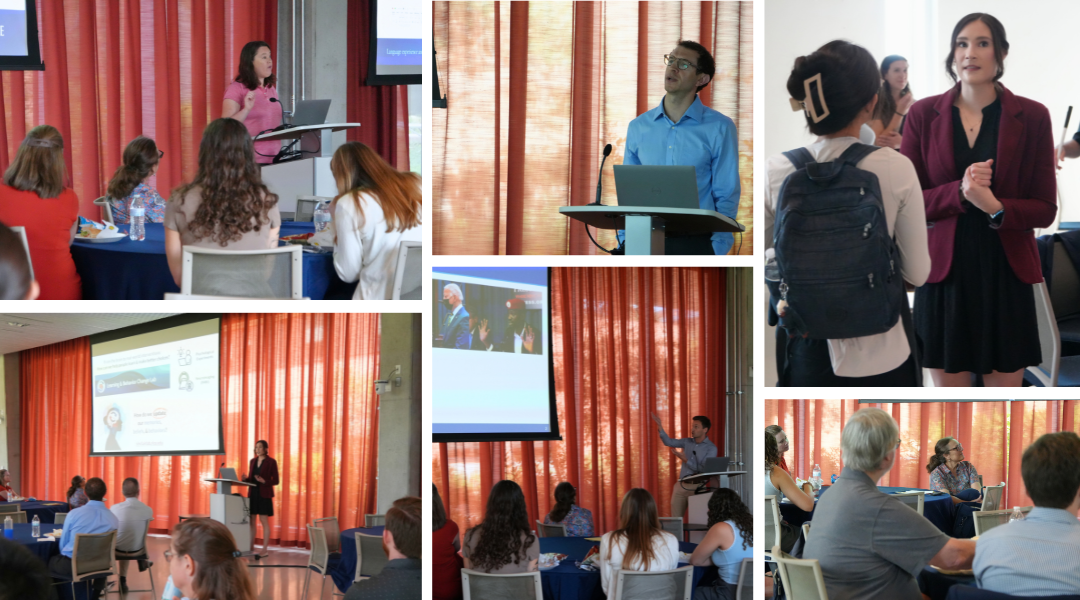
A cognitive neuroscientist and director of Rice’s new Learning and Behavior Change Lab, Sinclair studies how people learn from experience and use that information to make future decisions.
Her research combines psychological experiments, brain imaging, computational modeling and large-scale online studies. She is exploring why people sometimes learn from errors and sometimes reject corrective information, how imagination can help motivate behavior change and what makes people engage with and remember information.
“We learn from error, learn from experience, in order to make better choices next time,” Sinclair said.
Those insights have potential applications in student learning, misinformation, preventive health and sustainability.