
By Kelly Peters,
Special to Rice News
Advancements in robotics are paramount to today’s technology revolution, increasing efficiency and automation across industries with applications in factories, warehouses, hospitals, on roadways and even at home. To ensure that robot systems can operate effectively to complete desired tasks and navigate dynamic environments, extensive motion planning capabilities are required — and researchers at Rice University are at the forefront.
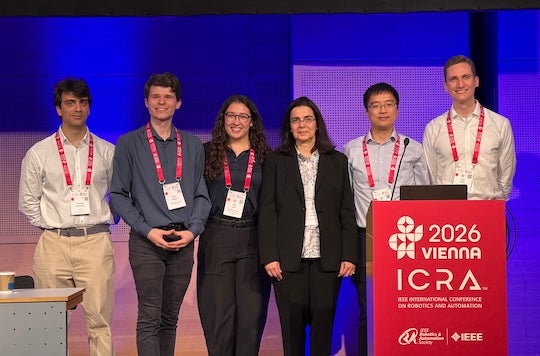
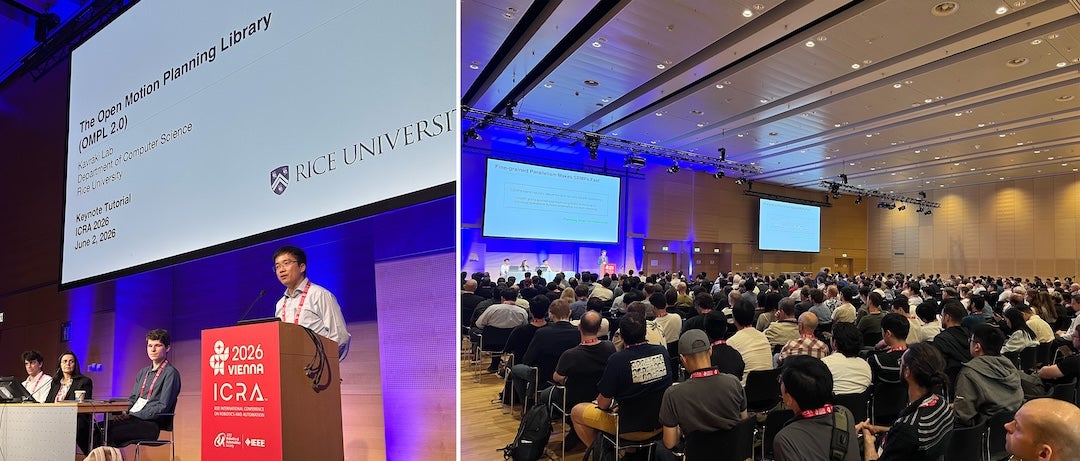
On June 2, Rice researchers from the Kavraki lab presented a keynote tutorial at the 2026 IEEE International Conference on Robotics and Automation (ICRA) in Vienna. The 90-minute, hands-on tutorial showcased recent upgrades to the lab’s Open Motion Planning Library (OMPL), which released its “2.0” version in April. OMPL first became available in 2008.
OMPL is a globally recognized open-source software package that implements sampling-based algorithms to plan realistic, accurate motions for a range of robotic systems. It is used widely across academia and industry.
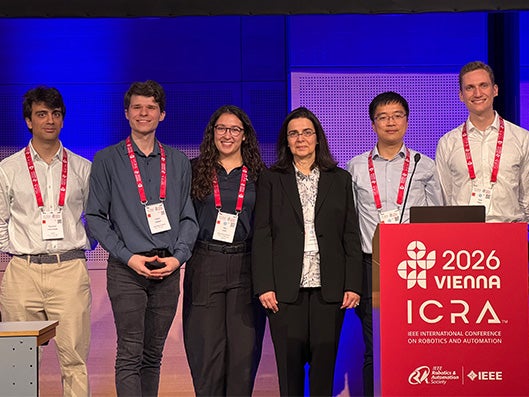
The international robotics and automation community packed the conference hall in Vienna for the tutorial, eager to learn about the library’s novel improvements firsthand. The keynote tutorial was led by Lydia Kavraki, university professor and director of the Ken Kennedy Institute, alongside postdoctoral researcher Thai Duong and graduate students Theodoros Tyrovouzis and Clayton Ramsey. Two more graduate students of the Kavraki lab, Nikki Hart and Arden Knoll, assisted the participants during the interactive portion of the tutorial.
“I was very excited to see hundreds of participants in the audience,” Duong said, noting the significance of delivering the tutorial on a global stage. “It really showcased the broad impact of our research toward a fast and efficient robot autonomy on the community.”
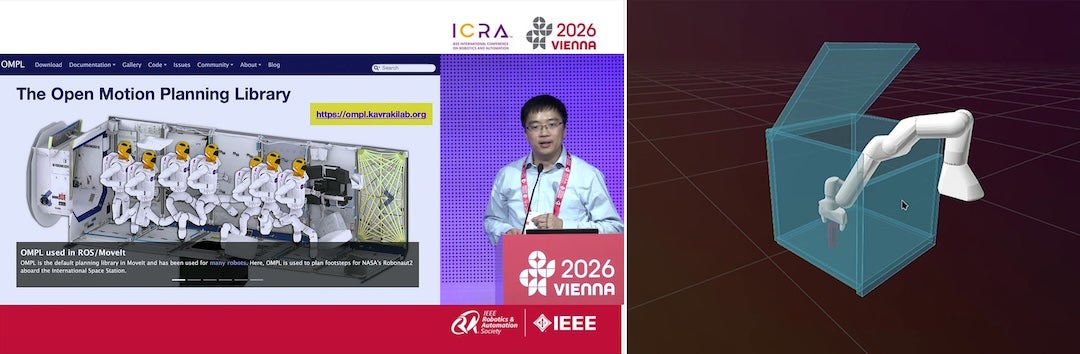
The presentation began with an introduction to sampling-based motion planning, a paradigm that achieves path generation by sampling the solution space, or randomly testing points within the surrounding environment for a clear path, rather than calculating the space’s exact boundaries.
Participants then learned about the library’s new features through hands-on instruction that demonstrated how OMPL 2.0 can drastically reduce motion planning time from a fraction of a second to the range of microseconds to milliseconds.
The tutorial showcased how OMPL’s ultrafast motion planning capabilities are achieved using recent algorithmic improvements and single instruction multiple data parallelism, which allows standard computer processors to test multiple potential paths simultaneously. The library runs on conventional central processing units and does not require expensive, specialized graphics processing unit acceleration.
Another new feature that drew considerable attention is the library’s new Python bindings. The bindings act as a bridge between OMPL’s code and common Python-based robotics software. This capability makes it significantly easier for artificial intelligence and machine learning researchers to effortlessly integrate OMPL 2.0 into modern workflows for efficient robot learning research.
“We were overwhelmed by the participation and interest of the robotics community,” Kavraki said. “We prepared for an audience of at most 100 participants, and we had more than 700 show up. The release of OMPL 2.0 leads to an exciting era for motion planning and robotics. We hope that the library will help our community move forward to build safe and reliable robots for automation and for serving people.”
A recording of the tutorial will be posted on the Kavraki lab webpage. To learn more about OMPL, view the resources linked below.
- Related links
-
About OMPL: https://ompl.kavrakilab.org/
Tutorial webpage: https://kavrakilab.org/icra-2026-ompl-tutorial/
OMPL 2.0 paper: https://arxiv.org/abs/2605.29301