

Rice University physicist Guido Pagano and his team use a trapped-ion quantum simulator, which involves manipulating an ion crystal trapped in a vacuum system with electromagnetic fields, to study molecular electron transfer, or the way electrons travel from one molecule to another. While they have been able to precisely control many variables, previous work was limited to two types of environments: one that drives the vibrations of molecules to their ground state, a very cool and stable state, or one that continually heats up the system. Now, in a study recently published in Physic Review Letters, they unveiled a new, two-knob addition that allows them to individually control the temperature and dissipation of the engineered environment for vibrational degrees of freedom in their simulator.
“The vibrations of the ion relate to the temperature,” said Pagano, an assistant professor of physics and astronomy. “More vibrations means a higher temperature, while fewer vibrations means a cooler temperature. With this new system, we can use vibrations to select a temperature to keep the ions at, and control the rate at which we moved them from one temperature to another.”
The researchers used two different knobs which worked independently of one another. One knob relies on adding random vibrations to the trapped ions with electric-field signals, thus heating up the system.
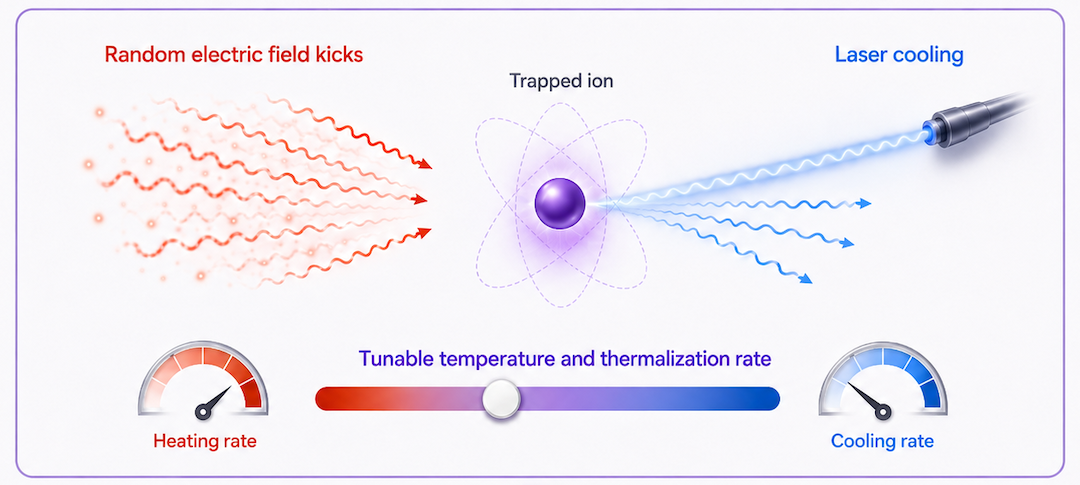
“You can think of it as random kicks to the crystal,” said Visal So, the first author on this study and a recent doctoral graduate from the Pagano lab. “Each kick provides vibrational energy, which essentially creates a heating effect on the ions in the study. By controlling these kicks, we can tune the rate at which we heat up the system.”
The second knob was a cooling laser, which can slow down the vibrations of the ions and therefore reduce the temperature. Because the two knobs are independent of each other, the cooling laser and vibrational kicks compete with each other, providing fine control of the final temperature the ion is held at.
“We can use the trapped-ion quantum simulator to observe how the electrons move through the system, from a donor site giving the electron through a barrier to a recipient site accepting the electron,” So said. “With these new controls, we can see that the higher temperature changes the transfer efficiency of this movement and allows activation of other processes we didn’t see at the ground state.”
“These new controls give us precise control over an ion’s thermal state, allowing us to place an ion into a specific state or interrogate an ion in an unknown state,” Pagano said. “With these, we can greatly increase the number and type of questions we can ask using the trapped-ions quantum simulator.”
This study was supported by the Welch Foundation Award (C-2154), the Office of Naval Research Young Investigator Program (N00014-22-1-2282), the NSF CAREER Award (PHY-2144910) and the Office of Naval Research (N00014-23-1-2665 and N00014-24-1-2593).