
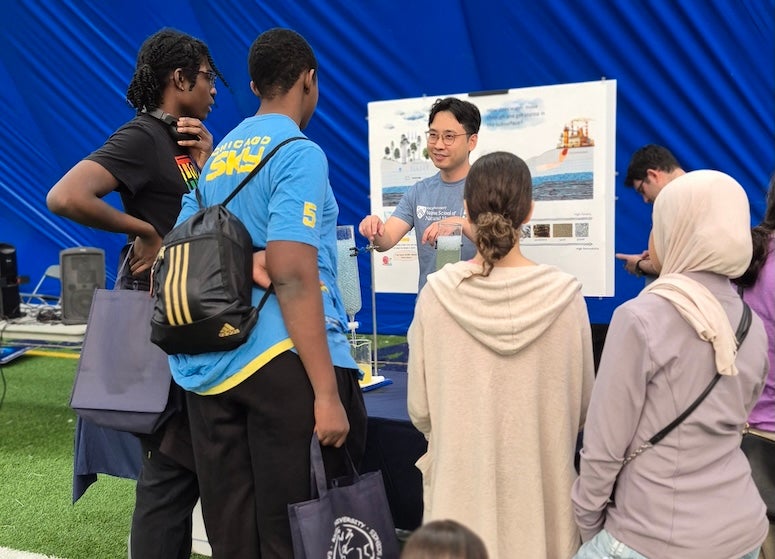
Rice University’s inflatable, indoor practice field was transformed Feb. 28 into something perhaps a little bit ironic but nonetheless exciting: an Earth, environmental, planetary and space sciences exhibition open to kids and their families.
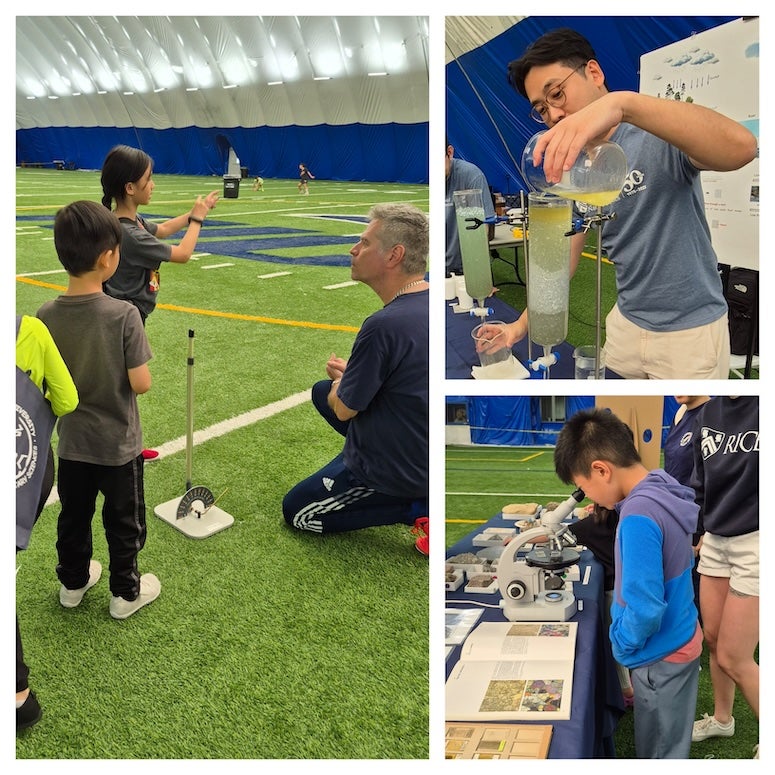
This was the second annual Earth, environmental and planetary science (EEPS) open house, the headliner for a series of science outreach events between Rice and Houston Independent School District, funded by NASA and hosted by Rice’s EEPS department and the Rice Space Institute Center for Planetary Origins to Habitability.
“This event is emerging as a central piece of our outreach work,” said Rajdeep Dasgupta, the Maurice Ewing Professor of Earth Systems Science and Rice’s primary investigator on the grants. “Many local students and their families are discovering what EEPS and astronomy have to offer, the opportunities they can pursue and what they could do at Rice.”
The building, a large, long grey arch, was filled with a line of exhibition tables on its artificial turf and a surprisingly gentle but undeniable hum of conversation. Colorful posters behind each table introduced their exhibit, while volunteers walked attendees through a variety of hands-on exhibits and activities.
The volunteers this year were mostly “faculty, grad students and former grad students that just couldn’t resist,” said Julia Morgan, professor and chair of EEPS. “The undergraduates are recovering from their field trip,” she added, referring to a trip to Death Valley she had also just returned from.
At her exhibit, Morgan’s volunteer partner, graduate student Maya Guise, holds a handheld sander against a sand-filled plastic tub to create an earthquake for the Lego village built inside of it. The sand darkens as the water table in the tub is disturbed, and all but one Lego building falls. Guise finishes and asks, “Which building would you want to live in?” to her captive audience.
Similar snippets of conversation were heard at each of the 23 booths: “This is what a garnet looks like under a microscope.” “What kind of rock is this?” “Moonquakes and earthquakes are different.” At the end of the row, a parent encourages their child, spinning on a stool and laughing, to “close [your arms] and speed up” and then “open and slow down.”
Graduate students make up the majority of volunteers. Jong Gil Park and Kaveh Farnoudi explained the difference between porosity and permeability with glass rocks and oil. Matthew Kumar demonstrated carbon dioxide capture in porous rocks using a bright red liquid in a glass container. Audrey Putnam and Daniel Sikes explained contour lines by sculpting mountains and valleys in a giant box of sand. Thomas Lee told participants to hit his table as a seismograph measured the resulting shaking on a giant computer screen.
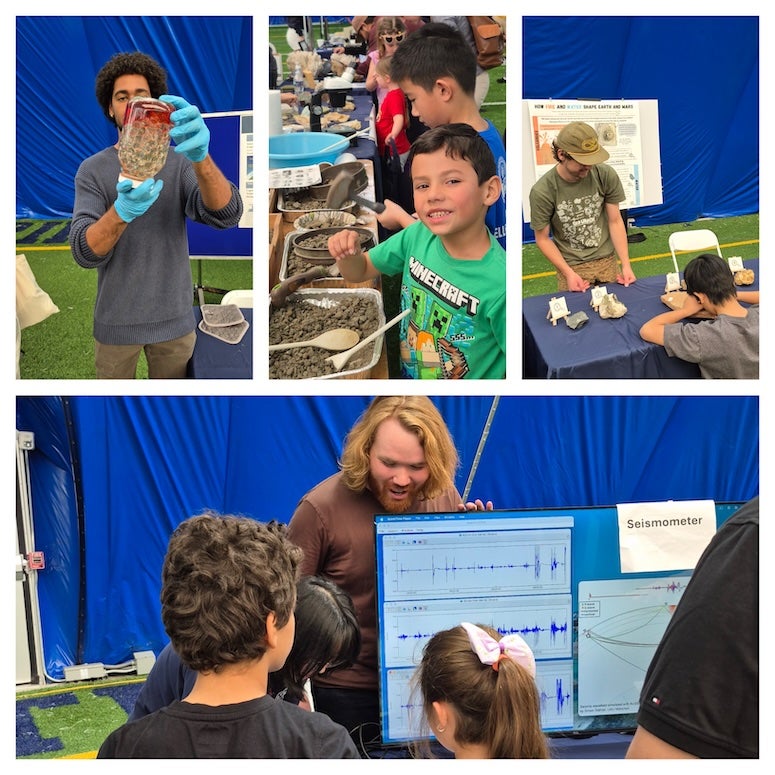
This connection between the graduate students and the community’s K-12 students is part of the longer-term goals of a series of grants. Though the open house is its biggest event, the community grants also support professional development for teachers, internships for high school students and middle school planetary exploration days. Many of these events will intentionally create opportunities for EEPS graduate students and postdoctoral fellows to share their research with primary students, teachers and community members.
Supporting their outreach efforts is Rice’s Office of STEM Engagement (R-STEM), whose booth had a giant floor map of Mars. Attendees used tablets to drive miniature Mars rovers over it, simulating how NASA would navigate the terrain. “Science is about knowing,” said Cedric Williams, a visiting student and R-STEM contractor staffing the booth. “Our bottom line is to get more kids interested in science.”
If the chatter at the event was any indication, the open house was successful in its mission. Parents and grandparents alike were complimenting the volunteers as their children engaged in the exhibits. One mother, stopping at the welcome booth, said, “The researchers are doing such a good job of bringing things down to the level of the kids,” before running off after her excited children.
Overall, more than 500 kids and a total of about 1,500 community members across all ages attended the open house during its four hours. The kids left the event with a prize for filling out their science bingo cards and a new understanding of the fundamental forces shaping our world and universe.