
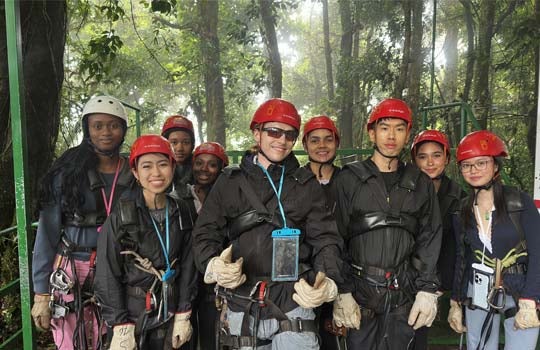
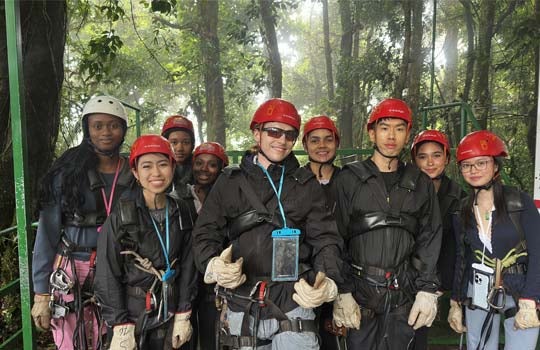
Textbooks and equations can only take engineering students so far.
This summer, Rice University’s Center for Civic Leadership launched the Moody International Changemakers program, creating a dedicated pipeline for science, technology, engineering and math students to participate in international community service. To solve the world’s biggest public challenges, young scientists need to get their hands dirty.
The inaugural cohort of undergraduate STEM students was dispersed to partner communities across Latin America and sub-Saharan Africa last summer.
The approach combines technical principles and coursework directly with community challenges; often that means addressing issues such as storm safety or poor access to clean water and public health resources.
“It’s sometimes difficult for STEM students to have these impactful civic and social impact experiences abroad,” said Kelsey Ullom, Center for Civic Leadership associate director. “Students who wouldn’t otherwise consider going abroad, such as first-generation or low-income students, are supported with this program because it’s fully funded for them.
Owen McCulloch, an electrical and computer engineering student fellow, partnered with a grassroots program dedicated to improving drinking water and educating local communities about public health campaigns.
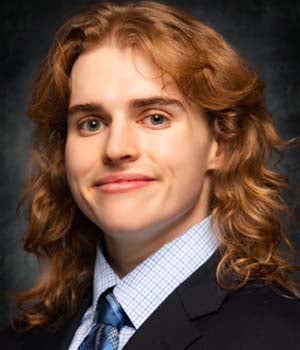
“I worked with a rainwater harvesting nonprofit organization in Mexico City. I approached it thinking I couldn’t do much technically because I was the only electrical engineer on the team and I didn’t speak five words of Spanish,” McCulloch said. “There were layers of unfamiliarity with culture, language and engineering I had to translate through. Leaving the experience, I can hold full conversations in this second language I’ve acquired.
“I had a switch flip in me after my first week in country. I had to develop a combined holistic lens to approach it through: culture, ethics, engineering and safety. That really helped me to make the most of the experience and, most importantly, support an underserved community in the process.”
The initiative serves as the hands-on technical counterpart to Rice’s long-standing Loewenstern Fellowship, which traditionally focused on humanities and social sciences.
“More recently we’ve had an increase in interest from STEM students alongside the development of our Center for Civic Leadership priorities to engage more STEM students across civic placements,” Ullom said. “We jumped from there to designate the Moody funding opportunity to further expand and support more STEM placements.”
To ensure projects remain driven by local priorities in the host countries, the undergraduate student fellows spend the preceding spring semester on campus studying cross-cultural ethics and collaborative design before traveling abroad.
“Even though they’re abroad for only a summer, it’s a yearlong commitment,” Ullom said. “Once they’re selected, they enroll in a predeparture course in the spring. We meet every week and prepare for experiences ranging from theoretical and emotional to logistical, all from a civic STEM perspective on international development.”
Their coursework on campus focuses on practical ethics, cross-cultural collaboration and design techniques that prioritize the needs and knowledge of local residents.
“We talk about international development, project-based learning and project management,” Ullom said. “Then the students meet with the partners that are hosting them over Zoom at least three or four times before they arrive in country to build rapport and understand the scope of their project.”
These experiences don’t only benefit communities abroad. For coastal Texas and other Gulf Coast communities facing frequent storms, heavy flooding and severe environmental or infrastructure strain, the work the engineering students focus on can also help deliver immediate, practical value.
The storm-proof shelters, water filters and environmental tools Rice students build abroad are engineered for tough conditions on tight budgets. By mastering these skills in low-resource environments, these young innovators bring home the exact expertise needed to strengthen public health, energy and infrastructure sectors.
“I actually felt like I could see myself having a use as an engineer for the first time,” McCulloch said. “At the nonprofit I got to do serious reverse engineering and then re-engineering, design work that could result with getting safe, clean water to thousands of people. You don’t usually get that as an intern. It comes with a lot more pressure but a lot more reward too, and it pushed me to take every piece of my work seriously. On top of that, it was super cool to experience a different kind of hospitality and humility.”
The Center for Civic Leadership will host a campus showcase this fall featuring student project presentations, photos and live demonstrations.
The deadline for summer 2027 applications for the next cohort of Moody International Changemakers is Nov. 1. Applications are open to first-year, sophomore and junior Rice undergraduate students from all majors. More details about upcoming information sessions and events can be found on the Moody International Changemakers website.