
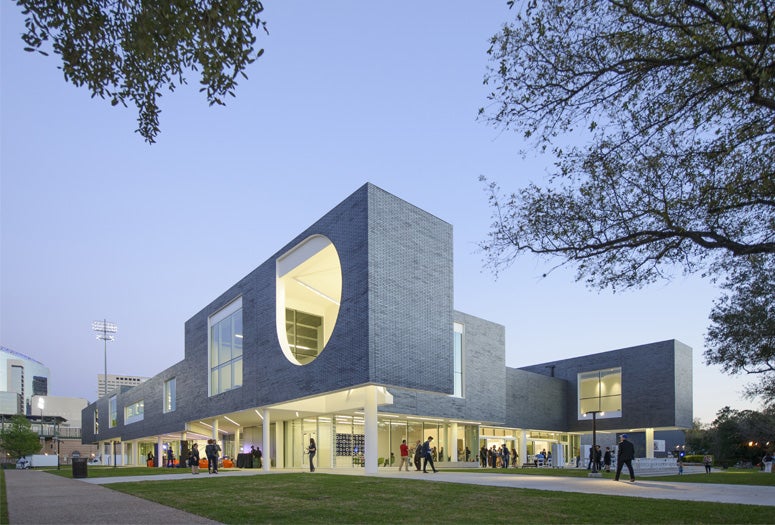
The Moody Center for the Arts at Rice University presents ”Radiant Geometries: Vectors of Knowledge from the Indigenous Americas” this fall, bringing together contemporary Indigenous and Latin American artists whose work explores connections among mathematics, science, technology, art and Indigenous knowledge systems.
On view through Dec. 19, the exhibition considers North, Central and South America as interconnected regions and presents knowledge as a living technology — one that connects mathematical and metaphysical ideas with relationships to land, waterways and the living world.
The exhibition features paintings, sculptures, textiles, video works and site-specific commissions by national and international artists, including Nanibah Chacon, Melissa Cody, Jordan Ann Craig, Patricia Domínguez, Sara Flores, Kite, Natalia Montoya Lecaros, Patrick Martinez, Cisco Merel, Caroline Monnet and Eamon Ore-Giron.
“At its core, ’Radiant Geometries’ centers Indigenous ways of knowing that continue to shape relationships to territories, waterways and interspecies care,” said Noor Alé, associate curator at the Moody Center for the Arts. “By reconsidering the histories of mathematics, architecture and science through Indigenous perspectives, the exhibition invites viewers to consider the enduring connections between cosmology, technology and the living world.”
Set within the context of a leading research university, the exhibition highlights artists whose practices frequently use abstraction and visual systems to examine the relationship between art, science, mathematics and technology.
“When we think about disciplines, there is a schism between the cosmological or the sacred or artistic practices or the humanities in this context, and they’ve been separated from STEM-related disciplines,” Alé said. “This exhibition looks to bridge those gaps, and Indigenous knowledge systems have been doing this since time immemorial and continue to do so. The knowledge that you see here in the exhibition — it is global, nuanced, complex and syncretic.”
The exhibition’s thematic inclusion and transcendence of political boundaries, pre-Colombian history and academic silos mirrors both the artists’ ideological concerns and their own cultural experiences.
“These works all show the artists’ unique cosmological perspectives and viewpoints. What the works [have] in common, though, is the notion of reciprocity, responsibility and interconnectedness between all of us on this planet,” Alé said.
Among the featured works is a series of paintings by Flores that emphasizes the interdependence of life forms and the importance of interspecies care. Martinez’s painted sculpture draws inspiration from the pre-Columbian murals of Cacaxtla, presenting Indigenous architecture as a form of material knowledge and urban intelligence.
Montoya Lecaros’ totemic sculptures reference an Aymara ceremonial dance associated with agricultural cycles, while Monnet’s Styrofoam installation, etched with Anishinaabe iconography, examines colonial legacies embedded in architecture.
Other works approach scientific and technological ideas through cosmology, plant intelligence and traditional design. Domínguez’s videos explore astronomy and plant intelligence as a way of bridging spiritual and scientific perspectives. Merel’s totemic work references protective sigils found in Guna textile traditions. Cody’s jacquard tapestry combines Navajo textile traditions with computational aesthetics.
The exhibition also presents newly commissioned works that extend its exploration of knowledge as an evolving technology and emphasize how knowledge is transmitted across generations while adapting to the future.
Among the commissions is an interactive sound installation by Diné artist Chacon incorporating Diné designs. Craig will present installations and paintings exploring Cheyenne beadwork and parfleche designs drawn from museum collections in Texas and Colorado. The exhibition will also feature new paintings by Ore-Giron inspired by Maya ceramics in Rice’s collection.
“Radiant Geometries” reflects the Moody’s emphasis on connecting artistic practice with the university’s broader academic resources.
“Through this compelling selection of works and complementary programming, we’re able to achieve the Moody’s mission to synthesize Rice’s academic resources and artists’ creative insight into meaningful connections and critical dialogue,” said Joel Thompson, Moody Center for the Arts deputy director.
Through these varied practices, “Radiant Geometries” asks viewers to reconsider conventional boundaries between artistic and scientific knowledge. The exhibition positions Indigenous knowledge not as a historical artifact but as an active and evolving system that continues to inform relationships among people, technology, nature and place.
Special programming involving the exhibit includes the following:
Dimensions Variable: Danza Azteca Macuilxochitl with Nameless Sound
Oct. 10, 3-5 p.m.
Performance by Danza Azteca Macuilxochitl with Nameless Sound, presenting musicians Laura Dykes and Aryn Ward, activating Nanibah Chacon’s site-specific mural.
Artists-in-Dialogue: Ore-Giron + Boornazian Diel
Nov. 12, 6-8 p.m.
Conversation with exhibiting artists Eamon Ore-Giron and Lori Boornazian Diel, the L. H. Favrot Professor of Humanities and professor of art history at Rice.
New Art/New Music: Radiant Geometries
Nov. 21, 3-5 p.m.
Original musical performances inspired by Radiant Geometries, composed and performed by Shepherd School of Music students.