
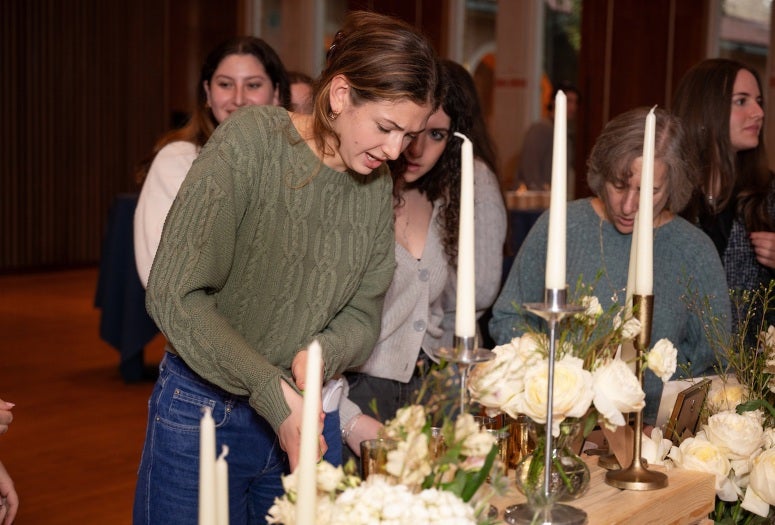
The annual Mega Shabbat, hosted by Chabad at Rice University, transformed the Grand Hall of the Rice Memorial Center into something far more than a dining space; it became a living expression of Jewish warmth, resilience and togetherness. Students and employees gathered for an evening that celebrated not only Shabbat (the Jewish day of rest and celebration that begins Friday before sunset), but the enduring power of community and shared tradition.
Rabbi Shmuli Slonim, co-director of Chabad at Rice, opened the night by reflecting on a question he was recently asked by a student: Why Mega Shabbat? Why does it matter to bring everyone together? His answer came through a powerful story shared in honor of International Holocaust Remembrance Day. He recounted the testimony of an 18-year-old named Anton, deported to Auschwitz in a freezing cattle car, who survived by keeping another person alive through physical warmth. Anton later concluded, Shmuli said, “The secret of survival is to warm the hearts of others. When you give heat, you receive heat.”
That message set the tone for the evening. Mega Shabbat, Shmuli explained, is about warming one another’s hearts by choosing connection, presence and shared identity. Gatherings like Chabad’s weekly Shabbat dinner on Fridays allow the community to thrive, carrying forward more than 3,000 years of Shabbat tradition with pride and joy.
The theme of sharing warmth continued with a teaching from Menachem Mendel Schneerson, one of the most influential Jewish leaders of the 20th century.
“If you know aleph, share aleph,” Shmuli said, using the first letter of the alphabet as an example. “You don’t have to wait till you know the entire alphabet to teach what you know. If each one of us are able to leave here tonight and take the ideas, the mitzvahs and the experiences that we do have, that we did experience and that we did learn, and pass that on and share with one other person, then that’s how we’ll keep ourselves warm. That’s how we’ll keep the people around us warm and together will thrive and grow as a strong community.”
Senior Ramy Mizrachi then took the stage to share his personal Jewish journey at Rice. Originally from Panama, he described growing up in an environment where Judaism was “the air I breathe, my family, my school, my community.” Everything around him, he said, reinforced that Judaism was not only what he did but who he is.
Coming to Rice meant that same Jewish rhythm was no longer built into his surroundings. Instead, it had to be chosen. Chabad became the place where that choice felt natural and joyful. Mizrachi spoke candidly about how Shabbat became the anchor of his week: a pause from Rice’s fast pace, a moment to be present and a space where real conversations happen.
“I leave Shabbat feeling content,” he said. “Not rushed, not scattered — just perfectly content. I feel full, grounded and myself again.”
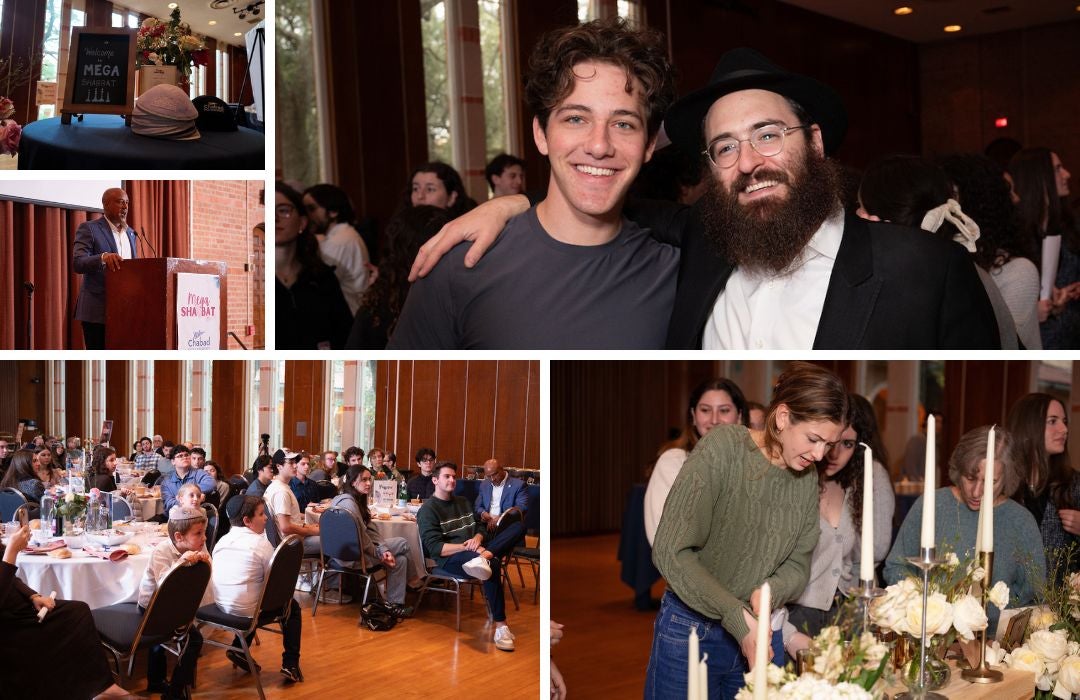
Mega Shabbat, he added, offered that same feeling on a larger scale: a room full of people creating sacred rhythm together.
Rice President Reginald DesRoches, attending his third Mega Shabbat, echoed these sentiments. He praised the vibrant Jewish community at Rice and thanked the Chabad team for their dedication. Reflecting on the meaning of Chabad — turning intellect into action — DesRoches emphasized the importance of resilience, belonging and unity, particularly during challenging times for the Jewish community.
“At Rice, we are committed to ensuring that every student feels safe, valued and supported,” DesRoches said. “We take great pride in fostering an environment where people of all backgrounds and beliefs can express themselves freely, learn from one another and build lasting relations. The sense of belonging is not just an ideal; it is a necessity, and it is something we will continue to work on and strive to do better. Chabad embodies that spirit of warmth and inclusion: The trust, the friendships and the sense of home away from home that you have created here are truly remarkable.”
The evening culminated with deeply moving words from Nechama Slonim, co-director of Chabad, who reflected on the timelessness of Shabbat candle lighting. She shared a striking image from a New York Times “future” edition imagining the year 2100, which quietly included a familiar line: Jewish women and girls light Shabbat candles 18 minutes before sunset. In a world racing forward, some traditions endure.
Nechama spoke about the power of Shabbat candles, lit by Jewish women across generations and under every circumstance, as a source of inner strength and continuity. From hidden candle lighting in 1492 Spain to the present day, the chain has never been broken. That legacy, she emphasized, lives not in headlines but at tables like the one stretched across the Grand Hall that night.
As women gathered to light candles together, the room fell into a reverent hush. Shabbat was welcomed not with microphones but with song, prayer, kiddush and a shared meal. Mega Shabbat concluded the way it began: with the warmth of community.