
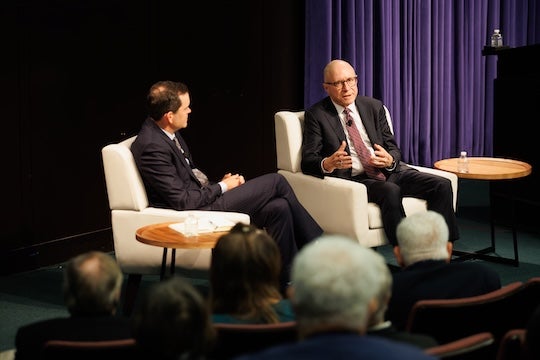
“Let’s begin with a very simple premise — simple but extremely important: Sound policy depends on sound data,” said David Satterfield, director of Rice University’s Baker Institute for Public Policy when welcoming the audience to an armchair dialogue between the institute’s John Diamond and William Beach, the executive director of the Fiscal Lab on Capitol Hill and a senior fellow in economics at the Economic Policy Innovation Center.
The U.S. economy has been changing faster than the measurement systems for more than a decade, Satterfield explained. Advances in technology and a shifting workforce have made it more difficult for policymakers to interpret the indicators. These challenges raise fundamental questions about whether today’s economic indicators are fully capturing the economic policy that policymakers are trying to understand and, by extension, how effective policy decisions can be made.
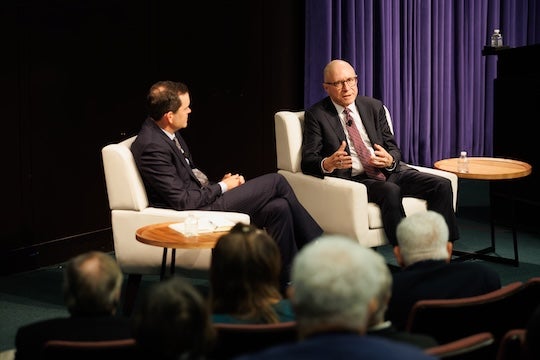
Beach has rare experience from inside the federal statistical system, from Capitol Hill and from outside government. He was the 15th commissioner of labor statistics at the Bureau of Labor Statistics in Washington, D.C., from 2019 to 2023.
“It is one of the oldest statistical agencies in the government, founded in 1885,” Beach said of the bureau. “Not quite as old as the oldest one, and I think that’ll surprise you: It’s the National Center for Education Statistics.”
The bureau’s traditions and standards stretch back to the beginnings of data science and the computer age. The bureau has always been a way to gain insight into how the U.S. economy is changing, Beach said.
“What happens is a survey is taken that represents the country, and the survey is 60,000 households out of 110 million households,” he explained. “They’ve been selected in order to represent the country. Then we ask questions to the people who live in those households — who have agreed, by the way, to talk to us. We ask them, ‘What are you doing? Are you doing it for pay in the past four weeks? Have you looked for work? Are you working?’ That’s how the unemployment question starts, a question we’ve been asking in the same way since 1947.
“And then on the basis of those responses, we sort of multiply the sample to blow it up to the entire country, and so the number of unemployed that you read, or the size of the nonfarm employment population, those are statistics. Those are not actual counts”
During his tenure at the bureau, Beach worked to improve productivity measurement, modernize price programs and deepen understanding of how global supply chains were reshaping U.S. workplaces. His time as commissioner coincided with the COVID-19 pandemic, a stress test for statistical systems that exposed both their resilience and their limitations. Traditional assumptions about employment, inflation and output were under pressure. Remote work surged. Labor force participation shifted dramatically. Supply chains strained. Interpreting the data required both technical precision and careful communication.
The numbers began telling an incomplete story. Temporary blackouts during shutdowns do not mean the underlying statistical system has collapsed, but interruptions strain processes, delay verification and complicate interpretation, which culminates in uncertainty.
It’s important to take the whole picture into account, Beach said, adding that no single indicator tells the whole story. Payroll employment, household surveys, unemployment insurance claims, wage growth, labor force participation and productivity data are all pieces of the puzzle. Increasingly, private sector and high-frequency data sources supplement official statistics.
The credibility of agencies like the Bureau of Labor Statistics rests on methodological transparency, professional independence and consistent communication, Beach said. It’s a system designed to refine its estimates as more complete information becomes available.
As the workforce continues to evolve and supply chains reconfigure around the globe, the challenge for the bureau is to continue to adapt without sacrificing credibility, he added. View the entire conversation here: https://www.bakerinstitute.org/event/measuring-economy-transition-william-beach.