
BY ROSIE NGUYEN
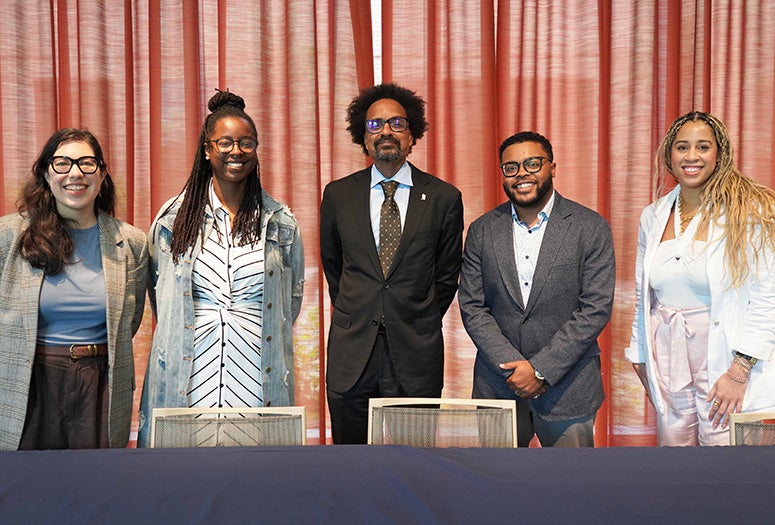
Ten years after a group of Rice University students came together to work for change, four alumni returned to campus to reflect on what it took to transform their concerns into action and how those lessons continue to shape the way they lead today.
Hosted by Rice's Office of Access and Institutional Excellence as part of the university's sixth annual Juneteenth commemoration, this year's panel, "Looking Back, Looking Forward: Leading in the Time of Black Lives Matter," brought together former members of the Students of Color Collective. The group played a pivotal role during the 2015-16 academic year in advocating for changes that ultimately helped reshape campus life, including the creation of Rice's Multicultural Center.
Moderated by Alexander X. Byrd '90, vice provost for the Office of Access and Institutional Excellence, the conversation invited the alumni to revisit a defining chapter in Rice's history while exploring how those experiences continue to inform their work and leadership.
"Juneteenth focuses on emancipation in Texas and the work of freedom, the work of creating a more just society," Byrd said. "This year is the 10th anniversary of the Students of Color Collective. We thought that we would bring as many of the people as we could who led that coalition back to campus and really dwell on what it meant to lead at Rice at that time."
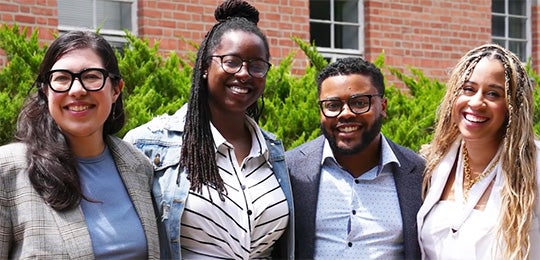
The panel featured Blaque Robinson '16, Gabriela Barrios '16, James Carter '17 and Katherine McElroy '16, who reflected on arriving at the university as students navigating unfamiliar environments while discovering both their voices and one another.
For Robinson, who came to Rice from Milwaukee, Wisconsin, as a QuestBridge Scholar, leadership began not with a formal title but with recognizing opportunities to strengthen community.
"I always will pick out an area of growth where I am," Robinson said. "I kind of just dragged people along and said, 'Hey, I identify this in you. Come bring this.'"
Carter, now an assistant professor at Cornell University, described how Rice's size allowed students to build relationships and exercise influence in meaningful ways.
"I liked having an influence," Carter said. "I thought if I went to a place that wasn't 15,000 or 30,000 students, it would allow me to learn more about myself but also have an impact on the people around me and the community around me."
For Barrios, who grew up in Houston, the experience underscored the importance of solidarity across communities.
"What I learned here at Rice was that concept of coalition work," Barrios said. "How can we build this out into a university that wasn't necessarily built for that originally?"
McElroy recalled both the excitement and uncertainty of transitioning to Rice and ultimately finding confidence through mentorship and community.
"I really thought that I was going to leave the university," McElroy said. "Through a lot of prayer and opportunities and mentorship, I ended up staying at Rice, and obviously it became so much better of an experience."
As the discussion shifted to the events of 2015 and 2016, panelists reflected on organizing during a period marked by national conversations about race and justice. What emerged from those efforts, they said, was an approach rooted in collaboration, persistence and specificity.
"We had very concrete demands," Barrios said. "I think that's really important. You really have to be concrete about it, because if not, people are going to disperse."
Carter emphasized the importance of understanding institutional priorities when advocating for change.
"What do the people that you want to do the thing that you want them to do care about?" he said. "We had to make our interests align."
Robinson described the moment she realized the movement had grown beyond a handful of student leaders.
"When I looked around that room and I saw people that were not at Black Student Association meetings who came in this room, I knew that there was something that was bigger than us," she said.
McElroy shared one of the most enduring lessons she carried from those experiences into her professional life.
"It is better to be effective than to be right," she said, recalling advice she received during conversations with university leaders. "There needs to be a way to communicate that this will be better in the long run."
The panelists also reflected on the progress that followed. McElroy noted that many of the coalition's original goals eventually came to fruition.
"I count it in all, 11 have been successfully achieved," she said.
Today, each alumna and alumnus continues to lead in different ways. Robinson is pursuing a Masters' of Divinity with hopes of becoming a chaplain focused on trauma and mental health., Carter mentors and advocates for students as a faculty member at Cornell., Barrios supports graduate students and postdoctoral scholars at the University of California, Los Angeles, while continuing labor organizing efforts, and McElroy serves patients as a primary care physician and medical leader.
Byrd said those varied paths reveal a broader truth about leadership.
"I took away a number of real gems from today's conversation," he said. "One of them was the importance of coalition building and working together."
He also pointed to another theme that resonated throughout the discussion.
"How hard leaders are on themselves, and how they're driven by this drive for excellence," Byrd said. "But this drive for excellence can also come with a cost, and how important it is for people who are in leadership to take care of themselves and to look out for one another."
As Rice celebrates Juneteenth, the conversation served not only as a reflection on the university's past but also as an invitation to future generations of students.
The work of building a more inclusive community, the panelists suggested, is never the responsibility of one person alone. It happens through shared purpose, sustained effort and the willingness to imagine what could be possible together.