
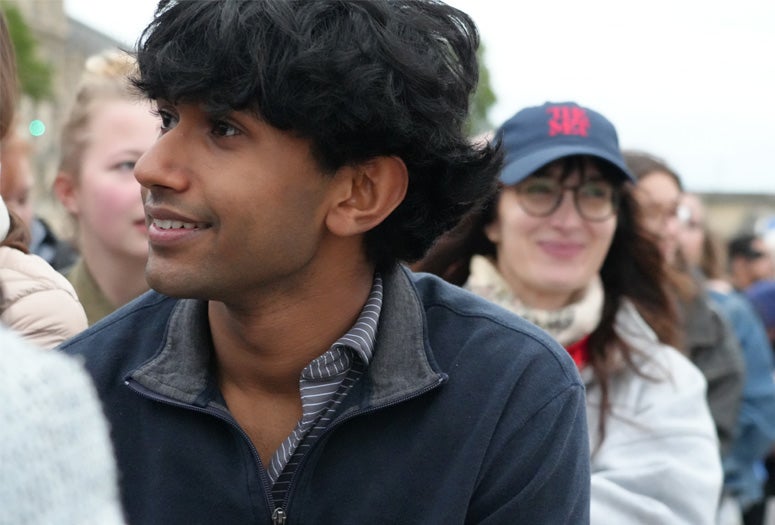
The climb through Montmartre wound past artists’ squares and up narrow staircases before opening onto one of the most recognizable views in Paris: the white domes of the Sacré-Cœur that rise above the city. The Rice undergraduates who made the walk this summer approached the neighborhood much as they might a novel or poem, reading its streets and monuments for clues to the lives of the women who once called it home.
The students were enrolled in Literature and Medicine taught by medical humanities lecturer Cameron Dezen Hammon through the Rice Global Paris Summer Program. Their walking tour traced the lives of women who shaped French culture, politics and medicine from Louise Michel, the revolutionary known as the “Red Virgin,” to the beloved singer Dalida, examining how women’s rights and women’s health have been contested and defended on these same streets.
The tour was one of several excursions built into a course that treats the French capital as a primary source. Hammon has taught Literature and Medicine at Rice for years, examining how novels, poetry, plays and journalism illuminate the experiences of patients, doctors, caregivers and families. Moving the course to the Paris Center gave that inquiry a second national tradition to draw on.
“How does French culture handle medicine? What is the history of medicine in a French context? It gives us a really interesting counterpoint to the American story,” Hammon said.
That comparative lens runs through the syllabus, which pairs French works in translation with foundational texts in the medical humanities and asks students to consider global health, inequality and ethical debate across both traditions. Class sessions meet at the Paris Center anchor each week, but the reading list extended into the city itself.
“The city as classroom is really the most incredible part of Rice Global Paris,” Hammon said. “The city itself is a walking museum of layers and layers of cultural, artistic and literary history.”
Some of those layers sit just blocks from the front door of the center, which is located in the Marais district.
“We have the incredible opportunity to walk to Place des Vosges and visit Victor Hugo's house and talk about how this giant of French literature was more or less a medical activist in his time,” Hammon said.
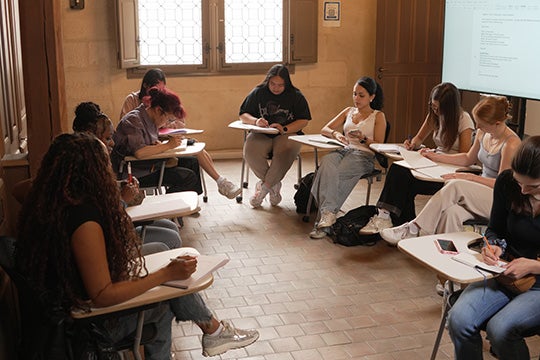
The compressed format changes the rhythm of the course as much as the setting does. A semester’s worth of material unfolds over three weeks with mornings in the classroom, afternoons in museums, bookstores and cafes, and Fridays reserved for writing workshops held in parks and libraries across the city.
“We become like a little pod, almost like a little family,” Hammon said. “What we do over 14 weeks in Houston, we do in three weeks there. It’s intense, it’s exciting, it’s challenging.”
That intensity pays off in ways an instructor can see in real time.
“Watching the light bulb go off in their minds is just so incredible as a teacher,” Hammon said.
For Hammon, the course also models something larger about what a Rice education can open up in Paris and beyond.
“We live in an international world, and it’s such a great opportunity to meet researchers, writers, thinkers, academics and creatives on the ground, which is an opportunity that comes through Rice Global Paris,” Hammon said.
The Paris Summer Program offers Rice undergraduates the chance to earn Rice credit while studying in Paris. Students interested in future summer terms are encouraged to apply early when applications open this fall. More information is available on the Rice Global website.