
A type of transformation best known for hardening steel and enabling shape-memory alloys may also occur in a much softer class of materials, according to new research from Rice University.
Researchers in the departments of Chemistry and Chemical and Biomolecular Engineering and at the Smalley-Curl Institute at Rice have shown that an organic semiconductor can transform from a liquid crystal into a solid crystal through a rapid, highly coordinated process resembling a Martensitic transformation — a phenomenon traditionally associated with changes between two solid crystalline structures. The findings, published in the Proceedings of the National Academy of Sciences of the United States of America (PNAS), expands scientists’ understanding of how materials reorganize during phase transitions and could eventually offer a new way to produce highly ordered organic semiconductor crystals for technologies such as flexible electronics and transistors.
“Martensitic transformations are usually thought of as exclusively solid-state processes,” said Kushal Bagchi, assistant professor and the Norman Hackerman-Welch Young Investigator in the Department of Chemistry at Rice and corresponding author of the study. “What we found is that a transition from something with fluidity into a solid can still exhibit the essential characteristics of a Martensitic transformation.”
Martensitic transformations are unusual because atoms or molecules move together in a coordinated way rather than slowly rearranging one by one. The process can happen quickly while allowing the new material to retain some structural “memory” of the phase it came from.
The Rice team studied HAT6, an organic semiconductor made of disk-shaped molecules that form columns in its liquid-crystalline state. They aligned those columns inside microscopic channels then rapidly cooled the material into a solid crystal.
Instead of losing its original organization during crystallization, much of the molecular alignment remained. At rapid cooling rates, the crystal retained roughly 70% of the alignment present in the liquid crystal. When the material cooled more slowly, however, the molecules had more time to rearrange and progressively lost that orientation.
“We had three qualitative indicators,” Bagchi said. “The transition appeared only when we cooled very fast, the daughter phase remembered the structure of the parent phase, and the transition was largely reversible. Once we saw all three, we became confident that this was qualitatively similar to a Martensitic transformation.”
“What was exciting to us was seeing how much of the molecular organization in the liquid crystal could survive as the material became a solid,” added Matteo Pasquali, the A.J. Hartsook Professor of Chemical and Biomolecular Engineering and an author on the study. “It suggests that we may be able to use the structure that already exists in a liquid crystal as a kind of blueprint for building highly ordered crystalline materials.”
The researchers found that the unusual transition occurred only within a narrow cooling range: The material had to cool quickly enough to prevent conventional crystallization but not so quickly that it became a glass instead of a crystal.
The transformation was also remarkably fast. Under strong cooling, the researchers measured a crystal front moving about 100 micrometers per second — roughly 10 million times faster than a commonly used model of conventional crystal growth would predict under similar conditions.
Bagchi said the liquid crystal’s existing molecular organization may help explain the speed.
“In the liquid-crystal phase, the molecules are already somewhat in the right position, so they don’t have to move very much to get to the final crystal,” he said. “It’s almost like adding steps between two points rather than having to make one big jump.”
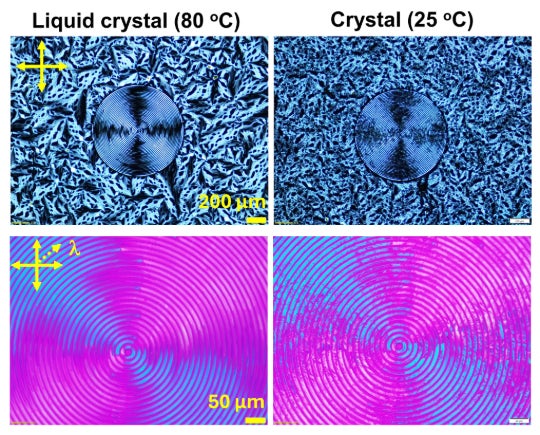
The team used polarized optical microscopy to track changes in molecular orientation as the material cooled and reheated. X-ray measurements at the Stanford Synchrotron Radiation Lightsource confirmed the structure of the resulting crystals.
The process was also largely reversible. When the researchers reheated the crystal into its liquid-crystalline phase, much of its earlier alignment returned, which is another hallmark of Martensitic transformations.
The finding is especially notable because the two phases behave very differently. Classical Martensitic transformations occur between solids. In the Rice experiments, the starting material behaved like a liquid while the final crystal behaved like a solid, suggesting the underlying physics of these transformations may extend more broadly across states of matter than previously recognized.
The researchers tested several other liquid crystals but did not see the same preservation of molecular order, suggesting that only certain molecular structures may be capable of this cooperative transformation. Understanding what makes those materials different could improve theories of how structured liquids become crystals.
The work could also help address a long-standing challenge in organic electronics. Unlike conventional electronics based largely on inorganic materials such as silicon, organic electronics use carbon-based semiconductors that can be flexible and potentially easier to manufacture. But their performance depends heavily on how their molecules are arranged.
“The difficulty is getting organic molecules to line up in the right way, so electrons can flow through them efficiently,” Bagchi said. “This gives us a possible route to first create that alignment in a liquid crystal, where it is easier to control, and then lock it into an ordered crystal.”
For Bagchi, liquid crystals also offer an unusually visible way to study fundamental questions about how materials change from one phase to another.
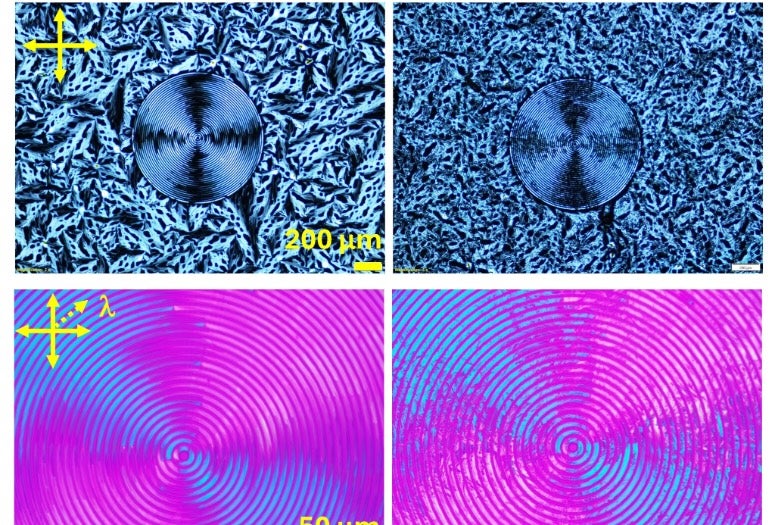
“With liquid crystals, you can often see these transformations directly under an optical microscope,” Bagchi said. “You can look at the images and see that the liquid-crystal and crystal phases are closely related. It gives you this remarkable visual way of learning something very fundamental about how materials behave.”
Additional authors of the study include Nurjahan Khatun, Joe F. Khoury, Agnes C. Nkele, Lingyu Wang and Tieqiong Zhang of Rice; Partha P. Paul of the Stanford Synchrotron Radiation Lightsource at SLAC National Accelerator Laboratory; and Paul Chibuike Okolie and Nabila Shamim of Prairie View A&M University.
This research was supported by the Welch Foundation under the Norman-Hackerman-Welch named fellowship. The use of the Stanford Synchrotron Radiation Lightsource at SLAC National Accelerator Laboratory is supported by the U.S. Department of Energy Office of Science’s Office of Basic Energy Sciences under contract No. DE-AC02-76SF00515. Additional support was provided from the Air Force Office of Scientific Research (FA9550-22-1-0296 and FA9550-18-1-0014); the Welch Foundation (C-1668); the National Science Foundation (2108838); the NSF-BSF (2404270); and The Kavli Foundation Exploration Award in Nanoscience for Sustainability (LS-2023-GR-51-2857).