
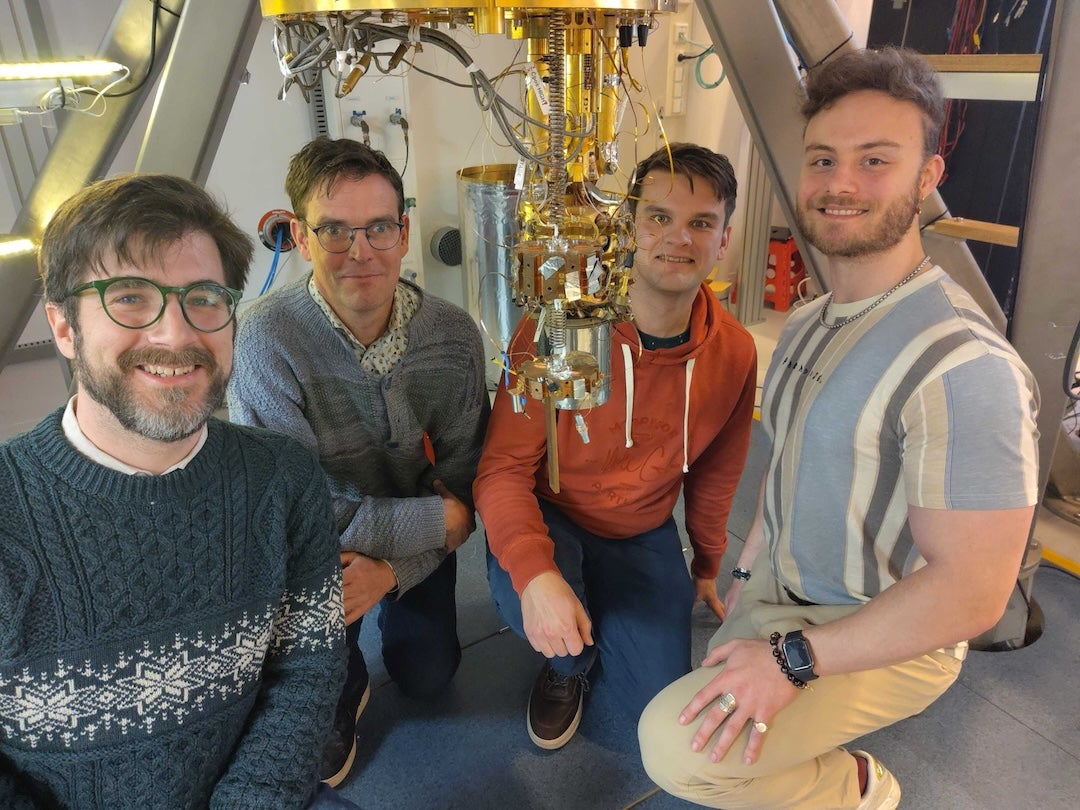
Rice University researchers have used a magnetically levitated particle to search for ultraheavy dark matter, extending the hunt for some of the heaviest possible forms of the invisible matter thought to hold galaxies together. Led by Christopher Tunnell, associate professor of physics and astronomy, the researchers used a tiny floating magnet as a highly sensitive detector designed to register the faint push an ultraheavy dark matter particle could produce as it passed through.
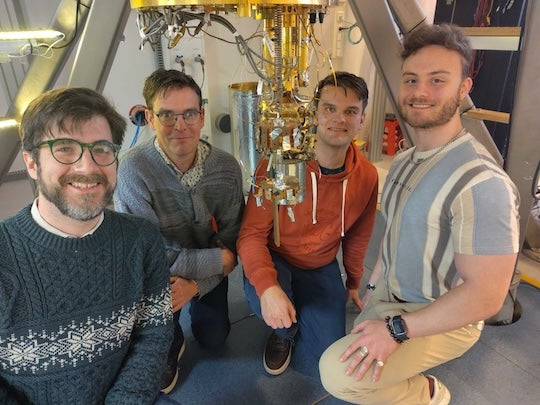
Dark matter plays a fundamental role in the structure of the universe, influencing the formation and stability of galaxies such as the Milky Way. However, scientists have yet to determine its composition. Understanding what dark matter is made of could enhance our knowledge of how galaxies formed and evolved. Most dark matter experiments focus on particles with masses similar to those of atoms, but some theories propose that the particles might be significantly heavier, potentially reaching the mass of a living cell. This Rice-led research demonstrates how a floating magnet can broaden the search to include these heavier candidates.
“Dark matter could be hiding at masses that our traditional experiments were never built to reach,” Tunnell said. “By turning a tiny floating magnet into a detector, we can begin searching a part of the dark matter landscape that has largely been out of experimental reach despite being the focus of extensive theoretical study by my Rice cosmology colleague Andrew Long.”
A tiny detector waiting for a knock
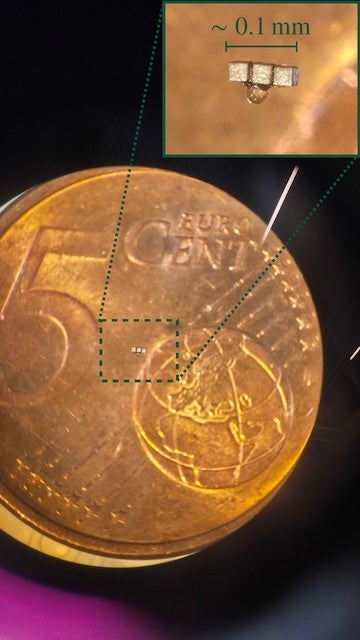
The detector is a permanent magnet roughly the size of a grain of sand. It levitates above a superconductor cooled to just above absolute zero, which is the lowest temperature physically attainable. Because the magnet does not touch any surface, friction is significantly reduced, allowing even a minute force to set it in motion.
The researchers monitored the magnet closely enough to detect movement about one-hundredth the width of an atom. This sensitivity enabled them to search for extraordinarily weak forces. If an ultraheavy dark matter particle were to pass through the detector and interact with ordinary matter, it could give the magnet a tiny push.
“Instead of looking for a steady signal, we are waiting for very small knocks,” said Juehang Qin, a Rice postdoctoral researcher and corresponding author of the study. “The challenge is making the detector quiet and sensitive enough that if something unusual pushes it, we can see that motion and determine whether it could be dark matter.”
The researchers gathered about a month of data and concentrated their analysis on quiet overnight periods, when external disturbances were minimized. They conducted their search in collaboration with collaborators in Leiden, the Netherlands, where scientists discovered early evidence nearly a century ago that unseen matter could influence the movement of stars.
Listening for a different signal
The experiment takes a different approach from searches for lighter forms of dark matter. Large detectors are designed to look for particles closer to atomic masses. A heavier sensor such as the levitated magnet gives scientists a way to investigate particles at much greater masses.
Previously, the same apparatus was used to search for ultralight dark matter, which could produce a gentle, repeating force. Ultraheavy dark matter calls for a different strategy.
Rather than listen for a continuous signal, the researchers watched for an impulse, a sudden push that could result from a single particle passing through the detector.
“Nobody had combined this type of sensor, this level of sensitivity and a long listening period to search for ultraheavy dark matter in this way,” said Dorian Amaral, a former Rice postdoctoral researcher and corresponding author of the study. “What makes the approach promising is that we are applying technology designed to measure extremely small forces to a different range of dark matter search.”
The experiment required three elements: a relatively heavy sensor, the ability to detect minute forces and long periods of stable measurements. Together, these features enabled the researchers to explore dark matter masses that were beyond the scope of previous levitated-particle experiments.
Narrowing the places dark matter can hide
Ultimately, the researchers found no evidence that an ultraheavy dark matter particle interacted with the detector. The absence of a signal is itself useful, as it allows them to rule out certain combinations of particle mass and interaction strength that would have been expected to produce a detectable signal.
The experiment explored nine orders of magnitude in dark matter mass and was able to detect particles approximately 10 million times heavier than those studied in previous levitation experiments. In the middle range of the search, the milligram-scale magnet imposed strict limits on how strongly these ultraheavy particles could interact with ordinary matter.
These findings, released at the 2026 International Conference on Particle Physics and Cosmology Conference, help narrow the range scientists need to investigate. While large detectors remain essential for searching at lower masses, the research led by Rice demonstrates how levitated sensors can probe much heavier dark matter candidates.
The researchers next plan to cool the magnet further and collect data for longer periods. They also plan to levitate several magnets at once, which could help distinguish a possible dark matter interaction from vibrations and other background disturbances.
Other authors include Dennis Uitenbroek and Tjerk Oosterkamp of the Leiden Institute. This research was supported by the National Science Foundation, the Dutch Research Council and the European Innovation Council Pathfinder Project QuCoM.