

Building upon 30 years of research, Rice University’s Kinder Institute for Urban Research is examining the experiences, beliefs and attitudes of Asian residents in the greater Houston area. The institute’s Asian American Community Study focuses on the lives of one of the fastest-growing segments in the region with particular attention on seven ethnicities: Asian Indian, Chinese/Taiwanese, Filipino, Japanese, Korean, Pakistani and Vietnamese.
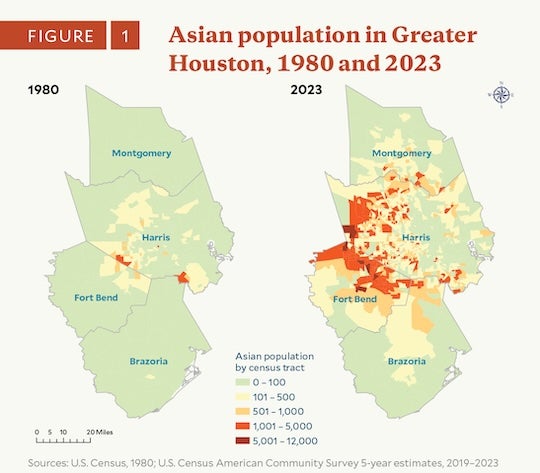
“More than 655,000 Asian residents call the Houston region their home, and this is a group growing in both size and diversity,” said Daniel Potter, co-director of the Kinder Institute’s Houston Population Research Center. “More Asian residents live in Fort Bend County today than lived in the entire state of Texas in 1980, yet there is often a lack of knowledge and understanding of the many different populations grouped under the label ‘Asian.’”

As part of the multiyear, multilingual Asian American Community Study, researchers surveyed 2,100 Asian residents in Harris, Fort Bend, Montgomery and Brazoria counties. The first series of reports, published today, touch on a range of topics including people’s political views and party affiliations, positions on issues such as gun control and abortion, education and economic backgrounds, opinions on family and identity and experiences with discrimination.
“As an Asian American, I know firsthand the vital role our community has played in shaping this region’s history,” said Anne Chao, philanthropist and lecturer at Rice, who generously supported the study. “As the Kinder Institute’s founding director Stephen Klineberg reminds us, Houston is where the American future will be worked out. That makes it essential to understand the views, attitudes and experiences of Asian residents, who are central in shaping the trajectory of our region and our nation.”
Asian residents are frequently grouped together in data and public discourse. This study shows that doing so obscures meaningful differences in opportunity, identity and experience with implications for policy, civic engagement and how the region understands its own growth.
In addition to the Kinder Institute survey, researchers drew upon census data, oral histories from the Houston Asian American Archive and other sources. Their research found educational and economic outcomes vary widely across communities and that identity is shaped by family, ethnicity and a sense of belonging. Politically, Asian residents as a group describe themselves as moderate with no clear majority identifying with any given party. However, these broad conclusions varied upon closer examination of ethnicity and generation.
Key findings:
- The Asian population is growing in size and diversity.
- Over the past four decades, the Asian population in the area has risen from 1.8% to 9.9%.
- In just 13 years (2010 to 2023), the Asian population surged by 117% in Fort Bend County and 180% in Montgomery County. Fort Bend County alone now has almost twice as many Asian residents as lived in all of Texas in 1980.
- Asian Indians have become the single-largest Asian ethnic group in the region with over 150,000 residents.
- Asian residents tend to be highly educated as a group. However, when examined more closely, this varies across ethnicities.
- Overall, Asian residents hold advanced degrees at a high rate.
- Only 28% of Asian residents have a high school diploma or less. However, 4 in 10 Vietnamese and Pakistani residents reported having a high school diploma or less.
- Economic success varies within and between Asian ethnicities.
- Nearly half of households (46%) report incomes over $100,000.
- A quarter (25%) of households earn under $50,000.
- Vietnamese residents have a bifurcated income distribution with 19% of households earning less than $25,000 and 30% of households earning over $100,000.
- Asian identity centers on family, gender, ethnicity and “being American."
- Significant majorities — 80% to 90% or more of each ethnic group — said their family role was important or very important to their identities.
- Being American was consistently rated as an important source of identity across ethnicities, including by 86% of Pakistani, 79% of Asian Indian, 75% of Filipino and 71% of Vietnamese residents.
- As a preferred pan-Asian label, “Asian” or “Asian American” was favored by the majority of survey respondents.
- Asian residents tend to be ideologically moderate and equally split in party identification with ethnic and generational variation.
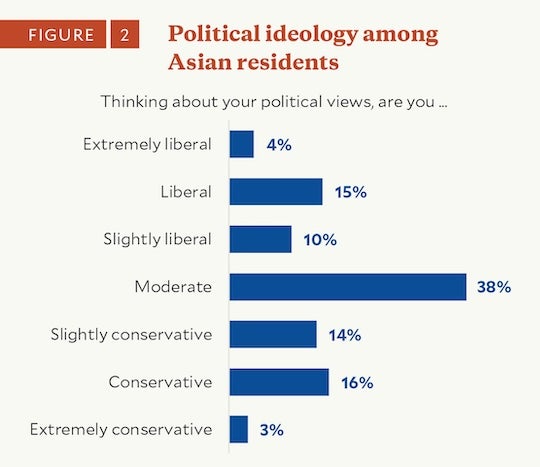
Survey responses show that most Asian residents in the Houston region describe their political views as moderate, with smaller shares identifying as liberal or conservative. - Asian residents are evenly divided (30%-31%) among Republicans, Democrats and independents.
- Asian residents tend to view themselves as politically moderate with 62% falling somewhere between slightly liberal and slightly conservative.
- More Vietnamese (45%) and Filipino (42%) residents identified as Republican, while more Japanese (42%) and Asian Indian (37%) residents identified as Democrats. Chinese/Taiwanese and Pakistani residents (47%) were more likely to identify as independent.
- Second-generation Asian residents (i.e., those born in the U.S. who have at least one parent who was born elsewhere) were more likely to identify as Democrats across most ethnicities.
- As a broad group, Asian residents tend to hold progressive views on social issues, but clear majorities also support gun rights with some form of regulation. Closer study reveals this varies across ethnicities.
- On abortion, 75% believe it should be legal in most or all cases.
- On LGBTQ+ rights, 71% somewhat or strongly support local policies protecting these individuals.
- Asian residents support protecting gun rights with 71% saying it was somewhat or very important.
- Simultaneously, 82% of Asian residents said regulating gun ownership was somewhat or very important.
- Asian residents report experiencing discrimination in a variety of forms and in many different settings.
- About 40% of Asian residents said either they personally experienced discrimination or a friend or family member had.
- The most frequently reported forms of discrimination were insults or derogatory jokes, differential or exclusionary treatment and questioning one’s belonging in the U.S.
- Study participants noted the COVID-19 pandemic, the political climate and xenophobia were contributing factors to anti-Asian behavior.
This study expands on previous Kinder Institute findings that used Harris County Asian population survey data from 1995, 2002 and 2011. The latest study includes four times the sample size, expands to include the growing populations outside Harris County and reflects the growing ethnic diversity of Asian residents in the region.
Over the next year, research will continue with additional surveys, interviews and community engagement. New findings will be shared in additional reports.
The latest study updates, data and additional coverage by the Kinder Institute’s Urban Edge blog can be found at https://kinder.rice.edu/aacs with other stories available at the Urban Edge.
To schedule an interview with one of the researchers, contact Kat Cosley Trigg at kat.cosley.trigg@rice.edu or 713-348-6781.