


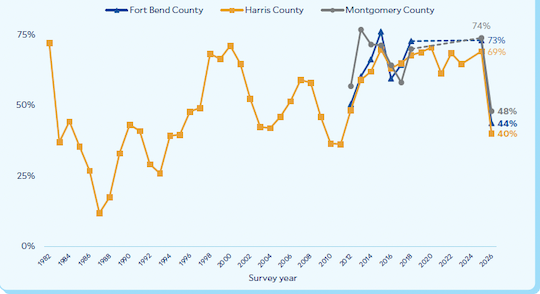
The region’s economy is the “biggest problem” identified by Rice University’s Kinder Institute for Urban Research, noting residents’ attitudes toward job opportunities experienced the largest one-year decline since the 1980s.
The Kinder Houston Area Survey is the longest-running study of any major metro area in the nation. It was released today at the institute’s annual luncheon.
“The Kinder Institute’s annual survey provides community leaders and the public with a map of where we’ve been on key issues, where we are now and what’s of looming importance. It allows everyone to work together toward a better future for our city and our region,” said Dan Potter, co-director of the institute’s Houston Population Research Center and lead researcher on the project. “This survey is the embodiment of our core mission — to conduct research as a public good.”
New to this year’s study, researchers also focused on the importance of social connections for the lives of Houston-area residents. Findings from the study showed that a person’s connections mattered for their wealth, health and sense of safety.
This year’s findings are based on nearly 9,000 responses from the Greater Houston Community Panel, which includes residents in Harris, Fort Bend and Montgomery counties — a region comprising about 1 in 5 Texans.
Key findings
Economy
- The number of residents who rated the region’s job opportunities as good or excellent dropped nearly 30% — the largest one-year decline since the oil crisis in the early 1980s.
- The economy was identified by residents in all three counties as the most common “biggest problem” facing the Houston area with crime and safety being the second-most commonly reported.
- More residents are experiencing financial pressures, especially lower- and middle-income earners who increasingly report just getting by and being unable to cover a $400 unexpected expense.
Environment
- More than 7 in 10 residents report being moderately to extremely concerned about extreme weather in their community.
- More than 6 in 10 residents are moderately to extremely concerned about pollutants in their community.
- More than 6 in 10 residents are moderately to extremely concerned with issues related to contamination from the built environment in their community, but these concerns vary by household income.
- About 7 in 10 residents are moderately to extremely concerned about the environment’s effects on their health with concern varying by household income.
Social connections
- Most people are unaware of the attitudes and preferences of others; however, they are more aligned than they think on key social issues such as criminal background checks for gun sales.
- Attitudes toward members of the LGBTQ+ community have shifted in the past 19 years with about 65% now saying homosexually is morally acceptable.
- Personal and professional connections matter for wealth and economic mobility.
- Social cohesion is positively associated with physical and mental health.
- Feeling connected with neighbors affects a person’s feeling of safety more than the prevalence of crime in their neighborhood.
In addition to presenting the annual survey’s findings at the luncheon, the Kinder Institute also honored Charles C. Foster, chairman of Foster LLP, with the Stephen L. Klineberg Award, which is given to individuals in recognition of their civic leadership and contributions to the Houston area.
“For 45 years, the Kinder Houston Area Survey has helped Houston understand the forces shaping its future,” said Rose Rougeau, executive director of the Kinder Institute’s external affairs division. “It was especially meaningful to mark this milestone with our community of supporters, including our founder, Stephen Klineberg, whose vision continues to guide leaders and strengthen public conversations across our region.”
To request interviews with Kinder Institute researchers, contact media relations specialist Kat Cosley Trigg at kat.cosley.trigg@rice.edu.