
Graduation is a time of becoming, a formal recognition of how knowledge and shared experience shape personal identity and orient agency. In addition to a diploma, graduates walk away at the conclusion of their studies with a transformed sense of self and of the world.
To mark this broader significance of the event, the George R. Brown School of Engineering and Computing held a rite-of-passage ceremony ahead of Rice University’s 113th commencement, inviting its graduating students to publicly affirm the values and responsibilities they will carry into their professions.
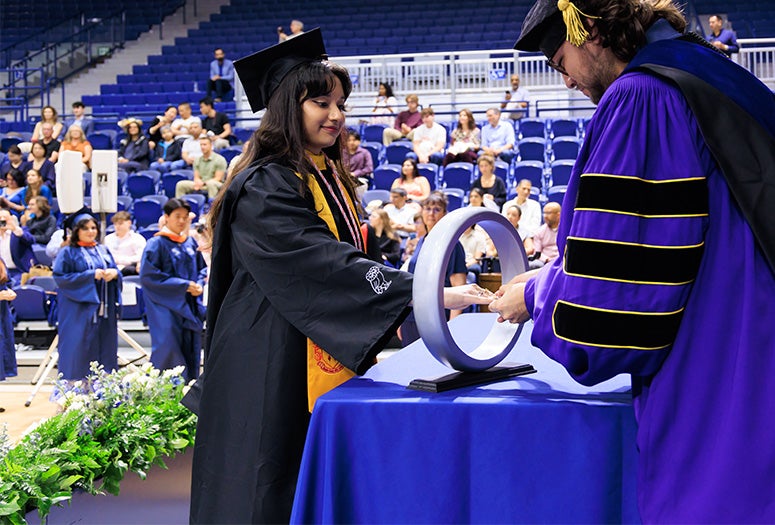
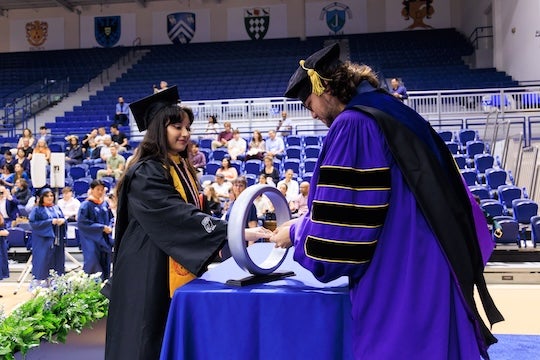
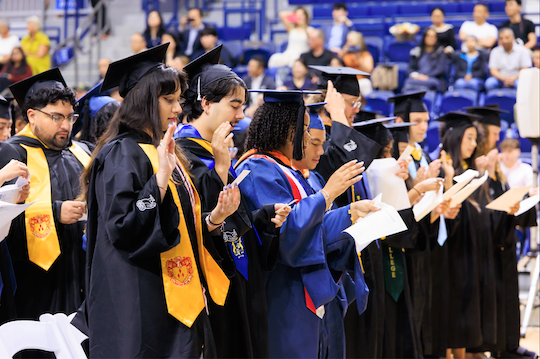
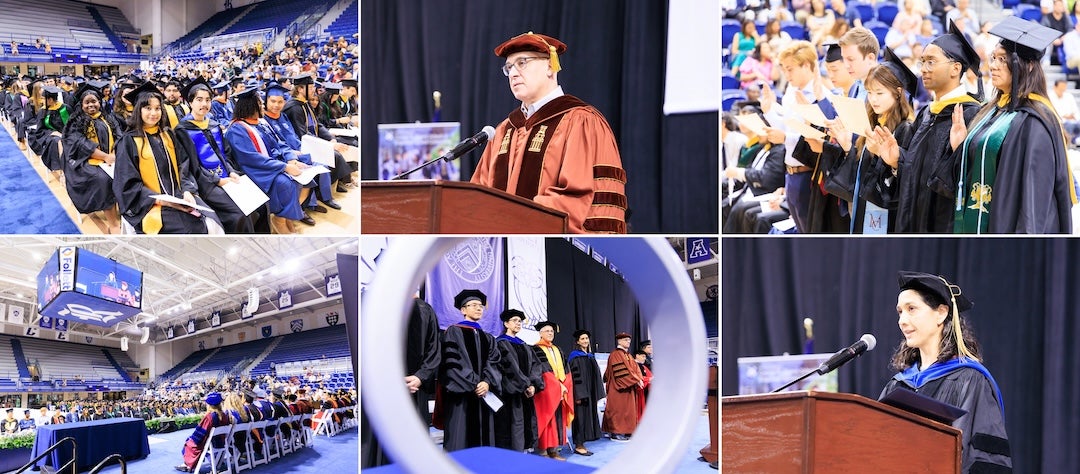
Held May 8 in Tudor Fieldhouse, the induction ceremony for the Order of the Engineer and The Pledge of the Computing Professional drew on longstanding traditions in engineering and computing education that treat entry into the profession not only as an academic achievement, but as a public and ethical commitment. Nearly 300 students crossed the stage to receive a stainless steel ring or ceremonial pin and recited oaths committing themselves to ethical practice and service to society.
“The ring on your finger and the pin on your lapel signify a commitment to integrity, to competence, to lifelong learning and to the use of your skills for the public good,” said Luay Nakhleh, the William and Stephanie Sick Dean of Engineering and Computing.
Nakhleh connected the ceremony’s themes to the school’s broader mission of “solving for greater good.”
“That phrase is not a slogan,” he said. “It is the heart of our mission to prepare leaders who advance engineering and computing through rigorous scholarship, creative problem-solving, ethical practice and interdisciplinary collaboration for the betterment of society.”
The ceremony marked the second year the school has held the joint induction event, which expanded this year to include both undergraduate and graduate students. Its emphasis on ethical leadership and public service echoed themes recently outlined in strategic planning efforts at both the school and university level.
“One of the things we hope students take away from this ceremony is that the work they do after graduation will affect people in very real ways,” said Renata Ramos, senior associate dean of academic affairs. “Whether they go into engineering, computing, research or industry, they will be making decisions that require technical knowledge as well as judgment, responsibility and an awareness of the broader impact of their work. This ceremony gives them a chance to pause and reflect on that as they enter the profession.”
The Order of the Engineer, established in the United States in 1970, asks participants to publicly accept an ethical obligation tied to the profession and to wear a stainless steel ring on the little finger of their working hand as a reminder of that commitment.
The Pledge of the Computing Professional, founded in 2011 and modeled after the engineering tradition, similarly emphasizes ethical responsibility and public service in computing-related fields. Inductees wear a pin that spells “honor” in zeroes and ones, based on the character encoding rules of the American Standard Code for Information Interchange.
Several students interviewed after the ceremony said the pledges resonated because they gave formal expression to values already central to how they understood their future work.
For computer science and business major Trisha Chinnimeni, the ceremony reinforced the idea that engineering and computing carry obligations beyond technical achievement.
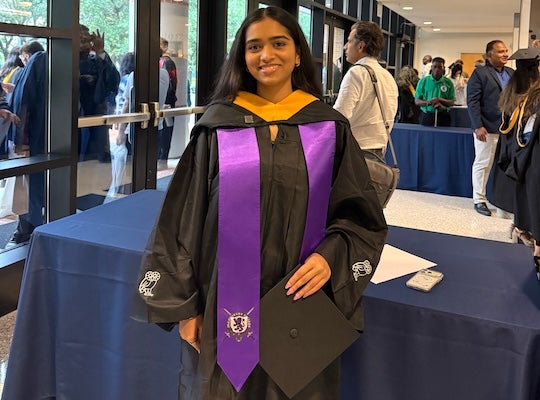
“It’s not only about what you learn and take away with you after Rice,” Chinnimeni said. “It’s about what you do with what you learn.”
She said hearing the pledge aloud felt like “tying that knot back together” — a reminder of why she chose Rice in the first place.
“There are so many beautiful opportunities and people who are so passionate about changing and helping the world,” she said. “Those experiences have instilled in me the same kind of values.”
Chinnimeni added that the ceremony’s focus on ethics resonated at a moment of rapid technological change.
“Technology, as we know, is going through a really big revolution right now, so making sure that we are very dedicated and intentional about the steps we are taking is super important to me personally, and it was nice to see that reflected here today,” she said.