
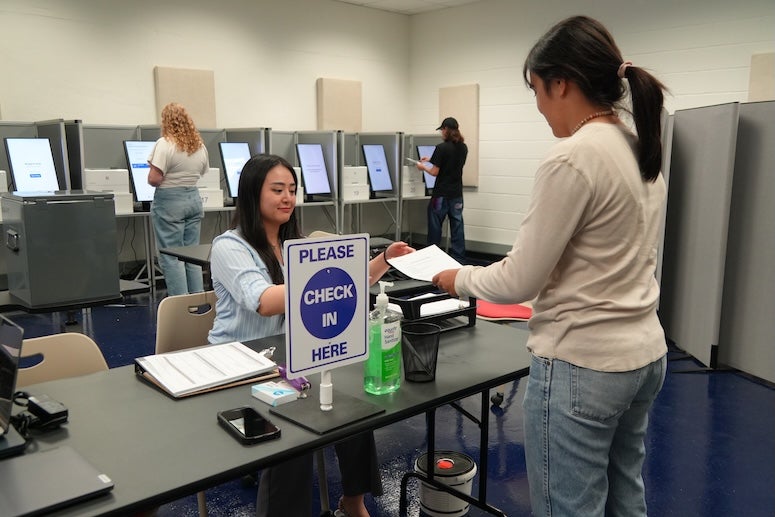
As voters head to the polls for the Nov. 3 midterm elections, researchers at Rice University are preparing to examine what happens inside a polling place, from the length of the line to the way voters review their ballots before casting them.
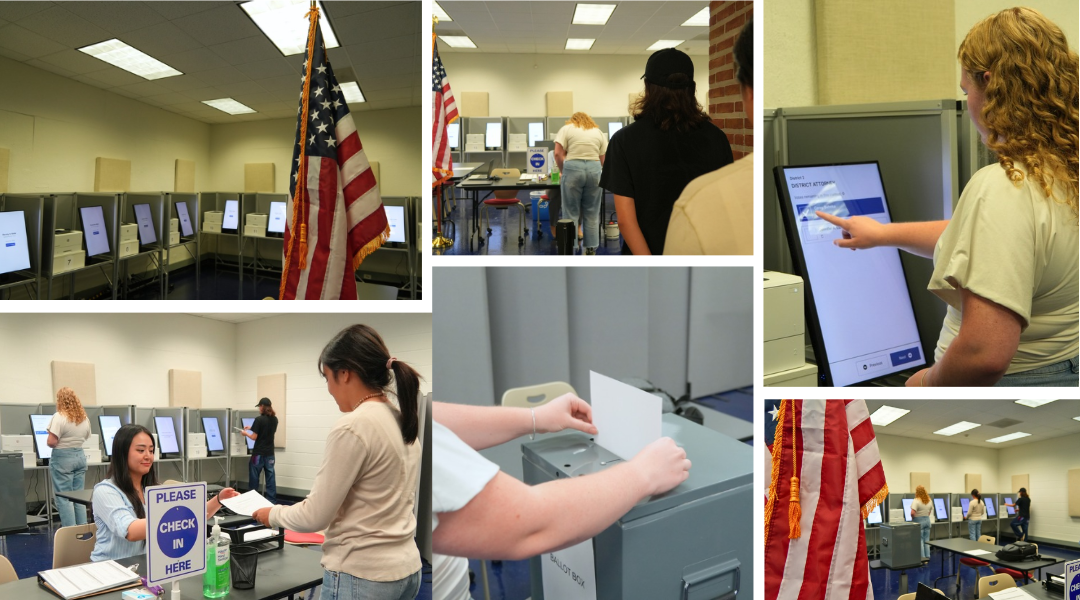
Inside Sewall Hall, the Rice Center for Voting has transformed a roughly 1,000-square-foot space into a simulated polling place equipped with 20 ballot-marking devices. The new facility allows researchers to study voter behavior in a realistic setting, exploring how seemingly small details can influence the voting experience.
For Annlyle J. “AJ” Diokno, a fifth-year doctoral student studying human-computer interaction and human factors, the new space represents years of progress. She has been involved in the research since its early stages, when the team worked with a single ballot-marking device and could study only one participant at a time.
“In the beginning when we only had one person down at the lab, we were thinking about ideas and how we could make this into a larger-scale operation and extend some research,” Diokno said. “Now having a bigger space with 20 BMDs, and seeing it all come together, it’s something I hadn’t imagined before.”
Michael Byrne, professor of psychological sciences and computer science and director of the center, said the facility represents an important step forward for research that brings together psychology, political science, computer science and election administration.
“There’s a lot of problems in the voting space that don’t neatly line up with disciplinary boundaries,” Byrne said.
The center brings together researchers from multiple disciplines to study voting technology, ballot design, election administration and the physical layout of polling places with the goal of making voting more accessible, accurate and secure.
Researchers can now recreate the experience of entering a polling place, waiting in line, checking in, marking a ballot and reviewing selections before casting a vote. They can also rearrange equipment, adjust the flow of voters and observe how those changes affect behavior.
One of the first studies will examine whether the number of people waiting in line influences how carefully voters check their printed ballots. Diokno is investigating whether voters feel pressure to move more quickly when others are waiting behind them and whether waiting in line themselves changes that behavior.
The research could help identify changes to polling place design and procedures that encourage voters to verify their selections before submitting their ballots.
The center’s location offers another advantage. Sewall Hallhouses an actual Election Day polling place, giving researchers an opportunity to recruit voters for studies in the simulated facility. The midterm elections will serve as the center’s first major opportunity to put its new space to work.
Beyond ballot verification, researchers hope to examine polling place layouts, voter privacy, equipment usability and poll worker training. Byrne said the facility will allow researchers to test questions that previously could only be explored through surveys, illustrations or smaller laboratory experiments.
The new facility also gives Rice students, from undergraduates to doctoral researchers, an opportunity to help design and conduct studies that could improve the voting experience.
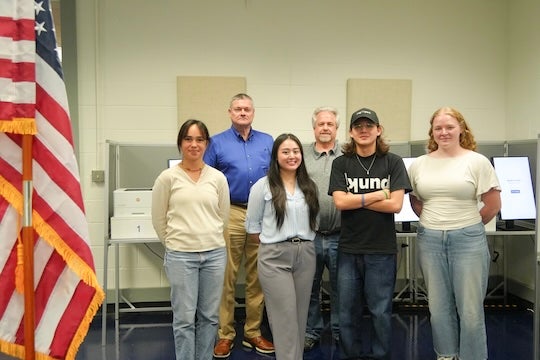
Chloe Diehl, a senior majoring in cognitive sciences, has worked with the team since her sophomore year. She helped develop the center’s physical layout, considering everything from the placement of voting stations to the movement of participants through the room.
Shreya Raj, a junior majoring in cognitive sciences, joined the research team two months ago after developing an interest in how people interact with technology. For Raj, the experience offers an opportunity to put classroom lessons into practice.
“I’m actually applying it to understanding — what is someone thinking when they’re walking through and waiting in a long line? What is someone thinking when they’re staring at a screen with so many different elements?” Raj said.
Claire Holmes, a first-year doctoral student specializing in human-computer interaction and human factors in Rice’s Department of Psychological Sciences, joined the research team in August. She said having access to a dedicated facility so early in her graduate studies opens opportunities to explore questions that would be difficult to investigate in a traditional laboratory.
For Israel Lerma, a sophomore majoring in psychology, the research has personal meaning. He turned 18 just a month before the 2024 presidential election and remembers recognizing the importance of exercising his right to vote. After participating in one of the team’s earlier studies, he became interested in the research and eventually joined the group, hoping to help make voting more accurate and secure.
Byrne said involving students in every stage of the process, from developing experiments to setting up equipment and working with participants, is an important part of the center’s mission. For students considering careers in research, the experience offers a firsthand understanding of what scientific work looks like beyond the classroom.
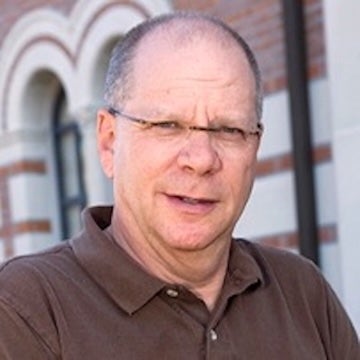
For Byrne, seeing the new facility come to life is also deeply personal.
The center was a shared vision of Byrne and the late Robert “Bob” Stein, a longtime Rice political scientist and former dean of the School of Social Sciences who helped establish the center alongside Philip Kortum and Dan Wallach.
Byrne said when Rice announced an opportunity for faculty to propose new interdisciplinary research centers, Stein reached out almost immediately.
“We have to do this,” Byrne recalled Stein telling him.
Stein, who died in July 2025, never had the opportunity to see the completed facility. During a recent visit to the center, Byrne became emotional reflecting on his longtime colleague and the work they started together.
Although Stein is no longer here to see the research unfold, the new space brings their shared vision to life, creating opportunities for students and researchers to explore questions that could help improve the voting experience for years to come.