
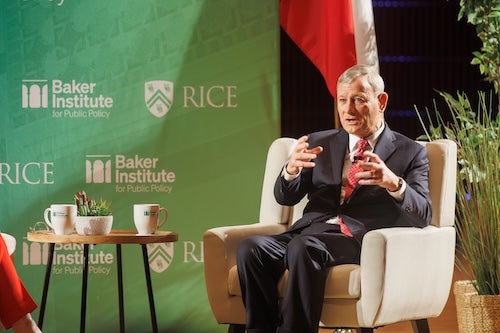
Chief Justice John Roberts returned to the Rice University campus March 17 for a special public conversation hosted by Rice’s Baker Institute for Public Policy. The event marked two decades of Roberts serving on the United States’ highest court and offered a rare opportunity to hear him reflect on his time on the bench.
His visit came at the invitation of James A. Baker III, honorary chair of the Baker Institute and former White House chief of staff under Ronald Reagan, whom Roberts began his legal career for as a junior staff member.
“This visit carries particular meaning because it continues a connection with Rice that many people here still remember vividly,” said Rice Provost Amy Dittmar in her welcome speech. “Thirteen years ago, the chief justice joined us as part of Rice’s centennial celebration, and that conversation left a lasting impression. Even today, alumni often recall that event as one of the defining intellectual moments of their time at Rice.”
Roberts was nominated to lead the U.S. Supreme Court by George W. Bush and has served as chief justice since 2005. Before joining the Supreme Court, he built a distinguished legal career that included service on the U.S. Court of Appeals for the District of Columbia Circuit, as principal deputy solicitor general of the United States and as associate counsel to Reagan. Earlier, Roberts clerked for Judge Henry J. Friendly of the U.S. Court of Appeals for the Second Circuit and later for Justice William H. Rehnquist — an experience that foreshadowed his eventual rise to lead the Supreme Court.
“The position of Chief Justice occupies a unique place in our constitutional system,” said David Satterfield, director of the Baker Institute. “It is, of course, a presiding role in the Supreme Court, but it is also something less formally defined and more demanded: steward of the court as an institution, guardian of the judicial system in our federal government and protector — not only of decisions taken by the court, of the court’s credibility as one of the three branches of our system of government.”
Lee Rosenthal, senior judge of the U.S. District Court for the Southern District of Texas and trustee emerita of Rice’s Board of Trustees, led the conversation with Roberts, touching on his career, public perceptions of the Supreme Court and the role of technology in judicial processes.
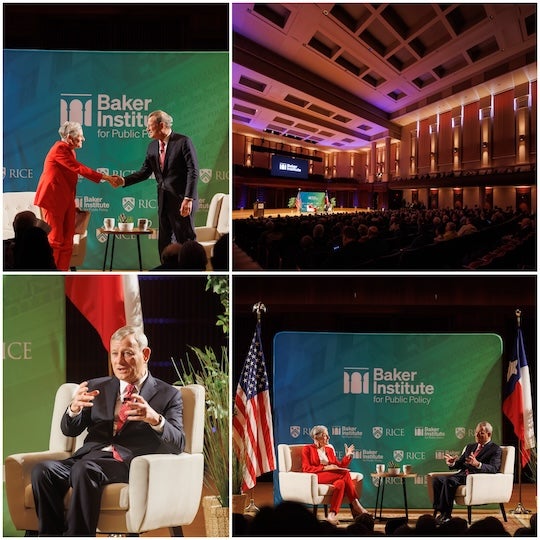
Rosenthal asked what Roberts sees as the most persistent misconceptions about the court. Roberts pointed to two: how frequently the court overturns precedent and the belief that justices act on the political agendas of the presidents who appointed them.
He said public perception is often shaped by a handful of high-profile cases, creating the impression that the Supreme Court routinely overturns precedent. In reality, he said, the data tell a different story. Courts led by Earl Warren and later Warren E. Burger reversed precedent somewhat more frequently than the current court, while the court during Roberts’ tenure has done so less often. The focus on a narrow set of controversial rulings, he said, can distort the broader picture of how the court operates.
“The notion that we carry forward the views of people who appointed us is absurd,” Roberts said. “President George W. Bush appointed me 20 years ago. The idea that I’m carrying out his agenda somehow is absurd. The issues here today, nobody would have thought those would have been a big deal 20 years ago. And history is full of examples of presidents appointing people and being really surprised how they turned out, going both ways. Felix Frankfurter turned out to be a lot more conservative than the president who appointed him. Justice Brennan, a lot more liberal than his.”
Reflecting on the role of technology, Roberts recalled seeing his first word processor as a law clerk in 1980. Since then, he said, technological change has accelerated dramatically, reshaping how courts operate.
“I think for people out there considering going to law school, they have to realize that it’s going to be a different job,” Roberts said. “You’re going to say, ‘Well, go research this and give me this answer. Just ask AI.’ Now, AI will make mistakes, but so do young lawyers. Work will change.”
He noted how the COVID-19 pandemic forced changes in how the Supreme Court conducts its work, including remote arguments that at times placed nine justices and multiple advocates on a single screen. The format proved cumbersome, he said, prompting the court to adopt a more structured approach, wherein each lawyer receives five uninterrupted minutes to speak before questions begin. The shift, he said, replaced what he described as the court’s earlier “rough and tumble” style, in which frequent interruptions and commentary often extended arguments.
Rosenthal closed with a final question, invoking the book “Fears of a Setting Sun: The Disillusionment of America’s Founders” and its account of a chair in Independence Hall present during the drafting of the Constitution. Carved on the back is a sun poised halfway over the horizon — raising a question that has lingered since the nation’s founding: Is it rising or setting?
“From my perspective, it is rising because of the commitment I see, not only on the court but in the trial judges, where the rubber really does hit the road,” Roberts said.
“The faith of so many people in our institutions — of course, certainly subject to criticism. But I think they emerge from a lot of the criticism stronger. The separation of powers, which framers’ stroke of brilliance realized was important to keep power under control by having its branches separate from each other. There are always difficulties. They’re going to change. That document has proven durable for almost two centuries, and I think it’s going to continue.”
The Baker Institute is a nonprofit, nonpartisan policy research organization based at Rice in Houston. The institute provides meaningful policy analysis on the most critical challenges facing Texas, the U.S. and the world thanks to more than 200 leading experts from academia, the private sector and government. Hailing from all over the globe, the fellows provide the highest quality research and analysis on critical foreign and domestic public policy issues. Learn more here.