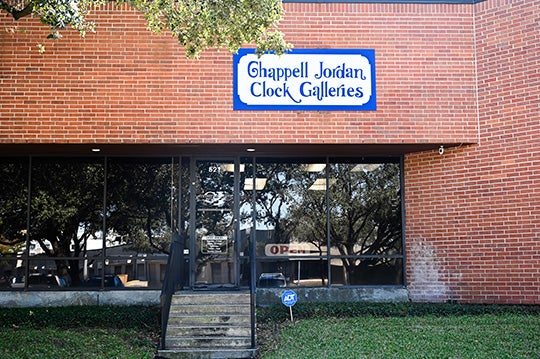
The first thing Karis Lai noticed was the quiet. Not the peaceful kind exactly. More the heavy, suspended kind. The kind that seems to hum. She had wandered into Chappell Jordan Clock Galleries in Houston almost by accident, unaware that the narrow storefront was one of the city’s last remaining clock shops, unaware that inside were rows of towering grandfather clocks, shelves of gears and pendulums and decades of accumulated mechanical patience. What she also did not know was that the visit would quietly reorient her thinking about one of the most ordinary and overwhelming forces in modern life: time.
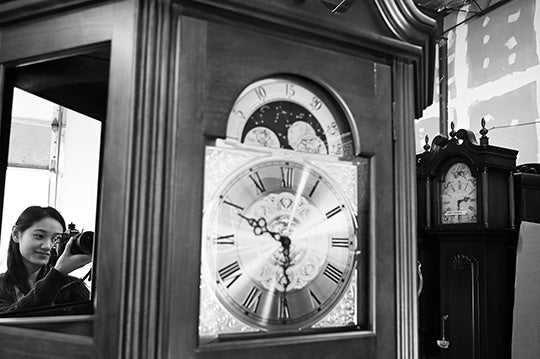
“It was like stepping into a new world,” said Lai, a Rice University senior majoring in history. “There were grandfather clocks everywhere, and the manager was so nice. He allowed me to come back multiple times and take photographs.”
An Elizabeth Lee Moody Undergraduate Research Fellow in the Humanities and the Arts, Lai is building a creative philosophical project that asks a deceptively simple question: How did time come to govern us the way it does? The question did not originate in a museum or a book. It started with a feeling, a sense that her generation lives inside a perpetual scheduling interface, slicing life into color-coded blocks, optimizing every hour, often without stopping to ask what any of it is actually for.
“We’re constantly subdividing every single second of our existence, and productivity is just the driving force behind everything,” Lai said. “Often we’re so obsessed with productivity, we don’t really stop to think about why we’re doing what we’re doing. We have all this ambition, but we don’t even stop to think about what our particular aim is.”
Rather than approaching that anxiety through a single discipline, Lai did what she has come to do best: She built a hybrid method. She read extensively. She conducted oral history interviews. She visited physical sites where time is not merely tracked but crafted. She recorded hours of conversations with clockmakers, museum staff and researchers. She took photographs. She asked philosophical questions in practical settings.
The Chappell Jordan Clock Galleries became central to that process. Through repeated visits, Lai began documenting not only the objects but the changing demographics of the shop’s customers.
“All their sales are declining among the new generation,” Lai said. “I started thinking about a future in which my kids wouldn’t know what a manual clock is, which is kind of crazy.”
What struck her most was the irony. For centuries, mechanical clocks symbolized efficiency, discipline and standardization. They were once the very technology people complained about.
“Everyone was grumbling about the clock, about why it’s directing every single second of our life,” Lai said. “Now that very symbol is kind of obsolete.”
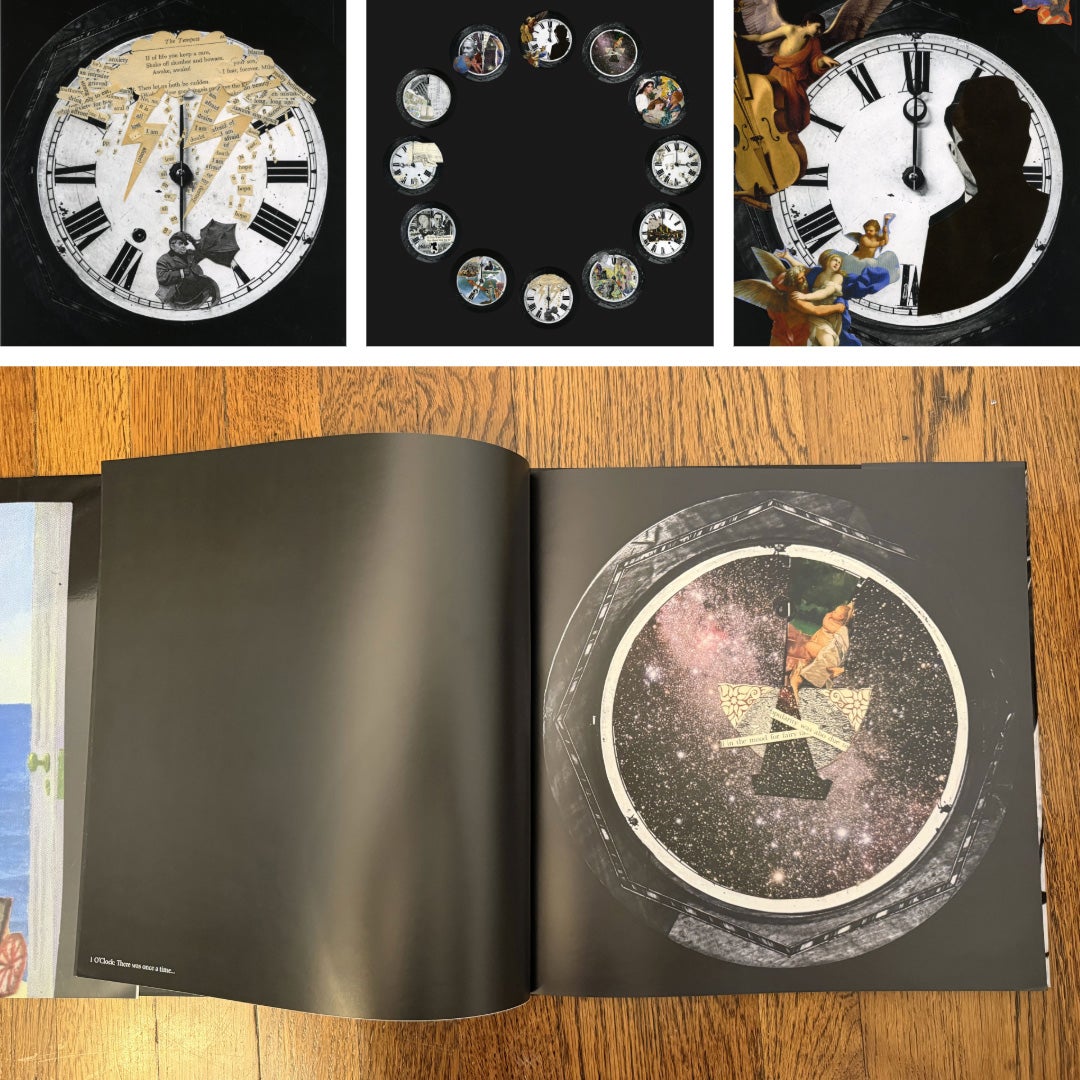
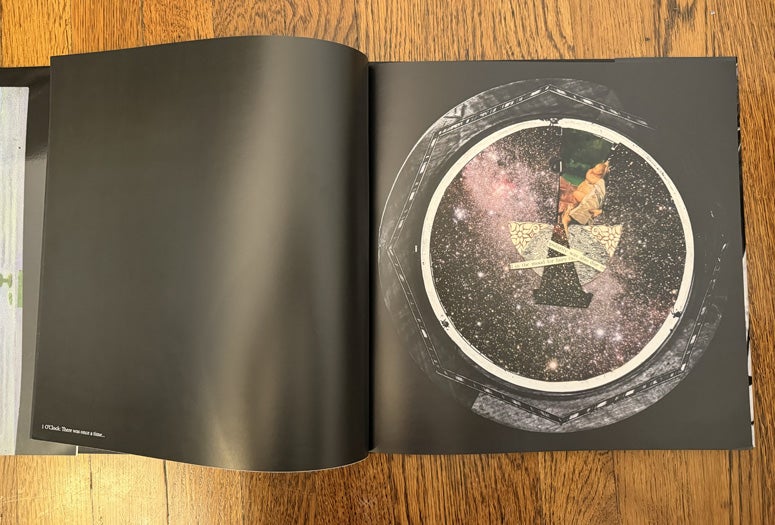
From those experiences, Lai began experimenting with form. She considered making a film. She considered creating something purely textual. Ultimately, she gravitated toward a tactile object: a handmade collage-style book that blends photographs, layered imagery and philosophical reflection.
“I felt like the best way to do it was through a more tactile, physical medium,” Lai said, noting that the book begins with an image of a clock face backed by material sourced from the Houston clock gallery. “It moves throughout all of time, but each time reflects a stage of life. It goes all the way to death.”
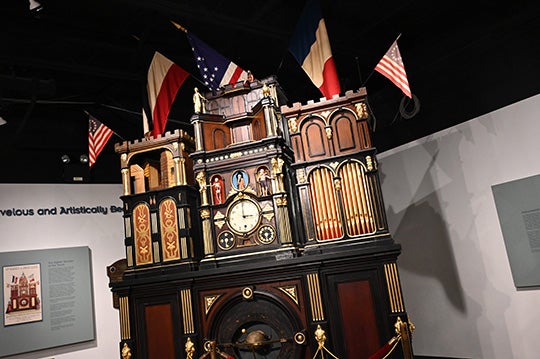
Her research also took her beyond Texas. Using Moody Fellowship funding, Lai traveled to the National Watch and Clock Museum in Columbia, Pennsylvania, where she encountered monumental historical clocks including one known as the “Eighth Wonder of the World.”
“It’s 11 feet tall and there are 48 moving figures,” Lai said. “It’s super cute but very impressive.”
Rather than treating these objects as curiosities, Lai treats them as philosophical artifacts.
“I really enjoyed being able to think about something that’s so big that it’s like the air we breathe,” she said. “We often don’t get the time to think about time.”
Lai does not describe the project in terms of conclusions or outcomes. Instead, she talks about it as an invitation to notice patterns that often go unquestioned, particularly the way modern life encourages constant motion without much reflection on direction. Her book weaves philosophical references together with voices gathered through interviews, a structure that allows abstraction and lived experience to sit side by side.
“Something I did with a lot of my interviews was asking people, ‘If time was a person, how would you describe them?’” Lai said. “Some people think of time as like Father Christmas. Some people see him as this cold, unfeeling man with a briefcase running 100 miles per hour.”
The questions did not remain theoretical for long. As the project developed, Lai found herself reexamining her own habits and expectations.
“I think it’s forced me to be more accountable to myself,” Lai said. “At Chappell Jordan Clock, they talked about how when you look at your grandfather clock, the act of looking at the time is like an experience of art. You pause. You look. You can see the passage of time, and it’s very beautiful.”
Alongside her time-focused project, she has conducted oral history-driven research on aging among Chinese Americans through a Fondren Fellowship, explored transportation and society through interviews with Uber drivers and worked with the Houston Asian American Archive on documentary and podcast projects.
“I’ve always been really passionate about taking a big abstract question, seeing it embodied in a certain way and having it be very accessible to people, so it’s not an ivory tower thing,” Lai said.
The Moody Fellowship provides both funding and community for that kind of exploratory, interdisciplinary work. Fellows receive a summer stipend to pursue self-designed research projects and participate in monthly gatherings with humanities faculty and guest speakers, remaining part of the cohort throughout their undergraduate careers.
For Lai, the fellowship has offered more than resources. It has offered permission to follow questions that do not arrive with clean disciplinary labels. Permission to let form evolve. Permission to sit with uncertainty.
“This project has just started my thoughts on this topic,” Lai said. “I’m sure they’ll change as I age, but I’m excited that this kind of opened the book.”
After all, the project isn’t really about clocks. It’s about learning how to notice and about what might happen if, every once in a while, we stopped long enough to look at time not as an enemy, not as a resource, but as something strange, human and worth contemplating.