
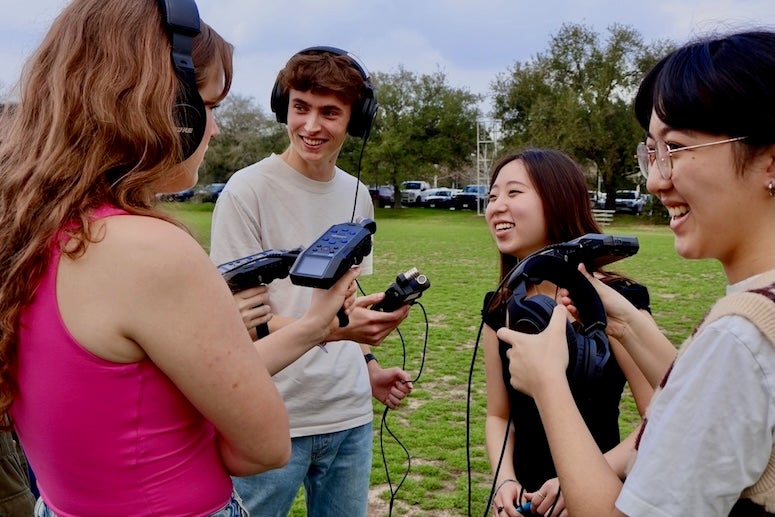
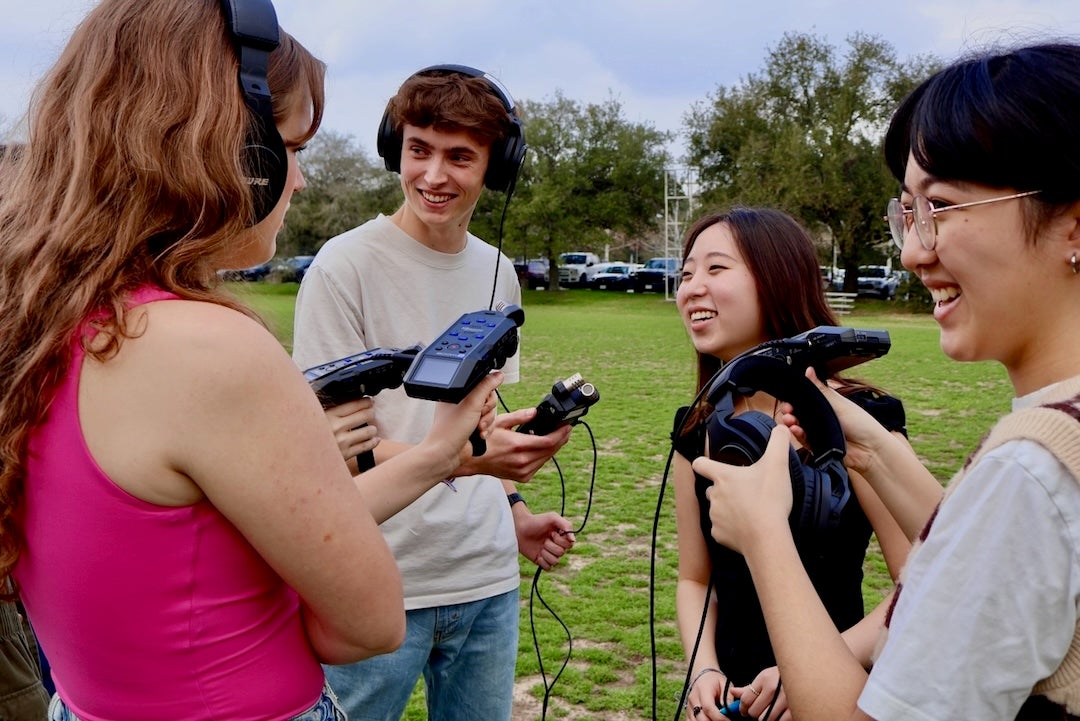
A new program at Rice University is giving students a front-row seat to the stories shaping Houston and putting them behind a microphone to tell them.
The Houston Newsroom, launched this spring through Rice’s Program in Media Studies, is an audio-first reporting course designed to mirror the rhythms and expectations of a professional newsroom. Students pitch stories, conduct interviews in the field and produce polished audio and web content for a public audience.
“Our identity is going to be as a working newsroom, and it is,” said Chris Evans, executive director of student media at Rice and the course’s instructor. “It’s not really covering Rice — it’s Houston. That’s the whole goal.”
Evans, who previously built a student newsroom embedded within an NPR affiliate at the University of Illinois Urbana-Champaign, said the idea for the course has been years in the making. In 2025, a year after he arrived at Rice, Evans even converted a former storage closet into a functioning podcast studio — a physical starting point for the broader vision of the Houston Newsroom.
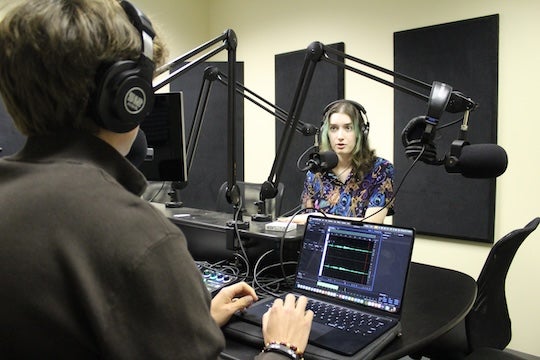
“My goal was always to do the kinds of things we’re doing with the Houston Newsroom right now,” he said. “We’re producing the kind of work you’d hear in news podcasts or on public radio.”
The work is inherently hands-on. Students are expected to leave campus, attend events, talk to strangers and report stories across Houston — from city council meetings to protests to neighborhood initiatives.
“One of the beautiful things about audio is that it requires students to get out and interact with people,” Evans said. “It’s not the kind of thing you can do just sitting at your computer. You have to engage.”
The audio reporting is structured around four standard storytelling formats:
- Cut copy: A news brief featuring audio complete with a professional script for a radio host to read.
- Wrap: A standard news story voiced by the student.
- Two-way: An in-depth interview with an expert in their field.
- Feature: A longer-form story with multiple interviews and ambient sound.
By the end of the semester, each student produces at least one of each format, gaining a portfolio of industry-relevant work.
For many of the nine students in the inaugural class, the experience is entirely new and has been quickly transformative. This is evident in students like senior anthropology major Paola Hoffman and sophomore political science major Mateo DeVries.
Hoffman’s interest in journalism started early. “When I was very little, I would go around with a notebook and interview people,” she said. After rediscovering that passion in an environmental journalism class, she knew she had to enroll in the Houston Newsroom.
“I saw that we had an audio newsroom, and I was like, no matter what I do next semester, I have to take this course,” Hoffman said.
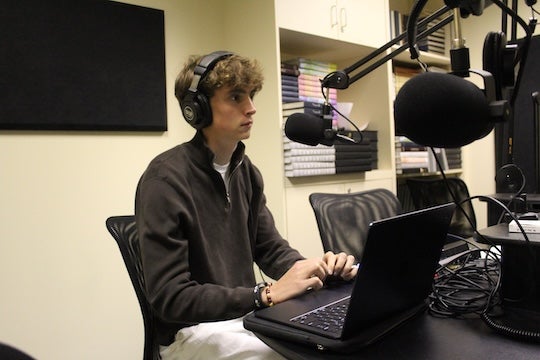
DeVries, on the other hand, had never delved into the journalism world before this semester, though he grew up hearing stories from his grandfather, a broadcast journalist. “I really love storytelling,” he said. “This seemed like a great opportunity to see if journalism was something I might want to pursue.”
Both say the course has given them access to experiences that would have felt out of reach before.
“When you’re a journalist, people take you seriously, and you get into so many places that never would have appeared otherwise,” Hoffman said.
Students work on individual beats, including politics, community response, neighborhoods and more, and are encouraged to pursue stories that focus on real people across Houston.
DeVries, who covers politics, is reporting on Texas’ 18th Congressional District with a focus on human impact. “Who are the people affected, and how do you tell that story?” he said.
Hoffman’s reporting focuses on community-driven efforts. “Nobody really has a better finger on the pulse of the city than the people standing up to do something,” she said.
The emphasis on audio storytelling adds another layer to that connection.
“Hearing someone’s voice carries something very human,” Hoffman said. “You hear the person who was impacted, not just read about them.”
For Evans, that intimacy is what makes audio effective and increasingly relevant.
“There’s no more intimate media than audio. It’s in your ear,” he said. “It’s the kind of thing you can listen to while driving or working out. It fits into people’s lives.”
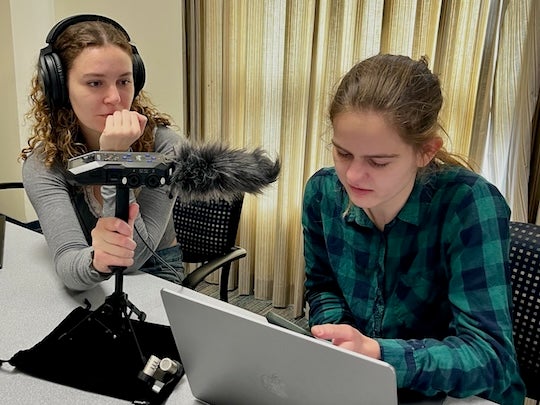
But producing that kind of storytelling requires students to step outside their comfort zones.
“It doesn’t come naturally,” DeVries said. “You have to walk up to someone and ask to talk. I was super uncomfortable at the start … but I’ve eased into it.”
Hoffman said each assignment has helped her push past social anxiety. “My first story … calling restaurant owners was terrifying,” she said. “Then I went to City Hall, then a protest … and I realized I’m allowed to belong somewhere because I’m doing this work.”
Evans said that kind of growth is one of the most rewarding parts of the course.
“They’re going places and doing things they didn’t think they were capable of before,” he said. “Going to political rallies, walking up to strangers — that’s not easy. But they develop that reporter persona.”
The course operates like a professional newsroom with regular meetings, pitches and editorial feedback. While Evans serves as the final check before publication, students are responsible for every step of the reporting process.
“I want to empower them to do everything on their own,” he said.
The Houston Newsroom is designed to continue beyond the classroom. As a hybrid model, students can keep producing stories even after the semester ends, building both experience and a body of published work.
About half of the inaugural class has already said they plan to continue.
“We are the inaugural group,” Hoffman said. “Watching the website get built out and seeing my stories up there has been really fulfilling.”
For DeVries, one of the biggest takeaways has been confidence.
“Being able to go into spaces where you’re not sure you belong and talk to people, that curiosity, I’ll carry that with me no matter what I do,” he said.
As the program grows, Evans said he hopes it will evolve into a self-sustaining, student-driven operation — a “living, breathing newsroom” that continues to expand its reach across Houston.