

We tend to think of memory as something stored away in the brain, ready to be retrieved when we need it. But remembering may be far more dynamic than that.
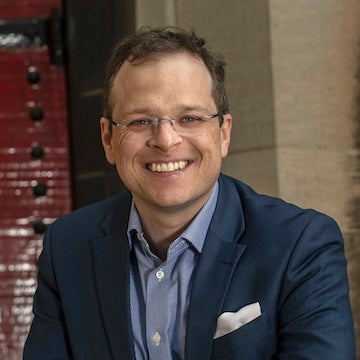
New research from Rice University’s Marc Coutanche suggests that each time we access information, the way we recall it can influence how the brain represents it the next time.
“Our memory is far from simply a fixed resource that we consult as needed,” Coutanche said. “It’s dynamic and adaptive. Memory retrieval actively updates our memories rather than just ‘playing them back.’”
Coutanche, who recently joined Rice as an associate professor of psychological sciences, and fourth-year doctoral student Amy Qi explored whether the way people access information leaves a trace that can be detected the next time they retrieve it. Their findings were published in the Journal of Cognitive Neuroscience.
Think about remembering your dog. You might focus on a specific detail, such as the pattern of its fur. Another time, you might simply think of it as a dog. Or you might think about its larger role as part of your family. Coutanche and Qi wanted to know whether those different ways of accessing information could affect what happens in the brain later.
To find out, participants learned pairs of images and unfamiliar Dutch words while undergoing functional magnetic resonance imaging, or fMRI. Researchers later prompted them to recall the objects in different ways, focusing on a specific feature, a broader category or a theme.
When participants were tested again, they were about equally good at remembering the information regardless of how they had previously thought about it.
But their brain activity told a different story.
“What I find most interesting is that we showed that a memory seems to carry a trace of how it was used before,” Qi said. “The neural activity related to the memory not only reflected what participants were doing in the moment but also something about how that memory had been accessed before.”
The researchers found that thinking about objects by category made neural patterns associated with different objects look more alike in areas involved in visual processing. Focusing on an individual object, meanwhile, made its neural pattern more distinct in an area involved in processing words.
The findings add to a growing understanding of memory as something that can change as we use it rather than a fixed record that is simply stored and replayed.

The study also demonstrates how computational tools can reveal aspects of memory that behavior alone may not show.
Coutanche and Qi combined fMRI with machine learning techniques to look for subtle patterns in brain activity. Those methods allowed them to detect how information had previously been accessed in areas including the hippocampus and visual cortex, even though participants performed similarly on the memory tests.
“Without looking at the subtle patterns of activity with techniques like this, we might have missed the findings entirely,” Coutanche said. “Computational methods like this allow us to detect and understand subtle patterns of activity in a way that gives real insights into how the brain remembers.”
That combination of psychology, brain imaging and computational science is central to the research Coutanche is bringing to Rice. His lab studies how experiences become lasting, interconnected knowledge, including how memories form, change over time and are eventually retrieved and used.
It’s also an approach Coutanche sees fitting naturally into Rice’s growing strengths in computational neuroscience.
“Rice is the perfect environment for this type of research,” Coutanche said. “The Rice Brain Institute helps enable cross talk between theoretical computational neuroscientists, bioengineers and empirical researchers.”
Rice’s expertise in data science, artificial intelligence and high-performance computing creates additional opportunities for collaboration across campus, including through the Ken Kennedy Institute. Coutanche sees possibilities ranging from comparing how artificial neural networks and human brains learn and store information to connecting his human brain imaging research with scientists studying memory from different perspectives.
For Coutanche, those connections offer an opportunity to bring different disciplines and approaches together to better understand not only how memories are formed but how they continue to change each time we bring them back to mind.