

As the nation marks the Juneteenth celebration June 19, new research from a Rice University historian argues that Houston, not Galveston, was the site of the holiday’s earliest known public observance.
In an article appearing in the next issue of the Journal of Texas History, Caleb McDaniel, the Mary Gibbs Jones Professor of Humanities and a Pulitzer Prize-winning historian, traces the holiday’s origins to a June 19, 1866, procession through Houston led by two Black ministers.
Details about the inaugural event were found in a rare newspaper, the Houston Evening Star, that history had largely forgotten. McDaniel identifies the march as the first recorded public observance of the anniversary that would eventually become a federal holiday in 2021.
McDaniel’s research documents that several thousand Black Texans gathered that morning at a newly built Black Methodist church in Houston’s Fourth Ward, paraded through the center of town and assembled at a grove on the city’s outskirts for speeches, music and a meal to celebrate the end of slavery.
The event marked one year since U.S. Maj. Gen. Gordon Granger issued his famous emancipation order in nearby Galveston. While Black communities had previously celebrated freedom on other dates, including in Galveston Jan. 1, 1866, Houstonians were the first to mark June 19 as an anniversary, according to McDaniel.
“Uncovering new things about the origins of this holiday is as important as if we were to learn something new about the earliest celebrations of Independence Day,” McDaniel said. “Juneteenth is our newest federal holiday, but it is as important in understanding the meaning and history of our country as the Fourth of July.”
Reconstruction, McDaniel added, deserves recognition as America’s “second founding.”
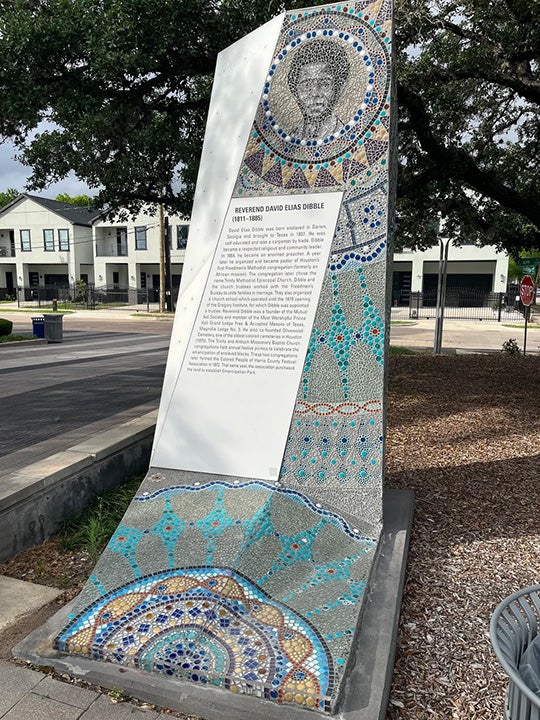
At the head of the June 19, 1866, procession rode two ministers: Elias Dibble, a Methodist leader who had been born enslaved and went on to become one of the founders of Houston’s Emancipation Park, and Sandy Parker, a Baptist minister who later served as a city alderman. McDaniel’s article is the first to spotlight their roles as leaders of that inaugural celebration.
The celebration reflected more than the arrival of a date on the calendar. Houston’s Black congregations had spent the year since emancipation breaking away from the biracial, segregated churches established under slavery and building institutions of their own.

Just weeks before June 19, Dibble’s congregation had completed the hard-won task of relocating its wooden church building to a city block owned by its members, a significant exercise of newly enforceable property rights.
“In many ways, the first Juneteenth celebrations in Houston commemorated freedom not only from slavery but also from proslavery churches,” McDaniel said.
The timing of the first celebration was no accident and anything but safe. On June 14 just five days before, white Houstonians staged a pro-Confederate firemen’s parade through the same streets, complete with cheers for Jefferson Davis and a float mourning the “dead nation.” A statewide election over the terms of Reconstruction was set for June 25.
Against that backdrop, the Black Houstonians who took to the streets June 19 carried American flags and marched in direct contrast to the Confederate display of days before. McDaniel described the event as an act of political assertion: Black Texans “voted with their feet in favor of federal power, boldly asserting their understandings of what freedom and equality entailed.”
The crowd of 3,000 to 4,000 people included visitors from Galveston and surrounding counties, ultimately exceeding Houston’s entire Black population at the time. The Tri-Weekly Telegraph later confirmed the celebration had been organized entirely by Black Houstonians.
McDaniel traces his interest in this period to a broader wave of scholarship about Black Houston at Rice in recent years, including projects such as the Red Book of Houston initiative at Fondren Library, collaborations with organizations like the Descendants of Olivewood and research tied to Rice’s Task Force on Slavery, Segregation and Racial Injustice.
“All of this exciting work at Rice convinced me that even with all that is known about Houston’s history, there is much, much more to learn,” McDaniel said. “Sometimes you just have to look a little closer.”
McDaniel’s article “The First Juneteenth: Black Churches, Reconstruction Politics and the Houston Origins of June 19 Celebrations” will appear in the next issue of the Journal of Texas History.