
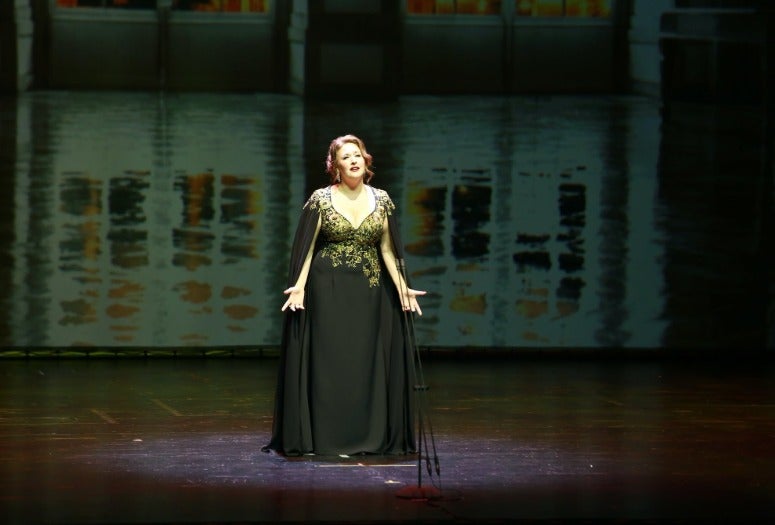
When Tessa McQueen ’24 walked onstage for the final round of Operalia in Shanghai, she carried something no one in the audience could see. Tucked into her hair were the earrings her teacher Nova Thomas wore when she sang the title role in Puccini’s “Tosca.” McQueen was about to sing an aria from the same opera.
“‘Tosca’ was very important in my own career, and passing on something that had meant so much to me was such a cathartic experience,” said Thomas, a professor of voice at Rice University’s Shepherd School of Music.
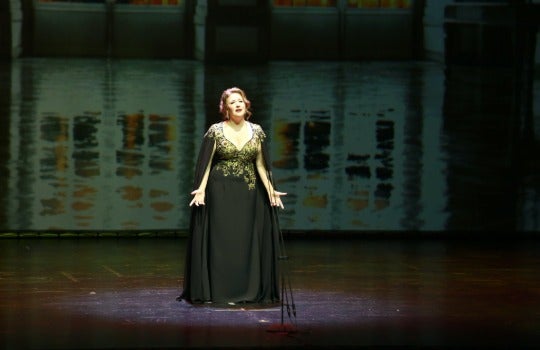
McQueen left the Nov. 1 final with second prize ($20,000) at Operalia, the World Opera Competition founded by Plácido Domingo, and with the Birgit Nilsson Prize ($15,000) for singers of Wagner and Strauss. With this achievement, McQueen joins the ranks of previous Shepherd School Operalia winners, including Nicholas Brownlee, Brenton Ryan ’11 and Luke Sutliff ’21 as well as professor of voice Ana María Martínez.
A recorded audition earned her a trip to Shanghai, where she competed in three live rounds. She said she opened her quarterfinal with Elisabeth’s “Dich, teure Halle” from Wagner’s “Tannhäuser” to be considered for the Nilsson Prize, and the judges followed by asking for “Vissi d’arte” from “Tosca,” the aria she would return to in the final.
Competitors bring four arias, and judges choose what they hear in each round. McQueen had planned on including Tatiana’s Letter Scene from Tchaikovsky’s “Eugene Onegin” but swapped it late for “Ain’t It a Pretty Night” from “Susannah” by longtime Houston composer Carlisle Floyd. McQueen said she never expected the judges to request it. For the semifinal, they did.
“If I relate to any opera character, it’s ‘Susannah.’ I always introduce myself by singing her aria at the start of a program,” McQueen said. “Bringing that small-town mountain girl to a global competition in China and representing Houston and Carlisle Floyd was a gift. To do it all with Nino Sanikidze as my musical partner brought me so much joy. That aria has been with me since I was 22, so carrying it there felt very full circle.”
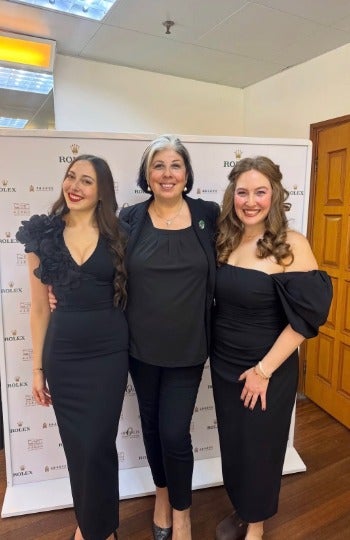
Floyd, who co-founded the Houston Grand Opera Studio, would have turned 100 in June. HGO marked the centennial by opening its season with a new staging of “Susannah,” conducted by music director designate James Gaffigan ’03 with Aaron Blake ’08 as Little Bat McClean.
“Most agents and mentors advise against taking an American work to a competition because the belief is that European judges won’t embrace it,” Thomas said. “I told Tessa, ‘Trust your instincts and trust the love you have for this piece.’ She chose not to be strategic but to be instinctive.”
McQueen’s instincts had pointed her toward Thomas years earlier.
“I didn’t get in the first year I applied to the master’s program at the Shepherd School,” McQueen said. “I was waitlisted and I was heartbroken, but I really felt Nova was who I wanted to study with, so I turned down offers from other schools and decided to wait and try again. That was a big chance to take.”
Convinced her voice would never translate over video, McQueen flew to Houston for a lesson with Thomas, and Rice admitted her on her second try.
“The first thing that struck me was her sound, a very unique, Old World sound,” Thomas said. “My job became equipping that sound with the technical tools that would give her access to her own imagination. Those skills are only as good as a student’s imagination for how sound communicates meaning, and Tessa’s imagination is enormous.”
McQueen’s final year at Rice coincided with the arrival of Joshua Winograde, who left LA Opera in 2023 to direct the Shepherd School’s opera studies program.
“When Josh came, that was one of the best things Rice could have done for the program,” McQueen said. “He made it a top-tier young artist program.”
After graduating with her master’s degree, McQueen went straight into the Metropolitan Opera’s Lindemann Young Artist Development Program, where Thomas is also a teaching artist, so their lessons never paused. She made her Met debut as Countess Ceprano in “Rigoletto.” This year, she won first prizes at the Jensen Foundation and Cooper-Bing competitions and placed second at the Butler Opera International Competition. She will make her European debut in Wagner’s “Die Walküre” at the Salzburg Easter Festival this spring.
“The Shepherd School is more than a collection of classrooms,” Winograde said. “It’s a place where talent is explored and grown and where relationships are nurtured and strengthened. Tessa shows our current students exactly where this path can lead.”
Before the Butler competition this fall, McQueen returned to campus for the first time since graduating to work with Thomas again.
“When I went back to talk with the students, I thought, ‘I was you and I am you. We’re all in this together,’” McQueen said. “It’s such a special thing to return to a place that gave me so much and still feel right at home.”