
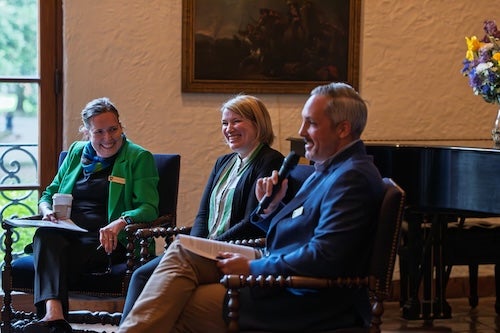
In a city as diverse as Houston, how are religious communities working together? The team at Rice University’s Boniuk Institute for the Study and Advancement of Religious Tolerance spent the last two years on a “listening research tour” conducting in-depth interviews and focus groups with religious and community leaders from every corner of the city to learn more about the barriers to religious cohesion.
Houston is home to some of the largest Christian megachurches in the world, but also to mosques, temples, synagogues and gurdwaras. Like most large cities with a diverse immigrant population, religious communities are highly influential in how they provide social services and crisis relief to their congregations — the “invisible safety net,” said Elaine Howard Ecklund, director of the Boniuk Institute and the Herbert S. Autrey Chair in Social Sciences.
“When we look at the landscape of American religious life, we find that religion is really interwoven into the social safety net — from things like education to food security to disaster relief. They provide the critical services that many people rely on every day,” Ecklund said. “Nearly half of all U.S. adults attend religious services at least monthly. But there is another side as well. There’s also a decline in public trust, broadly in the United States but specifically in the belief that religious leaders can actually cooperate. So the general public is uncertain as to whether or not this can all work out, that we can really join together for the public good. This gap in confidence is a serious hurdle for issues like disaster response or addressing poverty, which really no single group can solve alone.”
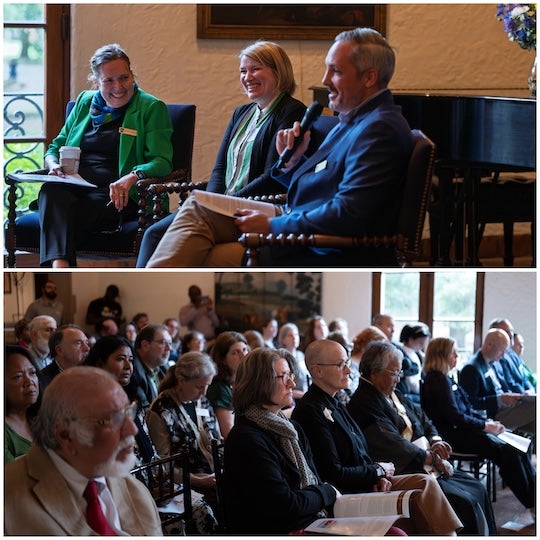
More than 70 congregations were studied, and the data was compared against Houston population data in partnership with Rice’s Kinder Institute for Urban Research. The project was guided by an advisory board of distinguished Houston leaders from many faiths such as Islam, Buddhism, Judaism, Hinduism, and Christianity, as well as civic and philanthropic institutions such as IM Houston and Bridges..
“We sought to understand not just what leaders do but why and how they think about collaboration,” Ecklund said. “Houston is a very special city. We don’t need to look far for examples of inspiration or collaboration across religious lines. There’s a 50-year partnership of what many have called the ‘Three Amigos:’ the late Rabbi Samuel Karff (Congregation Beth Israel), Rev. William Lawson (Wheeler Avenue Baptist Church) and Archbishop Joseph Fiorenza (Roman Catholic Archdiocese Galveston-Houston), who showed us that a Baptist, a Catholic and a Jewish leader can unite for the common good without losing their unique identities. In this study, we explored how that legacy lives on today, talking directly to leaders about the barriers they face and the breakthroughs they see on the horizon.”
The key findings show that Houston religious leaders see religious diversity as a strength and asset; interfaith leadership and collaboration emerge around shared concerns or crises; there are time and resource challenges to interfaith collaboration; and that these religious leaders engage via both formal and informal channels.
Practical steps from the data analysis include expanding neighborhood-anchored collaborations and ministerial alliances, seeking out “bridge builders” to develop wider collaboration and working to bridge Hindu, Sikh, Buddhist and other communities from Asian religious groups with Christian, Jewish and Muslim hubs.
“The greatest barrier from our interviews was time, and it’s tempting to focus first on reducing religious or political differences, but perhaps addressing time and resource constraints and bringing leaders together to address a shared problem may pave the way for other bridges to be built,” said Kerby Goff, associate director of research at the Boniuk Institute.
The Houston Religious Leadership Project team is still analyzing the data and will continue to look deeper into microlevel trends for patterns around the city’s regions, religious traditions, partnerships and more.
The data presentation was the final RPLC Religious and Civic Leader Gathering for the 2025-26 academic year, and the series will begin again in the fall with new programming. It includes carefully curated events that bring together local leaders with academic and industry experts to discuss the most pressing issues facing communities in Houston. The group spans all faith traditions and is designed to build a well-informed network of leaders who make Houston a more vibrant city. Past conversations can be viewed on the institute’s YouTube channel.
The research for this convening was funded by the Arthur Vining Davis Foundations, Ecklund, Elaine Howard, PI, (Kerby Goff, co-PI, Rachel Schneider, co-PI), “Revitalizing Interfaith Leadership in Houston & Beyond,” Grant #R-2308-24271.