
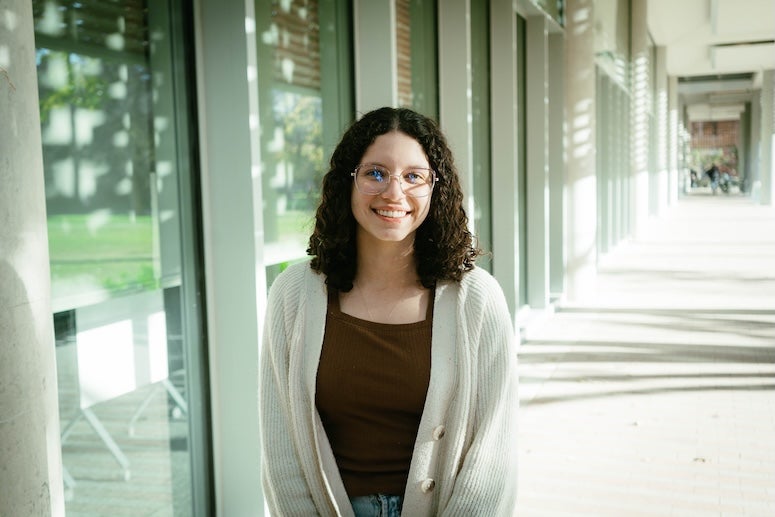
When Sofia Urbina was growing up in Honduras, engineering wasn’t part of the conversation.
“When I was in high school, I had no idea what engineering actually was,” said Urbina, who is now a graduate student at Rice University. “I knew it was a possibility as a career, but I had never considered it.”
What she did know was medicine.
Her family worked throughout the health care system, and as a child, Urbina often accompanied them at work, absorbing the rhythms of hospitals and patient care long before she understood the science behind it.
“I grew up really close to the medical field,” she said. “Going to the hospital with them and seeing how everything worked — that stayed with me.”
Urbina was also an athlete, first competing in gymnastics and later in track and field, experiences that brought her into contact with rehabilitation medicine through injuries and recoveries.
However, an unexpected family challenge became a definitive turning point in her life.
“My mom had a medical issue that caused her to lose most of her hearing,” Urbina said. “The health care system in Honduras made it difficult for her to get a hearing aid, and I watched firsthand the difficulties she faced while adjusting to life with an invisible disability.”
As everyday environments grew overwhelming for her mother, Urbina began to understand how a loss like hers can quietly sever a person’s connection to the world they’ve always known.
That experience — watching a capable, professional woman struggle to navigate daily life because of limited access to medical technology — changed Urbina’s future.
“That’s when I started thinking about the engineering side of things,” she said.
Biomedical engineering felt like the answer: a field that bridged the health care world Urbina grew up in with the math and physics classes she loved.
At the time, however, it wasn’t a degree offered in Honduras. So Urbina set her sights abroad, searching for U.S. universities that offered biomedical degrees and combing through more than 100 programs online. One by one, she evaluated programs and navigated scholarships and tuition. After narrowing the list and applying to five schools, she landed a scholarship to Louisiana Tech University.
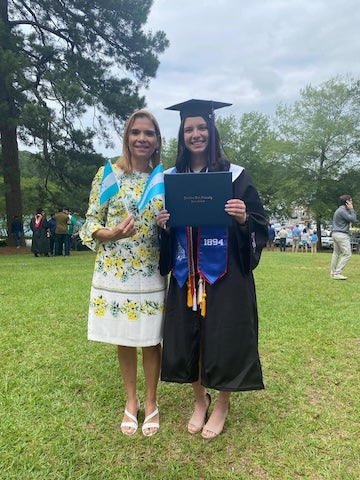
At Louisiana Tech, Urbina thrived academically, but she was still searching for how she could make the greatest impact. Her goal was clear: give back to Honduras through health care engineering. The path, however, was not nearly as apparent.
Then, the COVID-19 pandemic hit during her freshman year. Overnight, internship opportunities vanished, but a fellow student suggested Urbina apply for a National Science Foundation Research Experience for Undergraduates (REU) that summer instead. She landed at Cleveland State University, studying how a multijoint arm support affected and limited arm motion. It was the first time she did research like that — applying engineering to a real-world challenge — and she says she was hooked.
When she returned to Louisiana Tech in the fall, she joined a biomaterials lab as a research assistant, a shift that expanded her technical tool kit while keeping her focus on health care.
Her next REU brought her to Rice and the lab of mechanical engineer Daniel J. Preston.
“I didn’t know what project I would work on until I arrived,” Urbina said. “But the research combined soft materials and biomedical engineering for a rehabilitation device, so it was really exciting to merge the two research areas I had previously worked on.”
When it came time to apply to doctoral programs, coming back to Preston’s lab at Rice felt like a full circle moment. Now in her third year in the program, Urbina leads two complementary research efforts, both focused on making rehabilitation more wearable, accessible and patient-centered.
One project develops garments that use functional electrical stimulation (FES) to help people with spinal cord injuries activate muscles and prevent atrophy.
“FES applies a small electrical impulse to create a muscle contraction,” Urbina explained, noting that the challenge is precision. “Finding the right electrode placement is difficult. Our goal is to automatically identify the optimal locations to enable caretakers to administer FES in home settings.”
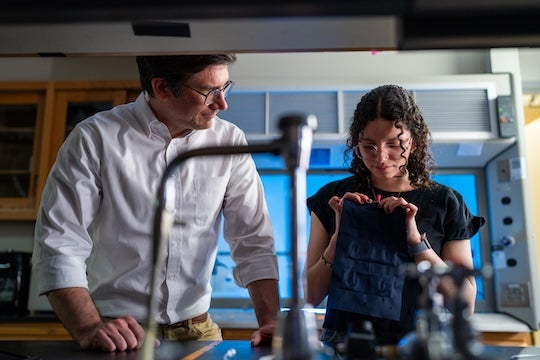
Her second project tackles a different limitation in soft robotics: control.
“Soft robots typically rely on bulky electronic controllers to manage pressurized air,” she said. “We’re working on embedding logic and control functions into soft robots, making systems lighter and more wearable.”
Together, the research points toward a single vision.
“Fully wearable rehabilitation devices,” Urbina said. “That’s the goal.”
Alongside her research, Urbina has become deeply invested in mentorship and community building — work shaped by her own experiences as a Latina woman in engineering.
“In my first engineering class at Louisiana Tech, there were only three girls,” she said. “And I was one of them.”
She found community through the Society of Women Engineers, eventually serving as president and leading mentorship programs for first-year students and outreach events for local high school girls. Additionally, she further found community in the Society of Hispanic Professional Engineers.
“In high school, I never took an engineering class,” she said. “Showing girls that this is a career path is important to me.”
Finding spaces where she could remain fully herself, Urbina said, has been essential. At Rice, she continues that work through mentoring, outreach and the Graduate and Postdoctoral Studies’ Graduate Student Ambassadors Program, guiding prospective students through the graduate school process.
As she continues her time at Rice, Urbina is clear about her goals: advancing wearable rehabilitation technologies and ensuring they reach communities like those in Honduras. Rooted in family, shaped by inequity and driven by care, Urbina is expanding who gets to imagine themselves as an engineer and what engineering can do.