
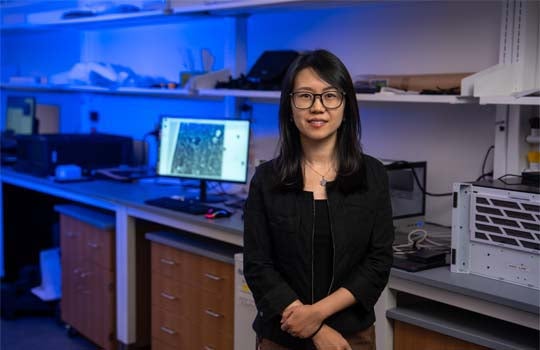
Some of the biggest tech breakthroughs happen at a scale too small to see, and Rice University’s Yimo Han has caught the attention of the U.S. Air Force for her work in the microscopic world of ferroelectrics.
Han, an assistant professor in Rice’s Department of Materials Science and NanoEngineering (MSNE), has received a 2026 Young Investigator Program award from the Air Force Office of Scientific Research. The funding enables her lab to study materials at the atomic level, laying the foundation for next-generation device design and material manipulation.
The award provides $450,000 in research funding over three years. Out of more than 150 applicants nationwide, the Air Force selected Han as one of 67 early-career researchers to receive the honor.
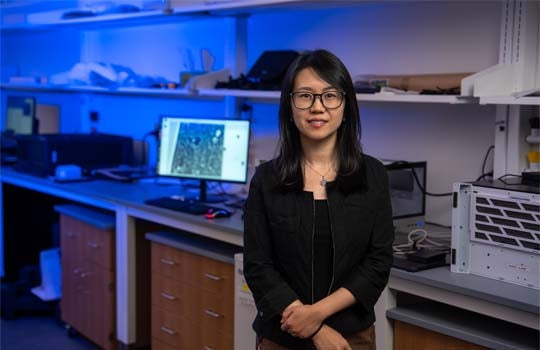
“This was my last year of eligibility to receive the award,” Han said. “This project really builds on several students’ prior work, which started as exploratory. The recognition really helps to pay back the effort that was put in.”
Han’s project, “Engineer Switching Pathways of van der Waals Ferroelectrics for High Frequency Applications,” advances basic research within the Air Force’s gigahertz-to-terahertz electronics portfolio, which focuses on developing ultrahigh-speed electronic systems.
“We’re very honored to have been selected,” Han said. “This award recognizes that this is a very important direction to pursue.”
The project studies van der Waals ferroelectrics, materials made of thin sheets held together by weak forces with strong bonds within each sheet. In these materials, positive and negative charges are slightly offset, creating a built-in electrical orientation. An electric field can flip this orientation, and the material can retain it after the field is removed.
These properties make materials promising candidates for low-power electronics and nonvolatile memory with potential for high-speed switching depending on material and device design.
“This research can help broaden the scope of materials science here at Rice and contribute to the overall goal of MSNE,” Han said. “This award is confirmation that our method of studying materials, especially at the atomic scale, warrants further investigation.”
Han’s team is mapping how individual atoms shift during these changes. This work lays the essential foundation for designing next-generation technology.
The findings could help improve low-power microelectronics, memory storage, brain-inspired computing and high-frequency communication systems.
“Rice is well known for its tradition of studying two-dimensional and ferroelectric materials, and this helps elevate the work being done along with bringing on new faculty,” Han said. “The new methods we’ve developed are useful for both the two-dimensional material sciences and ferroelectric oxide communities.”
The initiative focuses purely on basic materials physics. It does not involve manufacturing commercial devices, building microchips or producing military hardware.
Instead, Han’s work establishes the fundamental physics required before engineers can build practical applications.
Han noted that the material’s ability to switch internal charges could solve one of modern electronics’ biggest problems: excess heat.
“Right now, running constant electric current generates heat — that’s why your phone or GPU heats up,” Han said. “Implementing ferroelectric materials to control these devices could reduce overall power usage while supporting other applications.”
The award recognition underlines Rice’s growing prominence in two-dimensional materials research. For Han, the three-year grant provides both financial support and national recognition, helping her lab lay the scientific groundwork for future breakthroughs in microelectronics and communication systems.