

As children across the Houston area head back to school, a new Rice University study shines a spotlight on a widespread challenge, finding that half of Harris County households with children struggle to reliably access enough nutritious food.
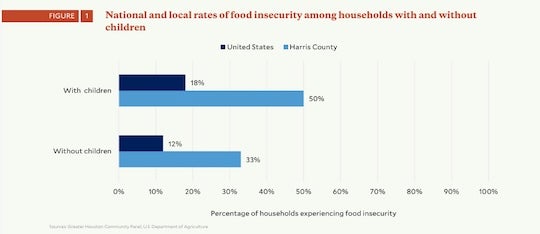
In Harris County, 50% of households with children reported food insecurity, compared with 33% of households without children.
“Imagine sitting down to a meal and having to think about whether there is enough food for everyone at the table. For households with children where there are more mouths to feed, that kind of uncertainty can become part of everyday life,” said Hannah Ballard, associate director of community and public health at Rice’s Kinder Institute for Urban Research.
The financial strain can extend well beyond the grocery bill.
“We’re seeing that income alone isn’t enough to put adequate, nutritious food on the table, especially for households with children,” Ballard said. “Because their paychecks are stretched farther, families may be making difficult trade-offs to meet basic needs.”
Researchers with the Kinder Institute’s Center for Community and Public Health analyzed responses from more than 5,200 Harris County residents who participated in the spring 2024 Greater Houston Community Panel. The study examined how food insecurity varies by household structure, income and neighborhood.
The data show that some families face even greater challenges depending on their household makeup. Nearly 2 in 3 households with three or more children, or 62%, reported food insecurity, compared with 49% of households with two children and 44% of those with one child. Single-adult households with children also reported higher estimates, 59% compared with 48% among multiple-adult households.
Income was another factor. Among households earning less than $35,000 annually, 68% of those with children experienced food insecurity. But the problem was not limited to the lowest-income households — 14% of households with children earning $100,000 or more also reported food insecurity.
The findings also point to broader financial pressures facing families. Among households with two adults and two school-age children, 59% reported annual incomes below $75,000, roughly the amount United Way estimates is needed to cover basic living expenses for that family type in Harris County.
In addition, food insecurity varies considerably by neighborhood. In five of the 15 Harris County areas with the highest concentrations of households with children, more than half of households experienced food insecurity. Greenspoint and IAH had the highest estimate at 80%, followed by Pasadena and Hobby at 58%, Greater Spring and Aldine West at 57%, Northside and Eastex at 53% and Aldine Northwest and Cypress Creek at 52%.

As students return to classrooms, researchers also emphasize the importance of ensuring children have consistent access to nutritious food throughout the year, including through school meal and summer nutrition programs.
“One of the biggest takeaways is that addressing food insecurity requires looking beyond food itself,” Ballard said. “We need to understand the barriers that make it hard for households with children to get the food they need and bring the right people and resources together to address them. Community organizations can help identify gaps and connect people to resources, while policymakers can help strengthen the systems that shape food access. By working together and using data to guide our efforts, we can move from understanding the problem to taking action.”
The study, “Food Insecurity Among Households With Children in Harris County,” was authored by Sejal Mistry-Patel, Ballard, Anna G. DeLisi, Karen P. Goolsby, Daniel Potter, Bret Sinclair, Anjelica Martinez, Katherine L. Perez, Toral Shah and Luz M. Garcini.