
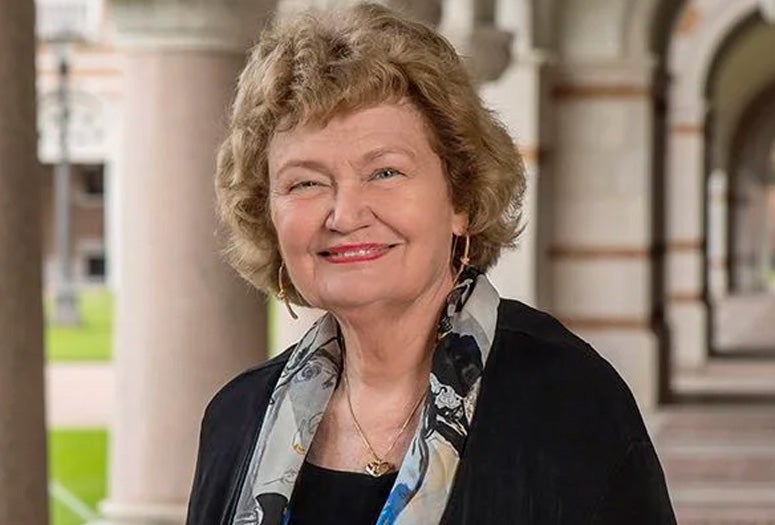
Deborah Nelson-Campbell spent her scholarly life amplifying silenced medieval women while also being a formative, present voice for her own students. She joined Rice University’s faculty in July 1974 and retired with the title of professor emerita of French studies in December 2023, leaving behind a career that spanned scholarship, teaching and institutional leadership across nearly 50 years. Nelson-Campbell passed away in her sleep April 12.
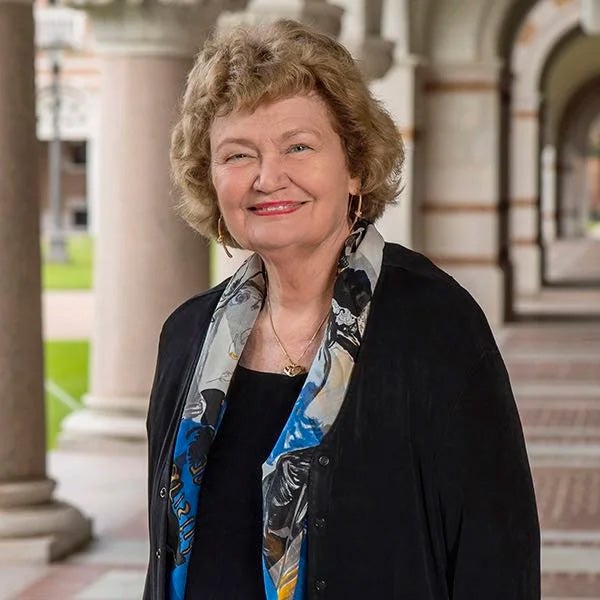
“Deborah Nelson-Campbell exemplified what it means to be a faculty member at Rice,” said Kathleen Canning, dean of the School of Humanities and Arts and the Andrew W. Mellon Professor of History. “Her contributions to this university extended far beyond the classroom and far beyond her department.”
“Above all, she will be remembered for her generosity, her intellectual rigor and her quiet but profound commitment to her students and colleagues,” said Jacqueline Couti, the Laurence H. Favrot Professor of French Studies and chair of the Department of Modern and Classical Languages, Literatures and Cultures.
Nelson-Campbell was a scholar of medieval and Renaissance French literature with expertise spanning the 12th through 15th centuries. An accomplished translator and editor, she produced critical editions of the 13th-century poets Adam de la Halle and Andrieu Contredit d’Arras, an English translation of historian Franck Collard’s study of medieval poisoning and an analytical bibliography of Charles d’Orléans. Her research trained sustained attention on women’s roles in Old French literature and the cultural significance of courtly love, a thread she followed from her earliest publications through her final years of work.
“Professor Nelson-Campbell passionately dedicated the five decades of her Rice career to the indefatigable development and continued support of essential aspects of our undergraduate program, an extraordinary achievement in itself,” said Bernard Aresu, the Laurence H. Favrot Professor Emeritus of French Studies.
That dedication earned formal recognition. Nelson-Campbell received both the George R. Brown Award for Superior Teaching and the Phi Beta Kappa Teaching Award during her career. She also organized student trips to France over many years, extending the classroom across the Atlantic.
Philip Wood, associate professor of French studies, said he would remember her for “her love for her domain of specialization: all things medieval.”
“Debbie was both generous colleague and skilled administrator, but there was nothing she cared about more than her students,” said Julie Fette, associate professor of French studies. “Teaching and mentoring young people absolutely invigorated Debbie, and she couldn’t wait to get back into the classroom after every summer. Her Rayzor Hall office door was always open, literally and figuratively, not to mention how plastered it was with quirky postcards, quotes and travel photos, all promoting French studies. Alongside their study of key medieval texts and pilgrimage treks across Europe, generations of students graduated Rice with meaningful life lessons from Debbie.”
That gift for human connection extended well beyond the faculty. Leticia Gonzales, who served as department administrator and worked alongside Nelson-Campbell for more than two decades, said their relationship grew into a deep personal friendship.
“Debbie had this incredible way of connecting with people,” Gonzales said. “She inspired curiosity, nurtured confidence and created a space where learning felt meaningful and personal. What I will always hold closest, though, is the way she showed up for me personally. During some of my roughest times, Debbie met me with compassion and understanding. She didn’t try to fix everything — she simply cared, and that meant more than I can say.”
Beyond the classroom, Nelson-Campbell took on the department’s most demanding administrative work. She served as chair of the Department of French and Italian from 1983-89, then chair of the Department of French Studies from 1990-93. Nelson-Campbell later served as director of what is now the Center for Languages and Intercultural Communication. In 1991, she was named co-director of Rice’s Affirmative Action Office, where she co-organized a symposium on sexual harassment and led efforts to bring campus facilities into compliance with the Americans with Disabilities Act.
“Her connection to the Rice community was a central pillar in her life,” said her daughter Holly Nelson Havlick ’91, who attended Rice as an undergraduate as did her sister Alissa Nelson ’88. “She was nourished by the energy, curiosity and promise of the students around her, and she found great joy in being part of a place that celebrated inquisitive minds and lifelong learning.”
In 1987, the French Republic named Nelson-Campbell Chevalier dans Ordre des Palmes Académiques, one of France’s oldest civil honors, originally established in 1808. She also served as a consultant for National Geographic magazine on translations from Old and Modern Occitan.
“It is through her teaching and the lives she shaped that her legacy will endure,” Couti said.