
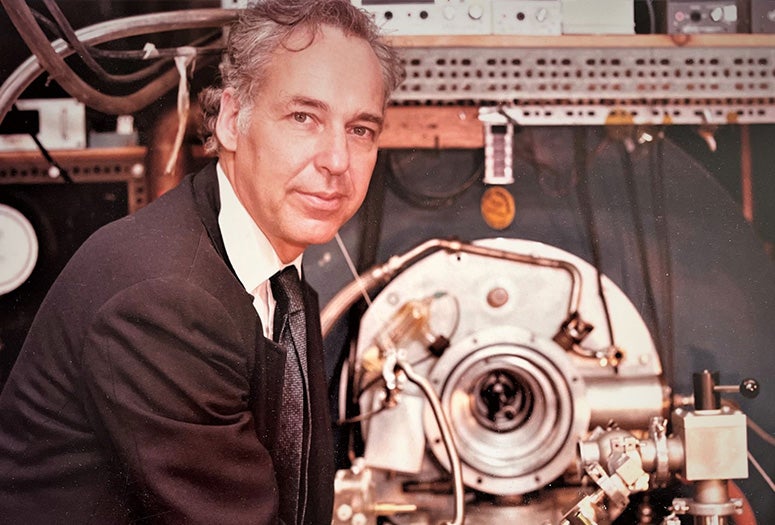
Frank Klaus Tittel, a physicist whose career paralleled the rise of modern laser technology and who helped build Rice University’s reputation in laser spectroscopy and trace-gas sensing over nearly six decades, died Feb. 17. He was 92.
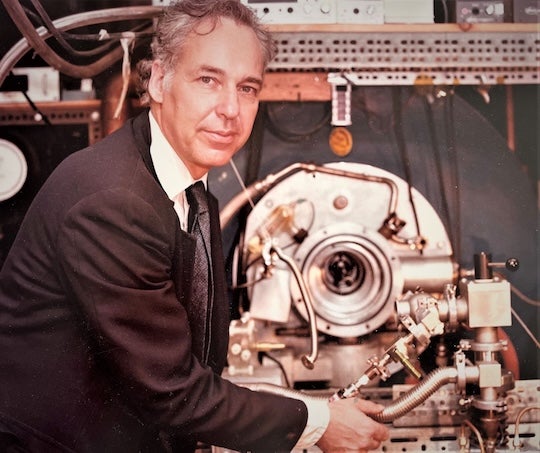
Tittel joined Rice in 1967 as an associate professor of electrical and computer engineering, following research posts at the General Electric Research and Development Center in Schenectady, New York, and the American University in Cairo. He was promoted to professor in 1973 and named the J.S. Abercrombie Professor of Electrical and Computer Engineering in 1989. He later served as department chair from 1992-95 and led the Rice Quantum Institute ⎯ which became the Smalley-Curl Institute in 2015 ⎯ from 1996-2000.
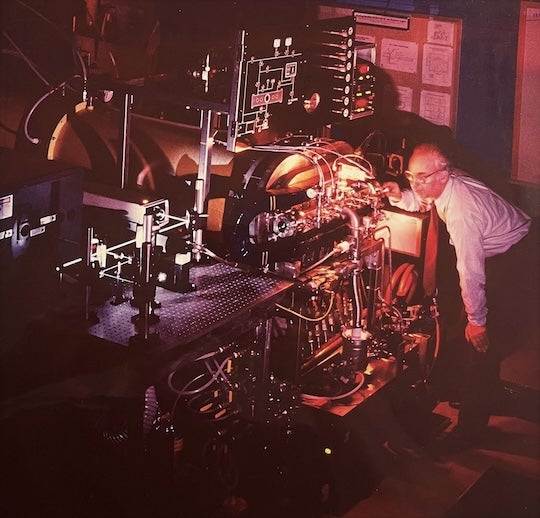
Tittel built one of the world’s first tunable lasers, capable of setting its wavelength to specific frequencies — a crucial advance for spectroscopy. It became foundational to a wide range of laser applications and helped position Rice at the forefront of optical science.
Tittel’s scientific reach extended across nonlinear optics, solid-state and gas lasers and applied spectroscopy. He worked closely with Robert Curl and Richard Smalley, who would share the 1996 Nobel Prize in chemistry for the discovery of buckminsterfullerene — the “buckyball.” Lasers developed with Tittel’s expertise were integral to the apparatus that vaporized graphite and analyzed carbon clusters in experiments that led to the discovery of C60.
His pioneering work in laser-based sensing of gases at minute concentrations has had an impact across a wide range of domains, including environmental monitoring, chemical analysis, industrial process control, security and defense applications and medical diagnosis.
A spectroscopy technique developed by Tittel in collaboration with Curl and colleagues made possible the development of highly sensitive, yet compact and rugged sensing devices used in field applications ranging from projects at NASA’s Johnson Space Center related to air and water quality for the International Space Station, Environmental Protection Agency monitoring of urban pollutants and National Institutes of Health-supported studies of noninvasive detection of nitric oxide and carbon monoxide in biomedical systems.
Tittel was a member of numerous professional and academic societies, including the Institute of Electrical and Electronic Engineers, the Optical Society of America, the American Physical Society and SPIE. He received an honorary Doctor of Science degree in 1993 from JATE University in Szeged, Hungary. In 2018, he was co-recipient of the IEEE Medal for Environmental and Safety Technologies. He also served in editorial and conference leadership roles in his field.
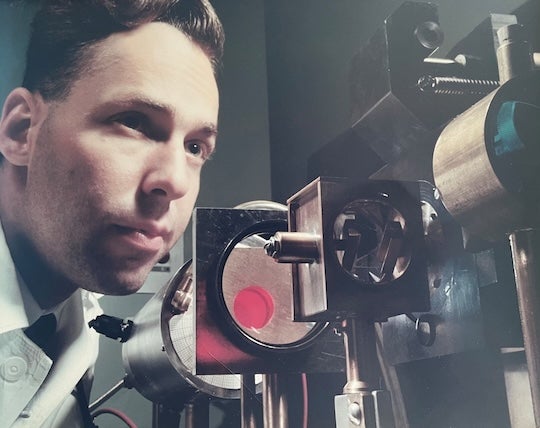
A longtime Houston resident, Tittel was born Nov. 14, 1933, in Oranienburg, Germany, and grew up in Schweinfurt during the rise of the Nazi regime and World War II. His father, a chemical engineer, died in a skiing accident when Tittel was still a boy. His mother, who was Jewish, lost the family home after it was seized by the Nazis and died by suicide in 1940. Tittel spent the war years with foster families in Germany and in a camp in Czechoslovakia. In 1946, he moved to England to live with his mother’s sister. He earned his bachelor’s degree in 1955 and his master’s degree and doctorate in 1959, all in physics from Oxford University, before beginning his research career in the U.S.
Colleagues and former students said his steadfastness, dedication, attention to detail and generosity as a mentor and friend left as deep a mark as his scholarship.
Behnaam Aazhang, the J.S. Abercrombie Professor of Electrical and Computer Engineering, said Tittel’s “passion for research was truly contagious.”
“He was always thinking about his projects,” Aazhang said. “His service and his contributions to Rice are immeasurable.”
Richard Baraniuk, the C. Sidney Burrus Professor of Electrical and Computer Engineering, recalls “that Frank’s door was literally always open and … he was always willing to listen and to offer advice.”
Caleb Kemere, associate professor of electrical and computer engineering and bioengineering, said Tittel embodied his “aspiration to be an active researcher into my 80s like the legend he was.”
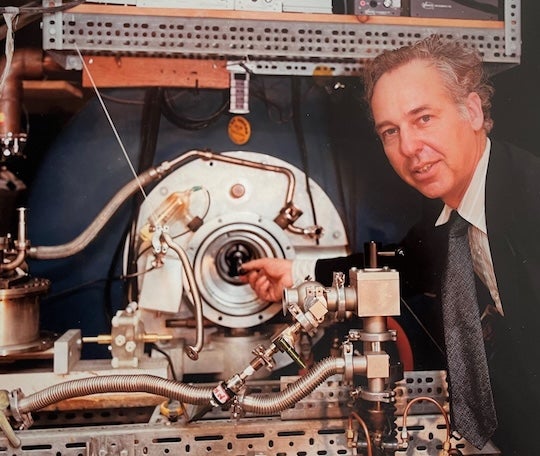
Surbhi Lal, a Rice research scientist, described Tittel as “a very gentle person” who “was always eager to share research interests.” As a graduate student interested in quantum cascade lasers, she approached him after hearing his lab had some of the only such devices on campus.
“I asked him about it, and he walked me over to his lab and showed me two of them,” Lal said. “Then he asked his postdoc to answer my other questions about QCLs.”
When Tittel later took a sabbatical and asked her to teach his laser spectroscopy class, he “was very generous sharing his class material and lecture notes.” After his return, they co-taught for three more years.
“I learned so much about his research from just having casual conversations over lunch,” Lal said.
Gururaj Naik, associate professor of electrical and computer engineering, recalls Tittel’s “passion for science,” sharing that during an office visit, Tittel showed him “a piece of a ruby rod that made the first solid-state laser.” When Naik invited Curl to an event celebrating Tittel’s 50 years at Rice, he recalled Curl’s reaction: “Is Frank finally retiring? I thought he would never stop working!” Naik added that Tittel “worked with Bob Curl and Rick Smalley in their Nobel-winning project on C60 molecules” and described him as “a great mentor.”
Lihong Wang, a Rice doctoral alumnus who is now the Bren Professor of Medical Engineering and Electrical Engineering at the California Institute of Technology, said Tittel “made important contributions to laser-based sensing of trace gases, advancing both the underlying science and its practical applications.”
Wang recalled that upon his first arrival in Houston, Tittel “personally picked me up from the airport around midnight — a deeply meaningful act of kindness that I have never forgotten.”
On many weekends, Wang would see Tittel’s large van parked in front of the Space Science Building, one of the few remaining vehicles in the expansive parking lot.
“He worked with tireless dedication,” Wang said. “His unwavering commitment to research left a lasting impression and quietly inspired those around him.”
Wang said that among the defining experiences of his time at Rice was working on a joint project led by Tittel, Smalley and Curl.
“Our weekly meetings brought together diverse perspectives and exceptionally high scholarly standards,” he said. “I learned not only scientific rigor but also the value of genuine collaboration. Those formative experiences profoundly shaped my career, and I remain deeply grateful for his mentorship and example.”
Luay Nakhleh, the William and Stephanie Sick Dean of the George R. Brown School of Engineering and Computing and a professor of computer science and biosciences said, “Like Sid Burrus and Larry McIntire, Tittel helped define what excellence looked like in this school. What strikes me most is how often his name comes up when I meet with alumni. They don’t just remember his research. They remember how he challenged them, invested in them and set a standard that still shapes our culture today.”
He is survived by his wife, Maria, whom he married in 1965; their sons, Mark and Alex; grandsons, Konrad, Sebastian and Gabriel; and daughters-in-law, Eva and Debra.
** Thank you to Mike Williams for his reporting on Tittel’s accomplishments, including Tittel’s development of quartz-enhanced photoacoustic absorption spectroscopy, his election as a fellow of the International Society for Optical Engineering, his contributions in light of the 50-year anniversary of the invention of the laser and the development of a portable laser to measure nitric oxide; and to Patrick Kurp for his earlier chronicle of Tittel’s retirement.