
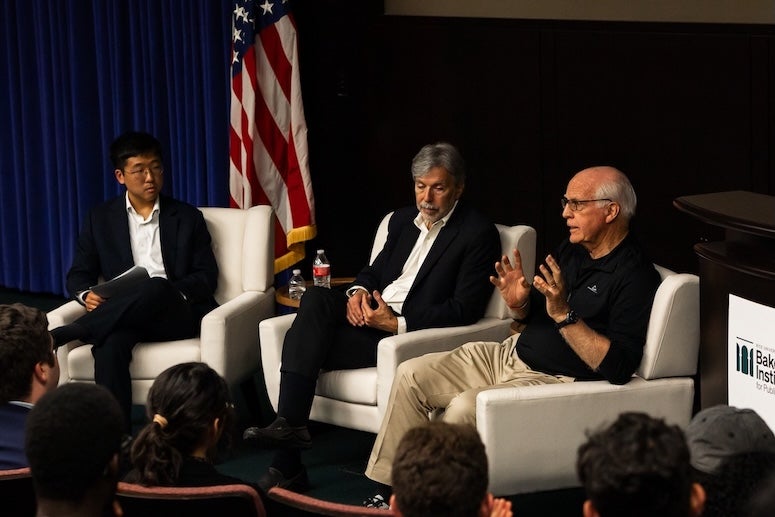
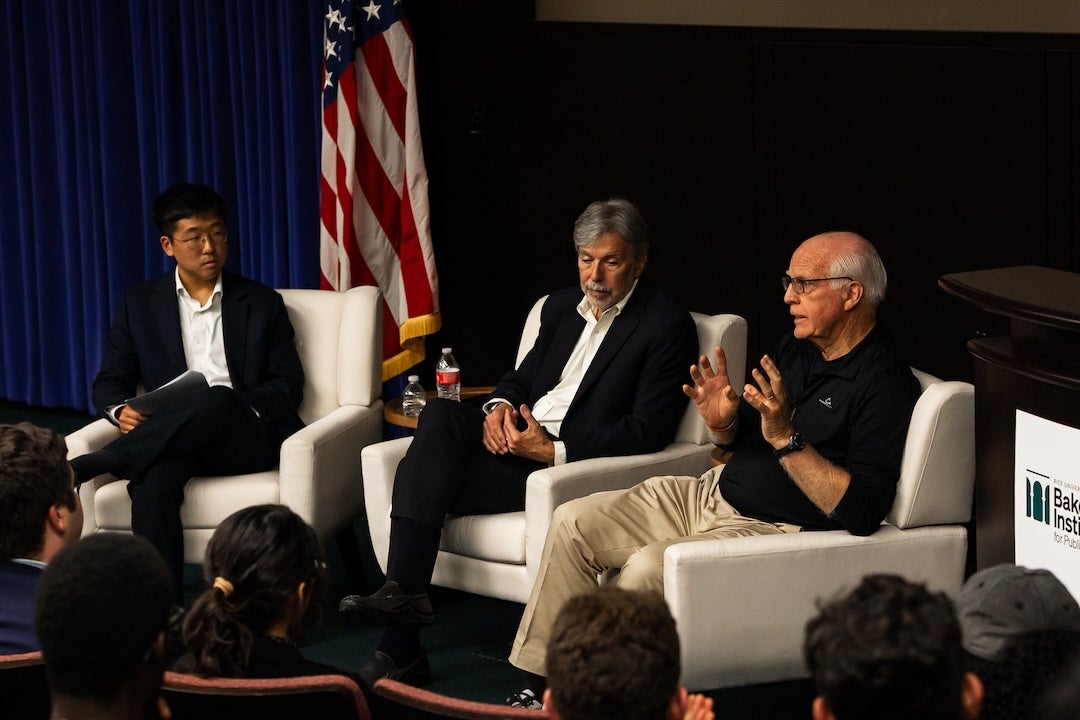
Students at Rice University had the opportunity to engage directly with former members of Congress from different political parties during a two-day campus visit that emphasized civil dialogue, public service and the role of politics in everyday life.
Christopher Shays, a Republican from Connecticut, and Sam Coppersmith, a Democrat from Arizona, visited campus for a series of classroom discussions, student meetings and a public panel held at the Baker Institute for Public Policy in Kelly Auditorium. The visit was part of the Congress to Campus initiative, a flagship program of the Former Members of Congress that brings bipartisan teams of former U.S. Representatives and Senators to colleges and universities across the country.
Over the course of two days, the former lawmakers met with over 100 students through visits to several classes, participated in a lunch with Rice Student Association leaders and joined smaller roundtable conversations. The visit culminated in a public panel that explored domestic policy issues, foreign affairs and career paths in public service.
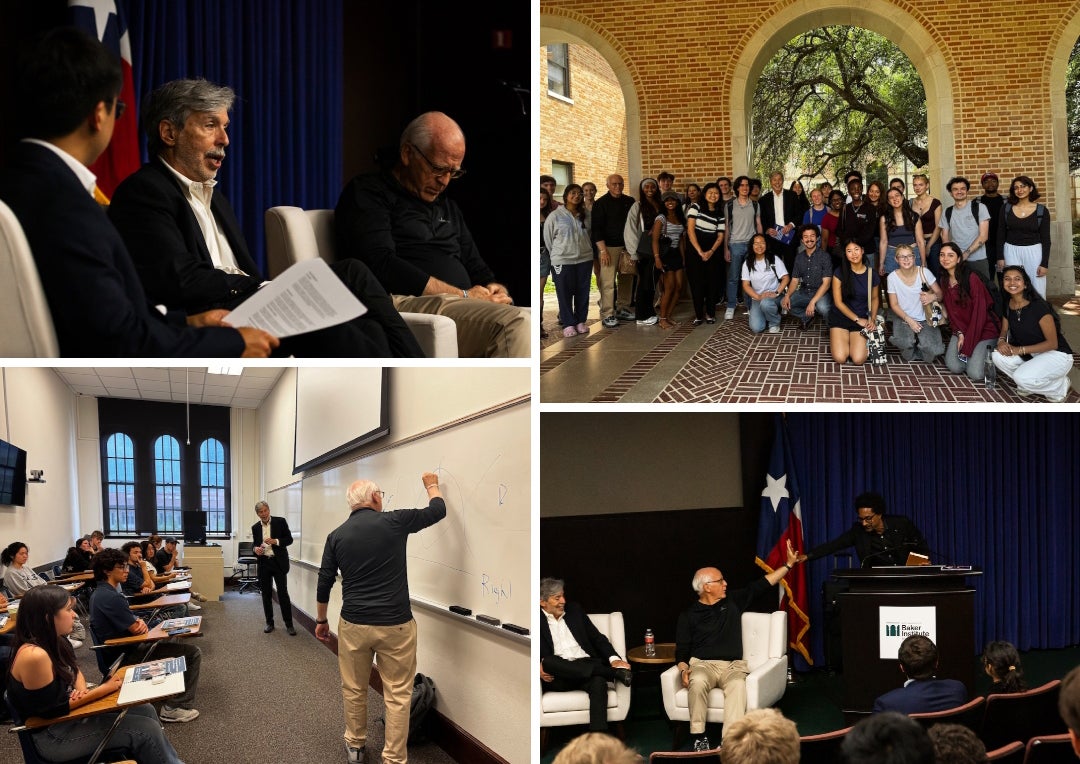
“The three main themes that I wanted to cover with the panel were domestic issues, foreign policy issues and public service careers for students,” said junior David Lee, chief of staff for the Student Association, who helped organize the visit. “We wanted to target more philosophical questions, how should we think about these issues, rather than just a literal domestic politics debate.”
The discussions gave students a chance to hear contrasting viewpoints from leaders who served in Congress while also modeling respectful engagement across political differences.
“It was really interesting hearing different perspectives in a respectful, civil dialogue,” Lee said. “I feel like we don’t get that very often nowadays.”
During the panel, the two former U.S. representatives highlighted how differently lawmakers can view foundational issues.
“The Democrat member was in favor of a major revision to the Constitution as an outdated document, while the Republican was much more in favor of the Constitution as it stands,” Lee said.
For many students, the visit offered a behind-the-scenes look at how Congress operates and the pressures lawmakers face.
“Seeing how people in the legislative branch think about these things and explaining the pressures that members of Congress are under that the general public wouldn’t be privy to — that was really interesting for me to hear,” Lee said.
The conversations also helped students move beyond the increasingly partisan tone that often dominates political discourse online.
“In the social media era, it’s very easy to see things through a partisan lens — as a fight, as a competition,” Lee said. “But what students saw with this program was politics not as a competition but as a way to make Americans’ lives better.”
For students less engaged with politics, the event offered an entry point into thinking about civic issues.
“Politics touches everyone’s lives in some way, shape or form,” Lee said. “Students who don’t think about politics much were able to see how it’s relevant to their lives and maybe think through it critically for the first time.”
Hosting conversations like these also reflects Rice’s broader role as a place where thoughtful discussions about public issues can take place, he added.
“In such a divided and partisan environment, it’s really important for us to display what it looks like for academia, for students and researchers to engage with the political realm in a wise and well-engaged way,” Lee said. “As Rice’s global recognition rises, it’s becoming more and more important that we use that platform well and wisely.”