
When two Rice University students spent a free weekend at Disneyland Paris, they came back with more than souvenirs: Each had quietly built a thesis, texting professor Lisa Balabanlilar their arguments as the case took shape over the course of the weekend.
Both were enrolled in Imperial Gardens, a course Balabanlilar taught during Session 1 of the Rice Global Paris Summer Program, and the final assignment asked students to find a garden of their own choosing and defend what made it one. Neither student had compared notes with the other, yet both landed on the same unlikely claim that a theme park deserved a place in the same conversation as the Tuileries.
Balabanlilar has taught incarnations of Imperial Gardens at Rice since 2007, tracing how political power writes itself into garden landscapes and public parks, and in Paris that argument stopped being theoretical and became something students could walk through.
“Is there a city in the world more appropriate for a class on authority and the garden?” said Balabanlilar, the Joseph and Joanna Nazro Mullen Professor in the Humanities, chair of the Department of Transnational Asian Studies and director of the Chao Center for Asian Studies. “There’s no better city.”
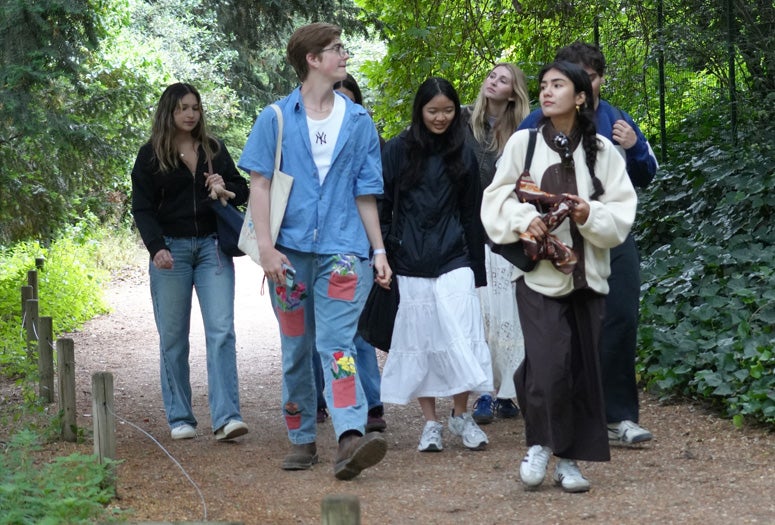
Mornings began with a seminar. Afternoons moved into the city, where the Tuileries, neighborhood parks and palace grounds became primary texts.
“The class and the city began to braid together by the middle of the second week,” Balabanlilar said. “Everything we talked about was physically in front of us.”
The immersion changed how students read the ordinary spaces around them.
“There really is no such thing as a neutral landscape that doesn’t carry other meanings and authority,” Balabanlilar said.
Grounding the daily rhythm was the Rice Global Paris Center, which gave the group a home in the Marais and a medieval courtyard to return to each morning.
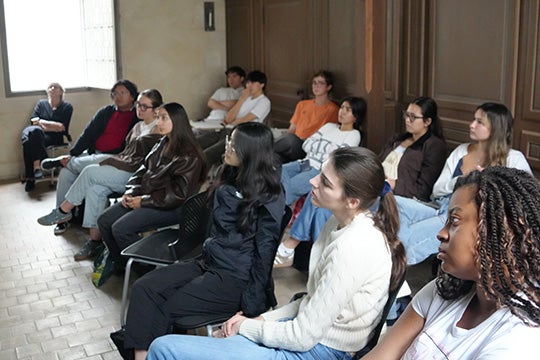
“I don’t think there was ever a day when I didn’t get a thrill walking into that building,” Balabanlilar said.
Only two of the 15 students in the course were pursuing history degrees, the rest crossing over from engineering, the sciences and business, disciplines with little apparent connection to gardens or empire.
“This is why I love teaching at Rice so much because every class I teach is like this,” Balabanlilar said. “I teach people from every corner of the campus, and they each bring something to the class.”
That range showed most clearly at the final presentations, where a business major pitched her garden to the class the way a marketing specialist pitches a client, while a classmate headed to law school built her case with the instincts of a future lawyer already on display.
“This is the great thing about working with these students,” Balabanlilar said. “They bring all their other experiences and ideas and they apply it to your class.”
Watching that same instinct surface again and again, students translating an unfamiliar subject through whatever discipline they already knew, is what convinced Balabanlilar the model could travel beyond Paris.
“I’m beginning to imagine ways to bring that experience back home,” Balabanlilar said.
This spring she said she’s redesigning a course on Asian gardens around the same principle, sending students into neighborhoods to discover landscapes for themselves.
Learn more about the Paris Summer Program on Rice Global’s website.