

Severe heat stress can be life-threatening, even for people in peak physical health: If the core temperature of an athlete competing in hot and humid conditions rises over 105 degrees, the window to act is short.
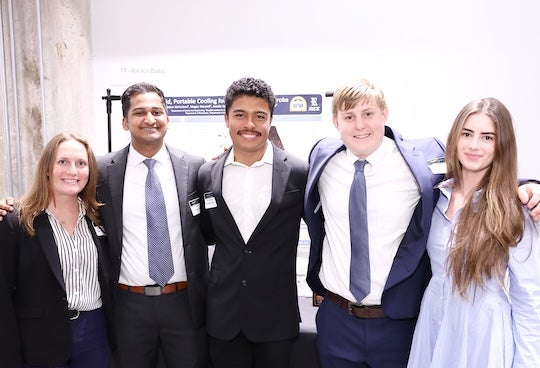
“Thirty minutes can lead to central nervous system dysfunction,” said John Israel, a Rice University senior majoring in materials science and nanoengineering who is working on a solution to manage exertional heat stroke (EHS).
Together with Rice seniors Amalia Kertsikoff, Adam McFarland, Rohan Palavali and Megan Worstell, Israel is part of team Ice Ice Baby, who are developing a portable cooling system to manage EHS as part of their engineering capstone design project. The project is sponsored by the Rice Engineering Alumni association and is supported by the resources of the Oshman Engineering Design Kitchen, Rice’s signature engineering maker space.
While their system is specifically designed with athletes in mind ⎯ for use on the sidelines, at practices and during travel ⎯ the cooling device could offer critical assistance for people experiencing EHS more generally.
The current standard of treatment for EHS involves full-body immersion in ice water, which is not only not always immediately feasible but also makes transportation to a medical facility problematic.
“You can’t have a giant tub of water everywhere you go,” McFarland said. “We are asking, how can we have an effective solution that is also portable?”
The team has been collaborating with Rice Athletics and the university’s Emergency Medical Services to develop and test a prototype, meeting regularly with trainers and emergency responders to measure setup time, evaluate performance and run through emergency deployment scenarios.
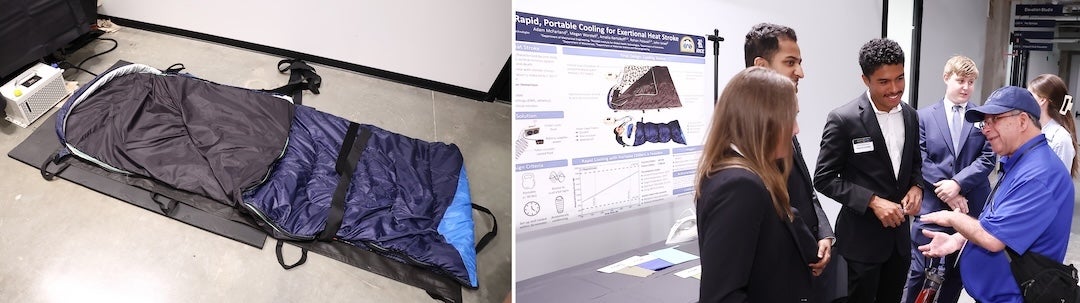
The prototype involves a full-body fabric-based wrap with embedded tubing that circulates a refrigerant fluid. The development has required some tradeoffs: More powerful cooling systems tend to be heavier, making transport more difficult, while material selection for the tubing has raised separate issues.
“We needed something that is thermally conductive, but a lot of flexible tubing is made to be insulating,” Worstell said.
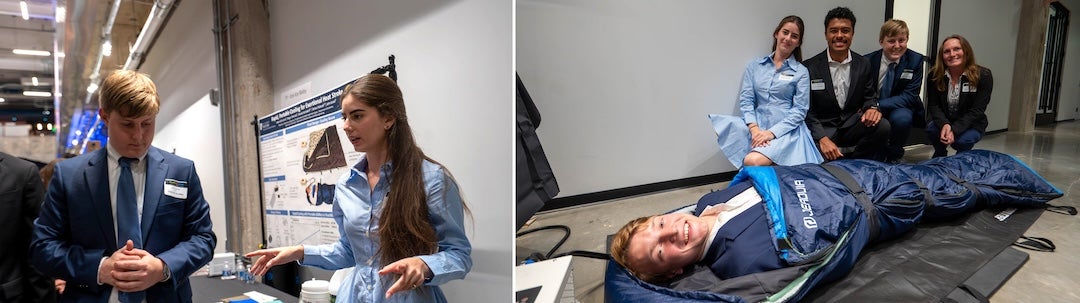
With the 2026 FIFA World Cup scheduled to take place this summer in cities across North America ⎯ including in Houston and other cities deemed as high-risk sites for extreme heat ⎯ the Rice team’s work helps underscore the need for EHS management preparedness.
“We want to be able to hand off a usable version of the prototype to Rice Athletics,” Israel said.
Kertsikoff, who is an economics major, said the iterative engineering design process is different from the “clean frameworks and clear outcomes I am used to.”
“Actually building and testing forces you to rethink everything,” Kertsikoff said.
Lisa Basgall, EMS director, and Deanna Doheny, head athletic trainer for Rice’s football team, initially pitched the idea for a project that would innovate methods to provide emergency cooling to patients in both prehospital and potentially emergency room settings.
“We asked, could a device be designed for the prehospital management of hyperthermic patients that is cost-effective, portable and doesn’t rely on access to ice or large quantities of water,” Doheny said.
Their proposal noted that exertional heat emergencies are becoming increasingly prevalent worldwide due to the intensifying effects of climate change.
“While the human body is highly adaptable, conditions such as heat cramps, heat exhaustion and exertional heat stroke can affect individuals across all fitness levels — from elite athletes to recreational exercisers — and pose significant risks to those without access to climate-controlled environments,” Basgall said.
Both Basgall and Doheny said the “students on this team were exceptional, committed to achieving this goal of designing a functional, efficient device.”
“Many hours of brainstorming, testing, sewing, designing, researching, redesigning and innovation occurred throughout the year, and it has been amazing to see ideas on paper turn into a highly useful design with great potential to save lives in a practical application,” Basgall and Doheny said. “The multidisciplinary expertise of these students forming into a team to work together was essential for this project, and the success of their final design shows the effort and time they put into this project.”
The team’s lead instructor was Kiara Lee, director of education strategy at Rice360 Institute for Global Health Technologies. Ricardo Zednik, professor in the practice of materials science and nanoengineering, and David Trevas, lecturer in mechanical engineering, served as faculty mentors.
- Access associated media files: