

Written in collaboration with Kelly Peters,
Special to Rice News
For nearly two decades, Rice University’s Ken Kennedy Institute has convened the energy and computing communities to focus on a shared reality: Modern energy discovery, production and transition depend on advanced computation.
That theme anchored the 19th annual Energy HPC & AI Conference, held Feb. 24-26 at Rice’s BioScience Research Collaborative. The meeting brought together nearly 600 leaders and experts from industry, academia, national labs and the information technology sector to engage in critical discussions on high-performance computing and AI-powered integrations that support increasing workload demands across the energy sector.
The program included keynotes, panels and fireside chats, technical sessions, workshops and numerous networking opportunities. Invited speakers represented organizations including BP, ExxonMobil, Massachusetts Institute of Technology, Oak Ridge National Laboratory, Texas Advanced Computing Center and the University of Texas at Austin. One keynote featured the 2025 ACM-IEEE CS Ken Kennedy Award winner Saman Amarasinghe.
The conference traces its roots to 2008, when it launched as the Rice Oil and Gas HPC Workshop. What began as a focused industry-academic exchange has grown into a premier annual gathering at the intersection of energy, advanced computing and data science. The program provides a platform to showcase technical rigor and emerging advancements in computing while also creating space for niche conversations on workforce strategies for a rapidly evolving industry.
In the opening remarks, David Sholl, Rice’s executive vice president for research and a professor of chemical and biomolecular engineering and chemistry, tied the conference to both institutional history and global need.
“Energy is the cornerstone of our modern economy,” Sholl said. He pointed to Rice’s long-standing contributions to computing, from early university projects in the late 1950s to Ken Kennedy’s foundational work in parallel computation in the 1980s.
“Today, the Ken Kennedy Institute connects over 300 faculty and researchers across the campus,” said Sholl, emphasizing Rice’s role in guiding the development of responsible and ethical AI as part of the university’s strategic plan.
Keith Gray, vice president of computational science and engineering at TotalEnergies and a co-founder of the conference, described its origins as a practical response to change inside the energy sector.
“High-performance computing was becoming more important to the oil and gas industry,” Gray said.
He noted that Houston is an ideal backdrop for the conference, given its status as “energy capital of the world” and the high density of high-performance computing practitioners in the area. He also pointed to Rice’s strengths in research and education, particularly in computer science, geophysics and applied math.
“The synergies just work,” he added.
It began as an opportunity to bridge communication across industries. The first gathering, held in conjunction with the Society of Exploration Geophysicists annual meeting, drew about 100 participants. Once at Rice, it expanded from roughly 200 attendees in Duncan Hall to now nearly 600 participants eager to shape the future of energy infrastructure and innovation.
An enduring goal of the conference is to build meaningful connections. The culture of Rice’s interdisciplinary network of researchers and exemplary students and faculty underscore that impact. In keeping its roots on campus, the conference maintains its influence through focused, smaller-scale connections that bring together a wide range of participants — from local industry professionals and Rice researchers to global partners from leading energy and computing companies.
“We’ve chosen to keep the scale at approximately 600 people,” Gray said. “It allows a much better sense of community, and we recognize how important it is to create a community within the industry to solve problems.”
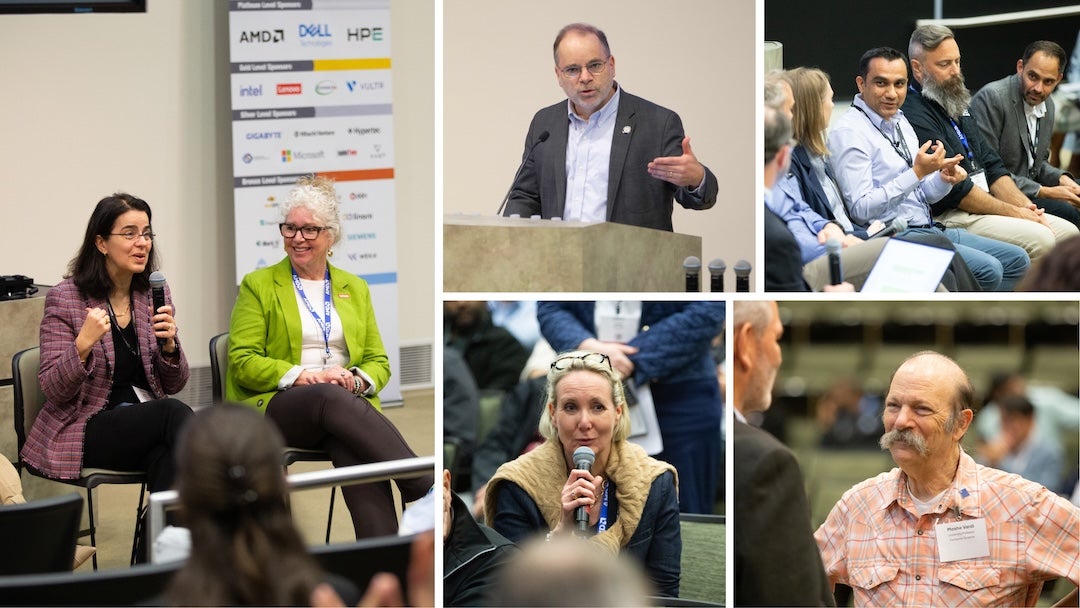
That community also reflects a long-running interplay between energy and computing. For decades, offshore seismic surveys — in which vessels tow sensor-equipped streamers to record reflected sound waves from beneath the seafloor — have generated enormous data volumes that must be processed into coherent subsurface images. As acquisition techniques and imaging methods advanced, so did the need for faster, more capable computing systems. Dedicated high-performance computing centers within energy companies, and close collaboration with hardware and software providers, grew in response.
That lineage was visible in the conference exhibit hall, where 30 sponsors demonstrated high-powered systems and architectures. On one screen, a detailed 3D slice of subsurface geology rotated in real time — a reminder that behind every visualization is a chain of data collection, modeling and compute-intensive processing that links field operations to decision-making.
Beyond industry exchange, the conference plays a direct role in graduate education at Rice.
Over the years, the Energy HPC & AI Conference has directly funded 95 graduate students through the Ken Kennedy Institute’s annual recruiting and sponsored fellowship programs. These awards help attract and support graduate students working in AI, high-performance computing and related areas of computational science and engineering, particularly in areas relevant to energy.
Gray sees that workforce connection as central to the event’s purpose.
“This is where we come to look for the interns who are going to become our next generation of professionals,” he said. “This is just incredibly valuable for us.”
Students were involved throughout the program, many presenting their work during lightning talks and poster sessions. Carolina Brindis, a chemical and biomolecular engineering graduate student in Walter Chapman’s research group and a recent recipient of the Scott Morton Memorial Fellowship, presented research on hydrogen and carbon dioxide geostorage — an area that combines laboratory experiments with large-scale computational modeling.
“I greatly appreciate how the Scott Morton Memorial Fellowship, along with the lightning talk and poster session, increase visibility for our research,” Brindis said. “This is particularly significant as our new consortium expands partnerships that integrate experimental measurements with large-scale computational modeling to advance energy innovation.”
Her comments reflect a goal of the conference’s broader structure: to create space for students to present work directly to industry representatives and computing specialists, while building relationships that extend beyond a single week.
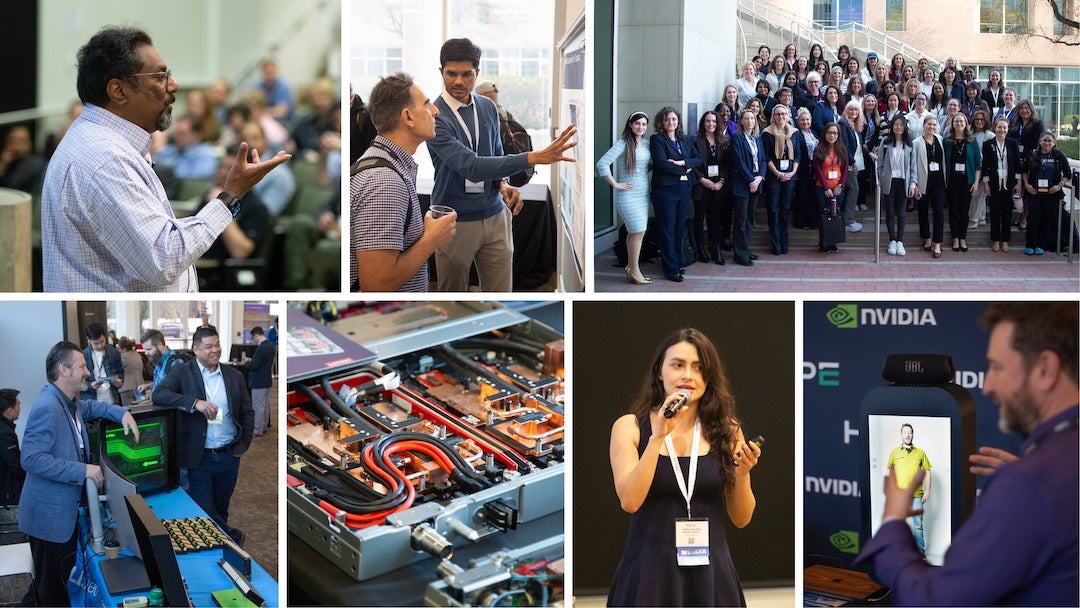
As advanced computation in energy has evolved, so has the conference. The addition of “AI” to its name reflects a shift in the kinds of methods practitioners are deploying.
“AI was a natural outgrowth of the use of advanced computation in energy,” said David Pynadath, executive director for research initiatives at the Ken Kennedy Institute, noting the steady increase in AI-focused submissions and presentations over the years. The change also reflects growing interest in shaping AI’s transformative impact across industries and workforces — a priority for both Rice as a leading research institution and Houston as the energy capital of the world.
Even as new methods gain attention, the conference remains a forum for taking the pulse of industry needs and discussing challenges, opportunities and new developments across the energy sector.
“The scale that we’re working at and the importance to the business continues to grow,” Gray said. “So I think that is another reason this continues to be exciting.”
Next year, the Energy HPC & AI Conference will celebrate its 20th anniversary Feb. 23-25, 2027.
Recordings of the 2026 conference presentations and of the Best Practices in HPC Systems Management workshop can now be viewed online.
- Video is available at:
-
https://youtu.be/0jhPdZkYPes
(Video by Jared Jones/Rice University) - Access associated media files:
-
URL: https://drive.google.com/drive/folders/1XJLEPnCaDVsJKjzn60jOecgxOjlA5WA0
Credit: Donald Soward, D2 Studios