
Houston-area residents are increasingly worried about the economy, facing growing financial strain and declining confidence in job opportunities, according to new findings from Rice University’s Kinder Institute for Urban Research. But that same study points to something less expected: Despite those concerns, Houstonians may be more aligned and connected than they realize.
Rice Provost Amy Dittmar said the annual Kinder Houston Area Survey offers an important snapshot of a region navigating both challenge and opportunity.
“This research helps us better understand not just where Houston is today but how we move forward,” Dittmar said.

The 45th edition of the Kinder Institute’s groundbreaking survey, released April 27, shows a sharp shift in how residents view the region’s economic outlook. Confidence in job opportunities dropped significantly across Harris, Fort Bend and Montgomery counties, marking one of the steepest one-year declines in decades.
“I expected more people to be concerned about the economy this year,” said Dan Potter, co- director of the institute’s Houston Population Research Center. “But I was quite surprised by how much more concerned we are about the economy.”
That concern showed up in multiple ways in the survey. For the first time in years, the economy ranked as the most commonly cited “biggest problem” facing the Houston area, identified by about 1 in 4 residents.
At the same time, more residents say they are struggling to keep up financially. The share of people who report they are “just getting by” or “finding it difficult to get by” has increased across income levels.
“It didn’t matter if you were making over $150,000 or less than $25,000,” Potter said. “You were finding it more difficult to get by.”
Financial vulnerability remains a concern as well. A growing number of lower- and middle-income residents say they would have to borrow money or would be unable to cover a $400 unexpected expense, a common measure of financial stability.
“The survey gives us a deeper understanding of how people are experiencing life in Houston right now,” Dittmar said. “That insight is critical for leaders, organizations and communities working to make informed decisions about the region’s future.”
Ruth López Turley, director of the Kinder Institute, said the findings reflect real challenges but also point to an opportunity.
“We have a clearer picture of what people are experiencing right now,” López Turley said. “The question is how we respond to it and how we work together moving forward.”
That sense of possibility comes from one of the survey’s newer areas of focus: social connection.
For the first time, researchers asked residents not only about their own views on social issues but also what they believed others think. The results revealed a consistent pattern. People tend to underestimate how much they agree with one another.
“We’re much more aligned than we think we are,” Potter said.
Across a range of issues, residents often perceived deep differences where there was actually broad agreement, a gap that can shape how people engage with one another.
Beyond attitudes, the survey highlights the tangible impact of connection in people’s lives.
“How well connected we are, it matters for our wealth, our health and our sense of safety,” Potter said.
Residents with stronger personal and professional networks are more likely to feel they have opportunities to get ahead financially, according to the survey. Social cohesion, a measure of trust and connection among neighbors, is also linked to better physical and mental health outcomes.
The survey has tracked Houston’s changing attitudes since 1982, when it was first launched at Rice by sociologist Stephen Klineberg as a classroom project that quickly grew into one of the longest-running studies of any major metropolitan area in the country.

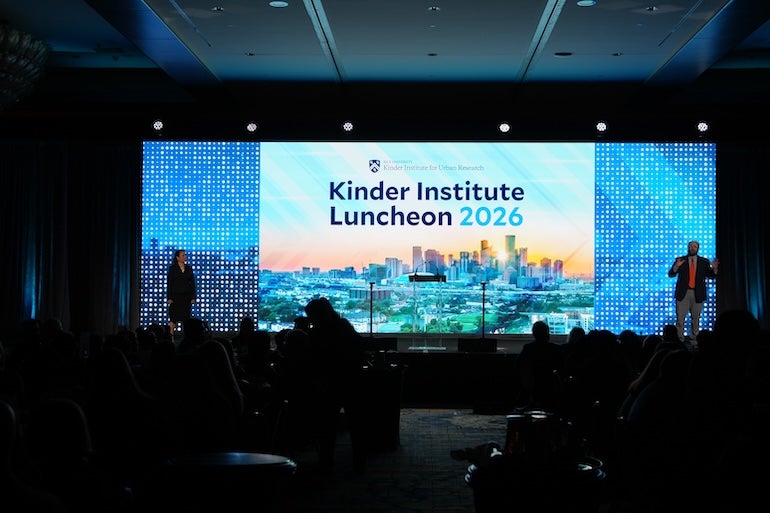
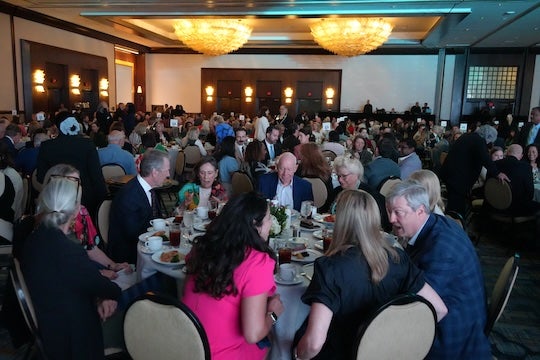
That history was highlighted during the institute’s luncheon, where Charles C. Foster, chairman of Foster LLP, received the Stephen L. Klineberg Award in recognition of his contributions to the Houston region.
“This award is especially meaningful because I had the opportunity to work with Stephen Klineberg at the inception of the survey in 1982,” Foster said. “From the beginning, the survey helped us understand how Houstonians think about issues that shape this region, including immigration. That work has only grown more relevant over time given its impact on our economy and our community.”
The Kinder Houston Area Survey draws on responses from thousands of residents across Harris, Fort Bend and Montgomery counties and continues to track how attitudes evolve over time.
Together, this year’s findings paint a complex picture of a region under pressure but not without promise.
“Houston has always been a place where people from different backgrounds come together,” López Turley said. “The data show that connection is not just part of our identity, it is part of the solution.”