
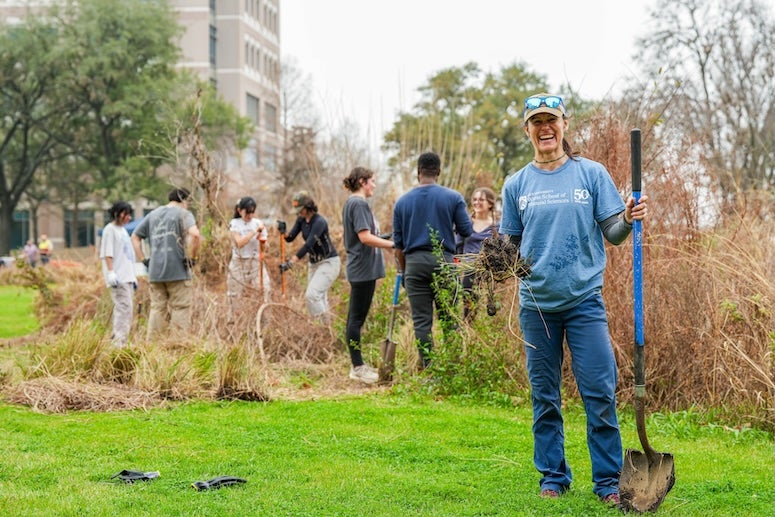
In 2012, The University of Texas MD Anderson Cancer Center built a temporary prairie on the site of a demolished building, allotting five years before it would give way to new construction. Fourteen years later, this location of the beloved prairie will make way for future construction projects, but it finds a new opportunity to live on at Rice’s Harris Gully.
“What’s really fantastic is that the prairie isn’t vanishing,” said Cassidy Johnson, director of Rice University’s Lynn R. Lowry Arboretum. “We’re digging up as many of the plants as possible and distributing them to urban conservation sites across the community. These hardy plants provide environmental value, wildlife value and cultural connectivity across Houston.”
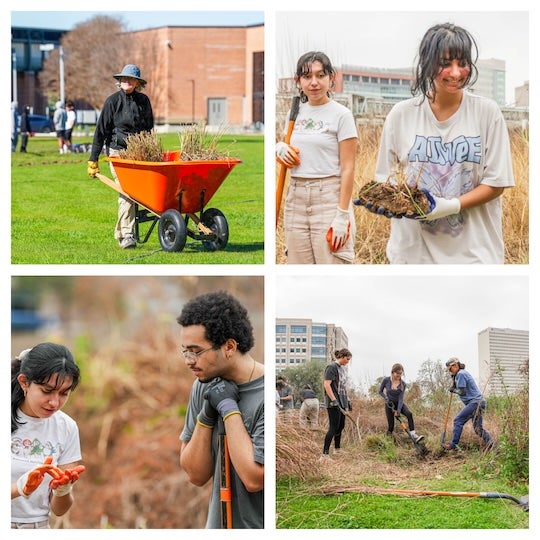
One of the urban community sites receiving these native prairie grasses is Rice’s Harris Gully, a detention ditch turned restorative ecology site on the edge of campus, bordering the medical center. On Feb. 21-22, over 100 volunteers, including Rice students, professors and alumni, Houston community members and students from other local universities, gathered to collect grasses from the mother prairie and relocate them.
The mother prairie was intentionally designed to bring nature and its benefits to UT MD Anderson’s busy urban campus. But as Jaime González, the executive director of the Institute for Ecological Resilience at the University of Houston, explained, it also served as an urban living lab for ecological resilience and biodiversity. “It’s influenced the planning and development of urban prairies at Memorial Park, Herman Park, Buffalo Bayou, corporate campuses, you name it.”
It is fitting, then, that some of the prairie’s grasses will live on as part of Rice’s living laboratory, part of a campus that encourages students to interact with, study and learn from nature.
Johnson, who is leading the restoration of Harris Gully, started the first day with a demonstration on collecting the grasses. The key was digging up the grasses’ rhizomes, underground stem structures. “Rhizomes are just chock full of stem cells,” Johnson explained. “Once we plant them, they’ll start growing again and make a big tuft of grass. They’re really resilient.”
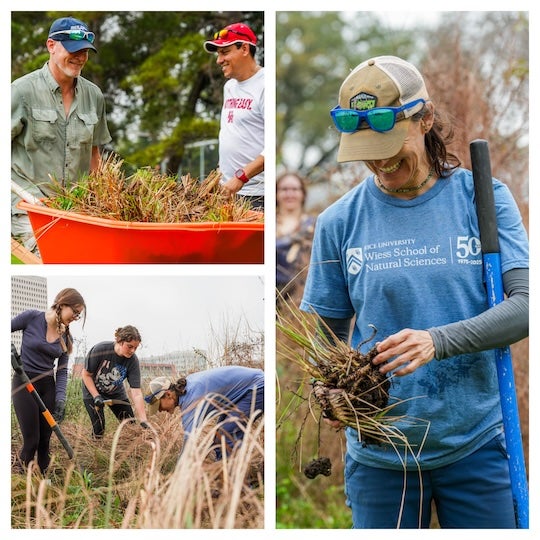
Good prairie grasses have thick, tough rhizomes in which the plant stores nutrients and starches. That’s part of why these native grasses, like blue stem, eastern gamma, Indian and switch grass, are resilient to local challenges like drought and intense heat.
“If they’re native to here,” said Brent Moon, Rice’s director of grounds and landscape design, “they’re used to all of our extreme weather events. They’re already evolved to handle the pressures, from insect disease to heat to droughts and floods.”
Prairie grasses also give back to the environment they are so well adapted to. They’re excellent carbon sequesters, storing carbon dioxide in their rhizomes, safely away from wildfires. They also trap water, lowering flood risk by collecting more water underground during high water events.
These particular prairie grasses are also bringing together communities. Undergraduate and graduate students, like Zoe Soltero and Annie Finneran, are part of the volunteer relocation efforts. They were joined by Rice alumni, like Julie Itz ’72, a history major who went on to become a Texas Master Naturalist. Many were inspired to join because of the Harris Gully restoration project.
“Oftentimes, when I go to visit the Harris Gully,” said Soltero, a sophomore and biosciences major, “there’s other people that aren’t Rice students just there, bird watching.”
Rice isn’t standing in isolation either. This work was done through collaboration with conservation groups like the Friends of the Columbia Trail, Coastal Prairie Conservancy and the Native Prairie Association of Texas. The prairie grasses will be replanted across the city, in locations such as nearby Hermann Park and Memorial Park.
“Because of our wonderful volunteers, the plants will continue to filter water and clean the air for us,” Moon said. “They will live on.”