
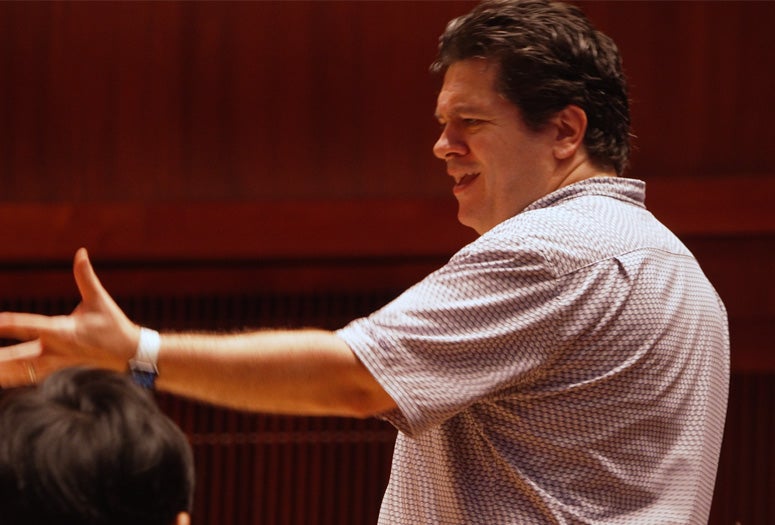
The Shepherd School Symphony Orchestra was deep into its second rehearsal of Igor Stravinsky’s “The Rite of Spring,” a work famous for its rhythmic volatility and raw intensity. On the podium, Cristian Măcelaru ’06 ’08 moved deliberately, stopping often, speaking directly to each section and unpacking the score’s dense layers. Rather than simply drilling notes, he urged students to think about character, narrative and communication. The room was electric as the players locked onto every cue.
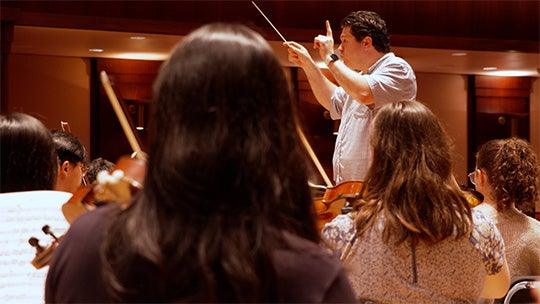
The February residency marked another return for Măcelaru, the Grammy Award-winning conductor who now serves as the school’s distinguished visiting artist through the 2027-28 school year. The role brings him back to campus several times each year to coach, conduct and mentor students across departments.
“I was here actually for eight years in total, and I still carry deep emotions and love for this place,” Măcelaru said. “When I left and started my professional life, I always wanted to return and share a little bit from my experience and the lessons that I’ve learned in the professional world with the students. Perhaps some of these lessons might be relevant to them as well.”
During the residency week, Măcelaru worked widely across the school, reflecting the breadth of his multifaceted career. His schedule included chamber music coaching, a class with horn students, mock auditions, conducting both of the school’s orchestras, sessions with conducting students and collaborations with the opera department and composition seminar.
Măcelaru currently serves as music director of the Cincinnati Symphony Orchestra and the Orchestre National de France and leads major festivals and youth orchestras around the world. He made global headlines two years ago when he conducted the French National Orchestra during the opening ceremony of the Olympic Games in Paris, viewed by approximately 1.5 billion people globally. Yet in Houston, his focus shifts squarely to students.
“I recharge so much in having these conversations,” Măcelaru said. “The experiences that I gain in working with the students always fulfill my own life.”
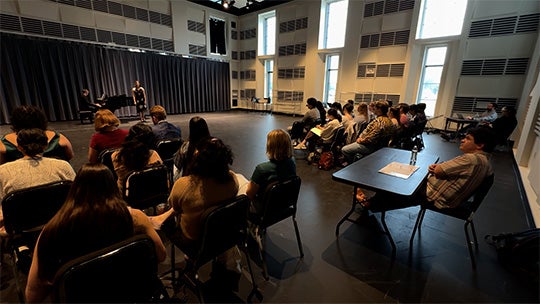
Voice student Nidia Guevara-Nolasco was among those who worked with Măcelaru during the visit. She performed “Acerba volutta” from Cilea’s “Adriana Lecouvreur” during an opera master class in which Măcelaru offered direct feedback.
“Getting his insight was really helpful,” Guevara-Nolasco said. “I don’t get to work with conductors as often as I get to work with other vocalists, so it was really interesting to get the perspective from someone who conducts very large orchestras and is very well established in the industry.”
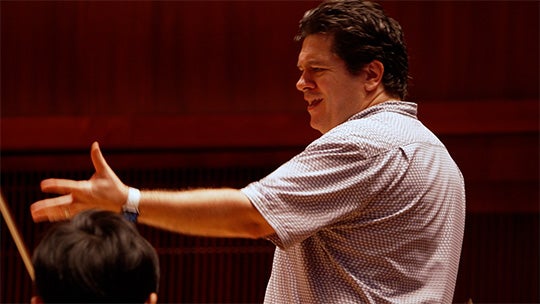
“He’s an incredible conductor and musician, and he’s inspiring on the podium as a conductor and an educator as well,” said violist Soren Lorentzen, who was part of the workshop on “The Rite of Spring.” “He really knows the music inside and out and does his best with a piece like this that we’ll be playing forever to really help us get to know it and understand it well.”
Beyond technical instruction, students also absorbed broader career wisdom. In a discussion about auditions, Măcelaru encouraged young musicians not to be discouraged by rejection, framing closed doors as moments that clarify direction and help define an artist’s path. Lorentzen said the message would stick with him.
For Măcelaru, these exchanges reflect the same community ethos that shaped him as a student at Rice.
“It was so beautiful for me to collaborate yet again with so many of the wonderful faculty at the Shepherd School, and it reminds me so much of how supportive the community is in creating this environment and this platform where we really enable the students to find the possibility of success and the possibility of a better world that they can create,” Măcelaru said. “This is really, truly unique to the Shepherd School.”
As the final chords of Stravinsky’s score thundered through the rehearsal hall, the full-circle moment was unmistakable: a world-renowned conductor back where his own journey took shape, helping the next generation find its voice.