
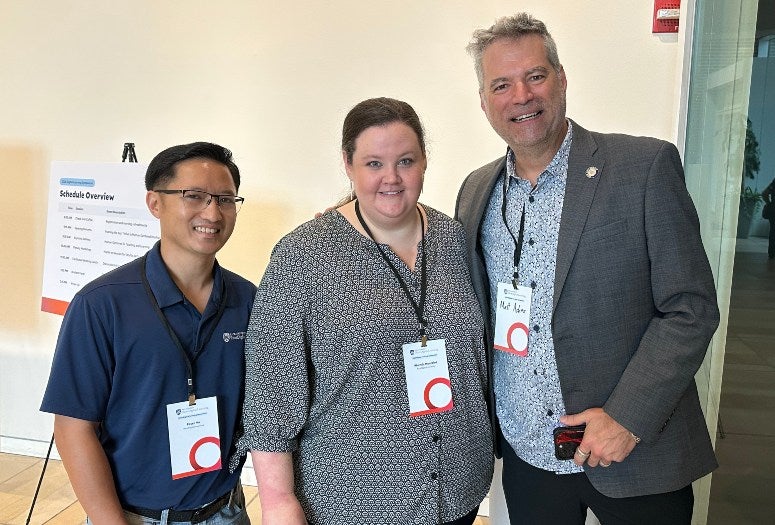
The 2026 Digital Learning Symposium, an inaugural event for Rice University, brought together faculty, students and thought leaders to explore a central question shaping higher education today: How do we preserve human-centered learning in an age increasingly defined by artificial intelligence?
With the theme Human-Centered Intelligence: Teaching and Learning in the Age of AI, the symposium positioned AI as a tool that supports, rather than replaces, human judgment, creativity, ethics and pedagogical relationships.
The event unfolded in three distinct but complementary parts, including a combined keynote and workshop by renowned educator José Antonio Bowen followed by a facilitated working lunch hosted by Rice’s Center for Teaching Excellence Fellows. The symposium ended with a panel featuring 11 students across disciplines moderated by Daniel Villanueva, senior director of growth marketing and analytics for Rice Digital Learning.
Bowen has led innovation and change for more than 40 years at Stanford University, Georgetown University and the University of Southampton, then as a dean at Miami University and Southern Methodist University and as president of Goucher College. He consults on innovation and pedagogy in higher education for Fortune 500 companies and co-authored a book titled “Teaching with AI” with C. Edward Watson.
Setting the stage: From knowledge transmission to cognitive coaching
Opening remarks emphasized that universities are at a unique crossroads, not only in technological history but in educational philosophy. Institutions are being challenged to move from simply transmitting knowledge to facilitating deeper inquiry, creativity and human development in partnership with AI.
Rather than competing with AI’s ability to generate content, educators are increasingly tasked with helping students move beyond the “what” and into the “why” by developing critical thinking, ethical reasoning and intellectual curiosity.
Bowen’s keynote delivered both urgency and clarity. His central argument underscored that AI is not just a tool: It is reshaping how humans think, learn and work.
Bowen framed AI as the latest in a long line of cognitive technologies, comparing it to writing, maps and calculators. Like these tools, AI can both enhance and diminish human thinking depending on how it is used.
He noted a paradox when using AI in learning: Cognitive offloading can free mental space, but overreliance may weaken core skills. AI can expand creativity but may also reduce the need to struggle through ideas, a key part of creative growth.
Bowen emphasized that students must learn not just how to use AI but when not to use it. A striking concept from the keynote was that students are now becoming what he called “AI bosses.” In the workforce, they will be expected to delegate tasks to AI systems immediately, deciding what to automate and what requires human judgment.
This shift, he said, demands new competencies like delegation and oversight, critical evaluation of outputs and ethical and strategic decision-making.
Bowen challenged educators to rethink assessment. Preventing AI use is not enough; instead, standards must rise so that student work surpasses what AI alone can produce.
He argued assignments should emphasize synthesis, judgment and originality, require iterative thinking and reflection and incorporate AI as a tool, not a shortcut.
Perhaps the most powerful idea from the morning was cognitive fitness. Just as physical fitness requires effort and resistance, intellectual growth depends on engaging in challenging cognitive work. AI risks becoming what he termed “intellectual junk food” if it removes productive struggle.
Bowen urged educators to act as cognitive coaches by designing tasks that build mental resilience, encouraging reflection and deep thinking and preserving the value of effort in learning.
Real voices, real practices
The second half of the symposium shifted focus from theory to student lived experience. Villanueva moderated a panel and drew from nearly 100 presubmitted questions to explore how AI is being used in academic life.
The questions centered on the following topics:
- How students use AI in real assignments versus traditional tools
- Deciding whether using AI crossed a line and how students make that decision
- The faculty awareness gap of how students are actually using AI
- Stance on policy clarification in academia about the responsible use of AI
- When AI improves learning versus hindering it
- How using AI is preparing or stifling students’ future careers
- Maintaining trust and meaningful learning environment with students in the presence of AI
- The use of AI outside of academia
Students provided poignant feedback, including that AI is not a replacement for learning but can become an assistant; a critical disconnect between academia and industry; a warning toward using AI as the path of least resistance; a hope that universities are preparing students for the evolving realities they will face after graduation knowing that AI is here to stay; and the underlying notion that human connection remains essential.
Key takeaways
The symposium revealed a complex but hopeful picture of AI in education:
- Avoidance of AI is not an option
- The role of the educator is evolving
- Students need more than rules regarding AI; they also need guidance
- Learning must remain human-centered
- The future requires balance between artificial and human intelligence
By the end of the Digital Learning Symposium, one lesson was made abundantly clear:
The future of education is not about resisting AI but redefining learning around what makes us human.
Bowen emphasized and the student panel reinforced the goal is not to outcompete AI but rather to cultivate learners who can think deeply, act ethically and collaborate intelligently with it. In the age of AI, education’s mission remains unchanged, but its methods must evolve.