
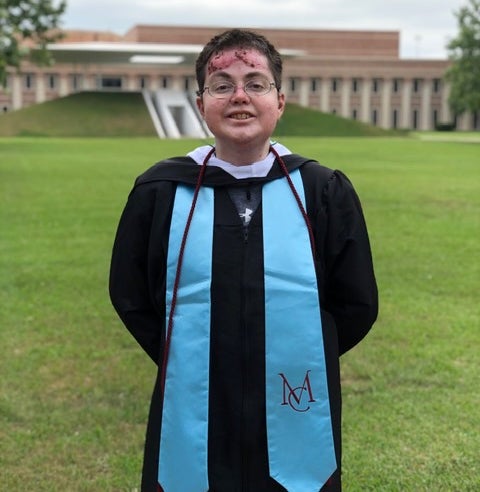
Rice University is remembering alumnus Shane DiGiovanna ’21 of Martel College, whose life and advocacy brought national attention to a rare genetic disorder while he inspired others with his resilience, compassion and boundless energy.
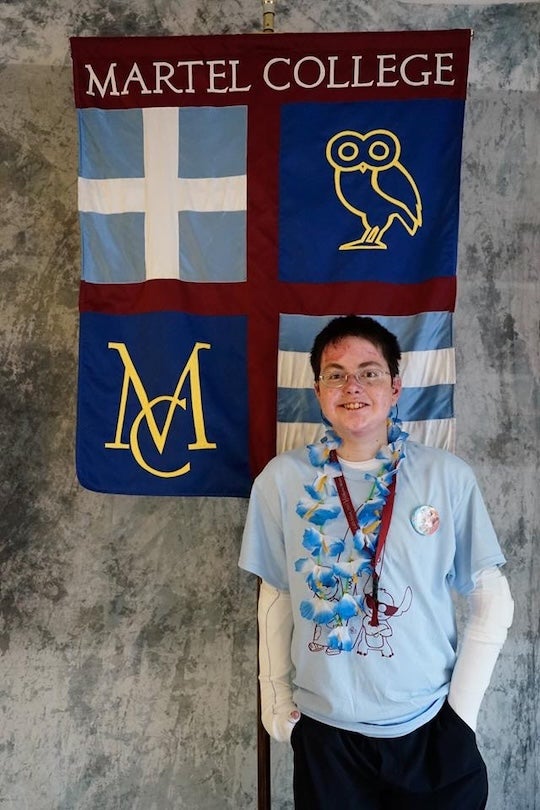
DiGiovanna passed away March 30 at age 27 after living his entire life with epidermolysis bullosa (EB), a rare and often debilitating condition sometimes called “butterfly disease.” The disorder, which causes extremely fragile skin and chronic wounds, affects an estimated 25,000-50,000 people in the United States, and many do not survive into adulthood.
Yet those who knew DiGiovanna say his life was defined not by limitations but by how fully he lived.
“I’m not sure that anyone has ever done as much living in 27 1/2 years as Shane has,” his mother Patsy McCormick said. “From the second he was born, he was a big lover of life and loved people.”
Despite constant medical challenges, including hundreds of surgeries, years of cancer treatments and progressive loss of mobility, DiGiovanna pursued his lifelong dream of attending college — eventually enrolling at Rice, where he quickly became known for his determination and vibrant personality.
“I was born with a rare genetic skin condition called epidermolysis bullosa,” DiGiovanna said in a Rice video produced when he arrived on campus. “I love learning, and for someone with my condition, I wanted to be one of the first people with it to really go to college.”
He said Rice’s close-knit community helped make that dream possible.
“I chose Rice because I really like the atmosphere and the residential college system. I wanted something small,” he said. “Rice works with NASA, it has really good academics, and the people here are just really nice.”
For DiGiovanna, attending Rice represented more than an academic milestone. It was a rare opportunity to experience independence.
“For someone with Shane’s condition, going away to college is virtually impossible,” McCormick said. “To have a real college experience was one of the highlights of his life.”
That experience required significant coordination and support, including personalized medical care and accommodations across campus.
“Without Housing and Dining at Rice, we would never have been able to do it,” she said. “They retrofitted a dorm room for him. He had to do a lot of first-time things at Rice.”
While at Rice, DiGiovanna also became a leader in advancing accessibility, founding a student-led disability committee within the university’s student government aimed at improving campus resources and inclusion.

“Starting that committee was one of his proudest achievements,” McCormick said. “He wasn’t going to just sit back. He wanted to make things better.”
His advocacy extended far beyond campus. Working with U.S. Rep. Greg Landsman (D-Ohio), DiGiovanna helped champion federal legislation known as the Shane DiGiovanna Act (H.R. 7877), which would direct the U.S. Department of Health and Human Services to study whether covering the high cost of specialized bandages for EB patients could reduce hospitalizations and overall health care costs.
“For me, this is personal. But it’s also bigger than me,” DiGiovanna told People magazine. “It’s about every child and every family facing this disease and making sure they don’t have to fight the health care system just to survive.”
Even in his final days, he remained deeply engaged in advocacy efforts.
“Even until the moment he died, he was still advocating,” McCormick said.
In addition to EB, DiGiovanna was also deaf, having received cochlear implants as a child and learning how to hear and speak through years of intensive training. Despite those challenges, he became known as an engaging and outspoken presence in the classroom and beyond.
“He overcame so much — even being profoundly deaf — and became an incredible speaker,” McCormick said.
That confidence was central to how others experienced him.
“You notice him when he comes into a room because he’s bandaged on his whole body,” she said. “But you also notice him because he has this just dynamic personality.”
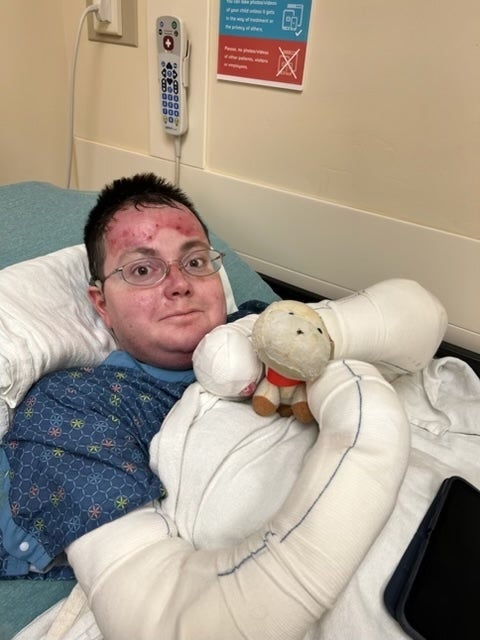
Beyond policy work, DiGiovanna created a lasting legacy of compassion through “Doggie’s Friends,” a charitable initiative at Cincinnati Children’s Hospital that provides stuffed animals to young patients facing long-term medical treatment. Inspired by his own childhood companion — a stuffed animal named Doggie that comforted him through countless surgeries — the program has already raised more than $160,000.
“He wanted to make sure every child going through something hard could have a special friend,” McCormick said. “It sounds simple, but the meaning behind it is so big.”
In his own words, the effort reflected his desire to ease the burdens of others.
“When a child receives one of Doggie’s Friends, I hope they get as much comfort as it gave me,” DiGiovanna wrote.
For McCormick, her son’s legacy is ultimately one of perseverance and purpose.
“When people face adversity, he showed you have to keep moving forward,” she said. “He was always thinking about other people.”