
As artificial intelligence continues to reshape industries, Rice University leaders highlighted the evolving demands on workers — and the role of higher education in preparing them — during multiple sessions at CERAWeek by S&P Global.
President Reginald DesRoches and Provost Amy Dittmar spoke at separate events during the weeklong conference, addressing how AI is transforming job roles, organizational structures and the skills needed in the workforce.
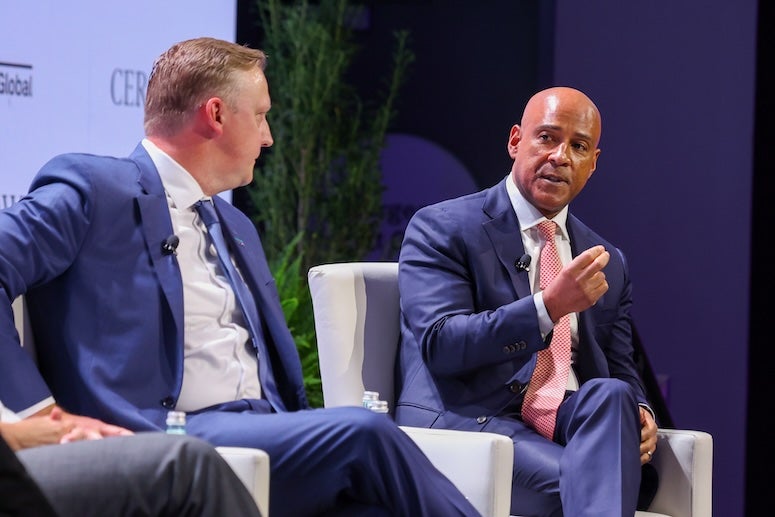
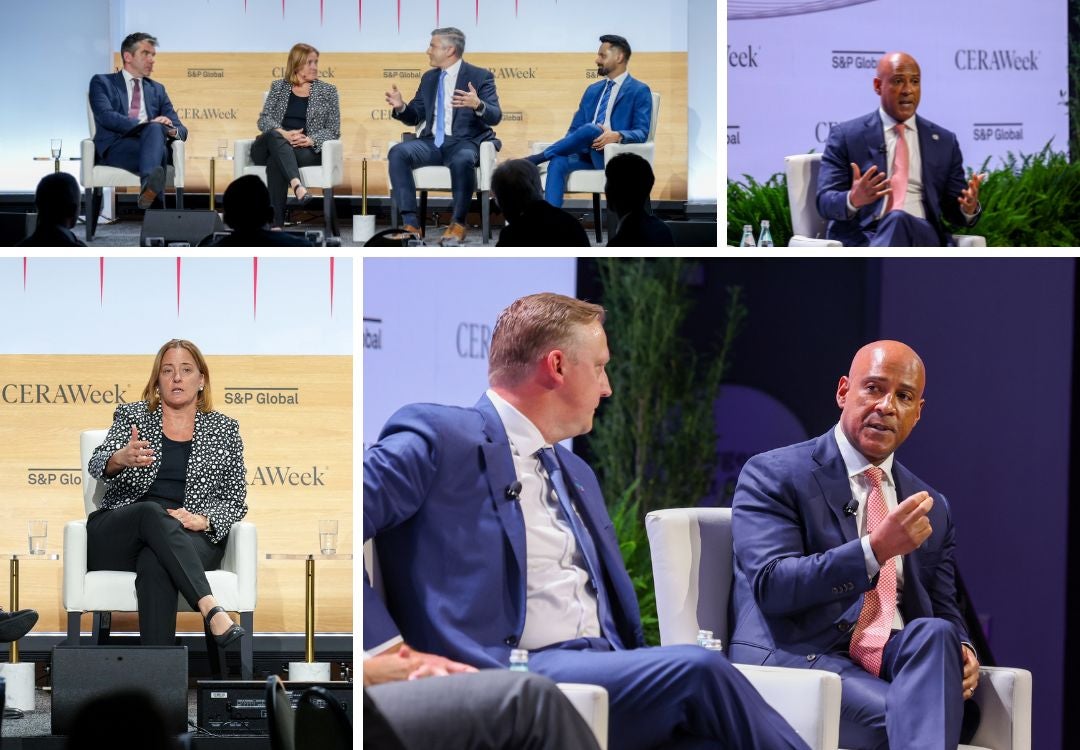
DesRoches participated in a March 25 panel, “Skills for Tomorrow, Today: Cultivating Workforce Agility,” moderated by CNN’s Van Jones and attended by a large audience of energy executives, policymakers and business leaders. Dittmar spoke March 23 at an “Insight Dinner” titled “AI: Changing organizations and how people work.”
During his panel, DesRoches emphasized Rice’s efforts to expand its student body in response to industry demand.
“We’re growing by about 25% over four years,” he said. “Part of the reason we’re growing is because we hear from industry: ‘We want more students. We want more Rice minds out there.’”
Rice maintains close partnerships with industry leaders in Houston, a global hub for the energy sector. And DesRoches said those relationships play a key role in shaping how the university prepares students.
“The energy sector is a system,” he said. “Students need to understand engineering and science but also business, policy and global issues.”
He added that Rice focuses on equipping students with both deep expertise in their fields and a broader interdisciplinary perspective to help them adapt as industries evolve.
DesRoches, who was joined in the panel by industry leaders Matt Neal of Siemens Energy and Debbie Pickle of Williams, outlined several ways Rice collaborates with companies, including guest lectures, student projects and advisory boards that provide input on curriculum and workforce needs. In some cases, those partnerships lead directly to new academic programs, including a customized data science master’s program developed for a global payments firm and a recently launched master’s degree in energy transition.
“We hear from industry what they need, and we develop programs for them,” he said.
At the same time, he noted that real-world experience is critical to preparing students for the workforce.
“When they get to the workforce, things are fuzzy,” DesRoches said. “The dataset is not always as clean as what you get in the textbook.”
Internships and industry-sponsored projects help bridge that gap, he said, allowing students to apply classroom knowledge in more complex, real-world contexts.
DesRoches also stressed the importance of developing critical thinking skills, particularly as job roles continue to change.
“It’s all about critical thinking,” he said. “Independent of what their role will be in five or 10 years, knowing that it will change.”
He added that a broad-based education remains essential.
“You need to have a full breadth of education so that you are a critical thinker,” he said. “What you’re doing in five years will be very different from what you’re doing right now.”
Dittmar highlights ‘human-centered’ approaches to AI
In her remarks, Dittmar focused on how AI is changing not only the nature of work but also how people approach problem-solving. She noted that while it is important for students to learn how to use AI tools, higher education’s role extends beyond technical training.
“Higher education is recalibrating … toward cultivating a discipline of the mind,” Dittmar said, emphasizing the need for students to engage in higher-order thinking as AI becomes more integrated into daily work.
She compared AI to earlier technological advances such as calculators and personal computers, which automated certain tasks but did not eliminate the need for conceptual understanding. Students must be able to evaluate and refine AI-generated outputs, she said, not simply accept them.
“This isn’t just verifying something is right,” she said. “It’s understanding what’s missing and what questions need to be asked.”
Dittmar also addressed the limitations of AI, noting that while the technology is effective at recognizing patterns and producing structured outputs, it lacks human creativity and original thought.
As AI tools become more widely available, she said, human insight and innovation will play an increasingly important role in distinguishing organizations and individuals. She also highlighted Rice’s focus on “human-centered” approaches to AI, where technology is used to augment — rather than replace — human capabilities.
Across disciplines, Rice faculty are incorporating AI into coursework in ways that emphasize critical thinking and ethical use — a tenant of the university’s overall strategic plan. Students are learning to test AI systems, evaluate outputs and understand their limitations, while also exploring how the technology can support research, communication and problem-solving.
This approach, Dittmar said, prepares students not only to use AI tools but to understand their broader implications in professional and societal contexts.
Together, the remarks from DesRoches and Dittmar underscored the need for continued collaboration between universities and industry as AI reshapes the workforce. By combining technical expertise, interdisciplinary learning and critical thinking, Rice aims to prepare students for careers in a rapidly changing landscape.
“The more experience our students have … the better they’ll be able to translate what they learn in the classroom to what they’ll need in the real world,” DesRoches said.