
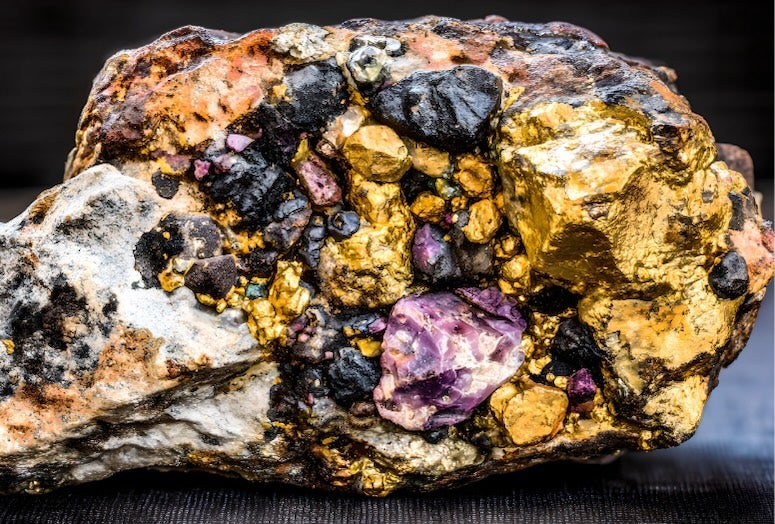
As the U.S. government reviews a proposal that could advance commercial deep-sea mining — a world first — Rice University experts are available to discuss the engineering and environmental questions surrounding the emerging industry and whether some critical minerals could instead be recovered from wastewater, electronic waste and other discarded materials.
The National Oceanic and Atmospheric Administration is reviewing an application from The Metals Company USA for exploration and commercial recovery of polymetallic nodules from the Clarion-Clipperton Zone in the Pacific Ocean. The nodules contain nickel, cobalt, copper and manganese used in batteries, energy technologies and other industries.
The following experts can address topics including those related to ecological questions surrounding seabed mining as well as alternatives for recovering rare materials.
- Sibani Lisa Biswal, the William M. McCardell Professor in Chemical Engineering, studies transport, interfacial phenomena and colloidal interactions in complex fluids with applications ranging from subsurface energy systems to resource recovery. Building on this expertise, her group is developing new approaches for critical-element recovery, including electrochemical flow systems for extracting lithium from geothermal brines and technologies to separate rare earth minerals from industrial wastewater.
- Shihong Lin, associate professor of civil and environmental engineering, has expertise in aqueous separations, including recovering lithium and other valuable elements from brines and industrial streams. His research includes electrochemical systems that can treat highly saline industrial wastewater while selectively recovering valuable metals such as copper and nickel. He can speak about alternative sources and their technical and economic challenges.
- James Tour, the T.T. and W.F. Chao Professor of Chemistry and professor of materials science and nanoengineering, develops technologies for extracting rare earth elements from electronic waste and industrial waste. He is also working on separating some of the individual rare earth elements from each other.
- Cin-Ty Lee, the Harry Carothers Wiess Professor of Geology, Earth, Environmental and Planetary Sciences, is a geologist and geochemist who studies ore formation and the movement of elements through Earth’s crust, oceans and atmosphere. His research includes a focus on how critical mineral deposits form, bringing together geology, geochemistry, surface process, Earth history and the physics of fluid transport.
To arrange an interview, contact media relations specialist Alex Becker at alex.becker@rice.edu.