
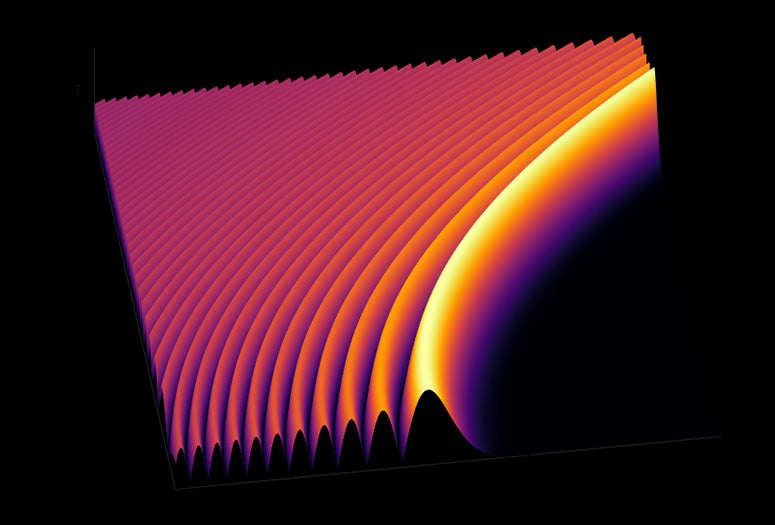
A new kind of wireless jamming attack could use curved radio beams to disguise where interference is coming from.

Rice University researchers demonstrated how this could happen and are presenting their research at the 47th IEEE Symposium on Security and Privacy this week. Their work challenges a core assumption about combating threats to wireless security ⎯ namely, that signal interference can be traced back to its source.
“This is the first demonstration of a jammer that cannot be reliably localized and the first time self-curving wireless beams have been used as an attack,” said Edward Knightly, the Sheafor-Lindsay Professor and a professor of electrical and computer engineering and computer science. “Our work uncovers a new kind of threat: A wireless device can be tricked into ‘seeing’ an attacker in the wrong place, making it harder to avoid interference or stop the source.”
Wireless systems are a critical invisible infrastructure underlying day-to-day life: Everything from cell phones and Wi-Fi routers to GPS, Bluetooth and emergency radios depends on radio signals moving unimpeded between transmitters and receivers. Jamming disrupts those signals by flooding the airwaves with interference. Attackers have used jamming to disable GPS tracking during vehicle thefts, interfere with drones, disrupt wireless cameras and interrupt communications during criminal activity or conflict.
One of the best defense tactics against jamming is for receivers to estimate the “direction of arrival” of an interfering signal in order to determine where the attacker is located. However, the new research shows that tactic may no longer be the go-to in attack scenarios.
“We show how a jammer can shape wireless wavefronts to curve a beam, making the attack appear to come from a false location,” said Caroline Spindel, a doctoral student in the Knightly lab who co-authored the research.
To illustrate the concept, Spindel used a soccer analogy.
“Imagine being hit on the right side of your head by a soccer ball,” she said. “You would naturally look to the right. But if the ball actually curved through the air, like a David Beckham free kick, then it was kicked from somewhere else entirely.”
The work hinges on curving beams, radio waves engineered to bend as they travel through space. Unlike conventional wireless signals, which are generally treated as traveling in straight-line wavefronts, these beams can follow curved trajectories and even reconstruct themselves after encountering obstacles.
The researchers used mathematical modeling, simulations and laboratory experiments to show that an attacker could manipulate these beams to fool wireless receivers into misidentifying the source of interference.
Their work shows attacks can exhibit different levels of sophistication. For instance, it is possible for an adversary to make interference seem as though it originated from the same location as the legitimate transmitter, thus lowering the receiver’s defenses and injecting disruption directly into the communication link.
“The curved signals disrupted communication so effectively that standard recovery methods failed,” Spindel said. “When the receivers tried to locate the source of the attack using two common direction-finding methods, both were tricked into pointing the wrong way.”
Exposing weaknesses before they are exploited in the real world not only helps protect existing infrastructure, but it also supports the safe deployment of next-generation wireless technologies. For example, future wireless networks, including advanced directional 5G or 6G systems designed to deliver stronger signals, may eventually rely on beam-shaping techniques similar to those studied in the paper.

“The implications extend beyond security in the present: Future communication systems that use these bending beams could unintentionally confuse older devices designed for beams that travel in straight lines,” Spindel said.
The study makes manifest the urgent need to rethink wireless security, especially in the context of rapid advances in physical AI and autonomous systems.
“As wireless technologies become more advanced, we also need smarter ways to keep them secure,” Knightly said.
The research was supported by the U.S. National Science Foundation (2433923, 2402783, 2211618). The content in this press release is solely the responsibility of the authors and does not necessarily represent the official views of funding entities.