
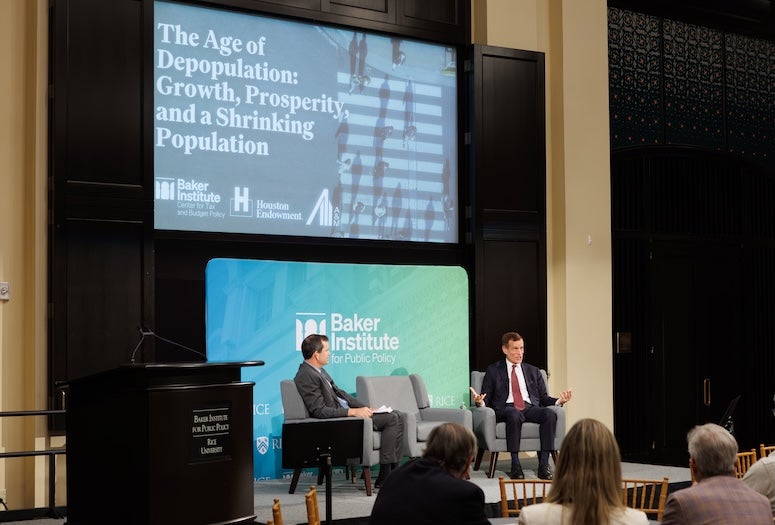
Fears of overpopulation and shrinking resources have been prevalent for the past century, but across much of the world today birth rates are falling, populations are aging and countries are starting to address what fewer people in the next generation means for the long term. The Baker Institute for Public Policy at Rice University brought together experts on demography, economics, immigration and more to a daylong conference to present and discuss the economic and social consequences of depopulation.
For much of the past century, the fear was simple: There would be too many people and not enough resources to support them. Today, that story is changing. Across much of the world, birth rates are falling, populations are aging and countries are beginning to grapple with what it means to have fewer people — not just in the distant future but within the next generation. The economic and social consequences of that shift were the focus of a recent conference at the Baker Institute, where experts examined the forces driving population decline and its implications for everything from immigration and education to fiscal policy, technology and infrastructure. But to understand why the world is now approaching a period of population decline, it helps to first understand the remarkable event that came before it: the population explosion.
For thousands of years, humanity grew slowly. Then starting in the 19th century and in a matter of generations, the trajectory changed dramatically. Not because people suddenly began having more children, but because far more of the children being born began to survive. As people learned more about the causes of disease, embraced sanitation and germ theory and improved nutrition and living conditions, child survival rose dramatically. This accelerated population growth — not because fertility increased but because mortality, particularly among children, fell.
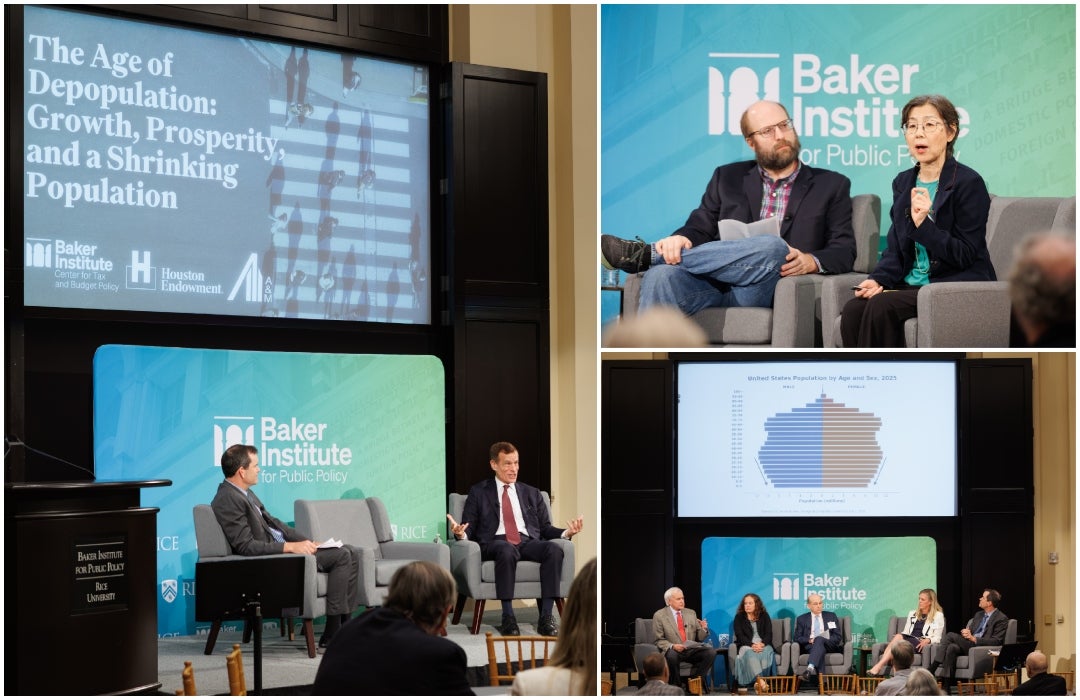
“‘It must be that people were having more babies,’ but actually, that’s not true at all,” said Dean Spears, associate professor of economics at the University of Texas at Austin and co-author of “After the Spike: Population, Progress, and the Case for People.” “The thing that happened, the thing that changed, that caused humanity to start blowing up the spike, is that we got better at keeping one another alive, and in particular, we got better at keeping children alive.”
The demographic transition that fueled the population explosion eventually began to work in the opposite direction. As child survival improved and societies became wealthier and more educated, families began having fewer children. Fertility rates fell across much of the developed world, in many cases below the level needed to replace the existing population.
The 1970s were another inflection point with the proliferation of birth control and tubal ligation — getting your “tubes tied.”
“So all of a sudden, women had an easy way to control how many children they were having, which they never really had before,” said Bill King, fellow in public finance at the Baker Institute. “But fundamentally, it seems to me what happened, starting about the middle of the 20th century forward, is women had a choice for the first time, probably in human history, to have some say about how many children they were going to have. And what we found out is they really weren’t that crazy about having five or six or seven kids. They thought that having fewer children was probably a good idea, and that there were other things that they might want to do. One incredible benefit to humanity here was that by freeing women from a lifetime of taking care of many children, we basically doubled the intellectual capital of the human race.”
As fertility declines, however, population change is no longer determined by births and deaths alone. Immigration becomes increasingly important because migration can change the size and age of a population much faster than fertility. Immigrants also tend to arrive during their working years, making migration particularly consequential for countries trying to maintain their labor forces as populations age.
Unlike fertility rates, which take decades to change the size and age structure of a population, migration can alter the population and workforce almost immediately — immigrants tend to arrive at working ages. That makes immigration an important demographic lever for countries facing aging populations and shrinking workforces, even if it cannot, on its own, reverse the underlying decline in fertility.
What happens in schools offers an early glimpse of a much broader challenge. A smaller generation does not simply mean fewer students; it changes where public resources are needed, how communities sustain themselves and eventually how economies replace retiring workers. Speakers pointed to Texas community colleges as one potential part of that response. Rather than measuring success primarily by enrollment, Texas has begun shifting community college funding toward outcomes such as completion and workforce results. Programs that connect high school students to college-level coursework, industry certifications and local employers could become increasingly valuable as the number of young people declines. In that sense, depopulation may make education less about accommodating ever-growing numbers of students and more about ensuring that every student is prepared to participate productively in a smaller workforce.
The conference also touched on the geopolitical and economic challenges that will arise as a result of depopulation. For example, major financial challenges are on the horizon for U.S. entitlement programs, as Social Security and Medicare rely heavily on taxes paid by current workers to finance benefits for current retirees. As birth rates fall and population growth slows, the number of workers supporting each beneficiary declines, while an aging population increases the number of people receiving benefits and raises health care spending. John Diamond, senior director of the Baker Institute’s Center for Tax and Budget Policy, said unless productivity, wages, immigration or labor-force participation rise enough to offset these demographic trends, the result is a widening gap between entitlement revenues and promised benefits, putting greater pressure on federal deficits and eventually forcing some combination of higher taxes, reduced benefits or later retirement ages.