
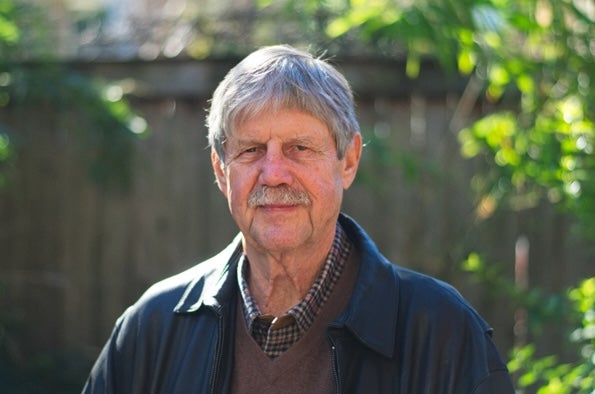
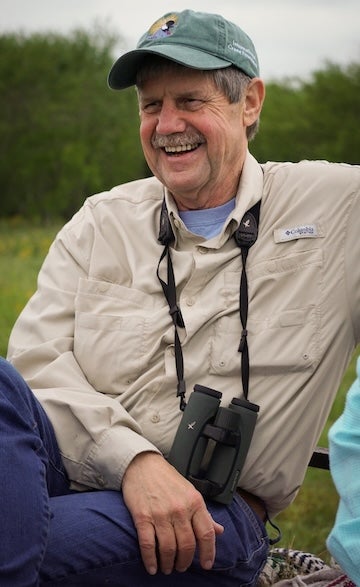
and Co-director of the SSPEED Center at Rice.
On the Texas coast, Jim Blackburn slips into his kayak the way some people step into a sanctuary.
Water folds around the hull. Birds settle back into the marsh. The shoreline opens — beautiful, fragile and increasingly tied to the future of Texas’ economy as much as its ecology. In “Calming the Waters,” a new documentary directed by Texas filmmaker Jeffrey Mills, that quiet entry point becomes both a literal scene and a metaphor: a veteran environmental lawyer returning, again and again, to the place that has guided his life’s work.
At its core, “Calming the Waters” tells two interwoven stories: the evolution of environmentalism in the United States, including the uniquely high-stakes story of the Texas coast, and the evolution of Blackburn himself, whose career has unfolded alongside the rise of environmental law, from its earliest battles to today’s more complex terrain.
Blackburn came of age as an environmental lawyer at a time when regulation was still finding its footing. He earned his law degree from the University of Texas just as modern environmental law was emerging, then distinguished himself further with a master’s degree in environmental science from Rice University, an uncommon combination that allowed him to ground legal arguments in science as the field matured.
That long arc frames the film’s central question: What does environmental protection look like now in an era shaped as much by markets and industry as by regulation?
“We don’t have to be at each other’s throats the way we were 50 years ago,” Blackburn said. “The challenges are different now. We’re talking about restructuring parts of the economy, not just regulating at the end of the pipe.”
Mills first encountered Blackburn’s name through conservation circles, including longtime members of Houston Audubon. Curious, he asked Blackburn to meet, and he quickly realized the story held an unexpected tension.
“What struck me was the contradiction,” Mills said. “Here’s someone who comes across as a very tough lawyer, and he is, but there’s so much more there. That complexity is what makes Jim’s story so compelling.”
That “more” includes Blackburn’s deep attachment to the Texas coast and a spiritual relationship with nature the film describes as “Earth Church” — a place of refuge, reflection and recalibration. The documentary also traces personal chapters of Blackburn’s life that have shaped his perspective and his work.
For Mills, the coast became a character in its own right.
“I grew up in Houston and thought I knew Galveston Bay, but only as a tourist,” he said. “I had no idea how beautiful it was, how much wildlife there is. When you really see it up close, it just takes your breath away.”
The film follows Blackburn through decades of legal and conservation fights that brought Texas’ environmental stakes into public view. Among them is the Aransas Project, a case tied to drought conditions and the deaths of whooping cranes on the Texas coast — one that, in Blackburn’s telling, revealed how difficult it can be to secure environmental protections in a development-driven state.
“In Texas, you’re not supposed to win environmental cases,” Blackburn said. “So if you want to oppose something and actually succeed, you have to come forward with real solutions.”
The film then moves into what Blackburn sees as the next phase of environmental progress: corporate action and market-based systems, particularly carbon credits and offsets that can turn conservation into an economic engine.
“This is an opportunity,” he said. “An opening. And we have to recognize those strategic openings and pursue them.”
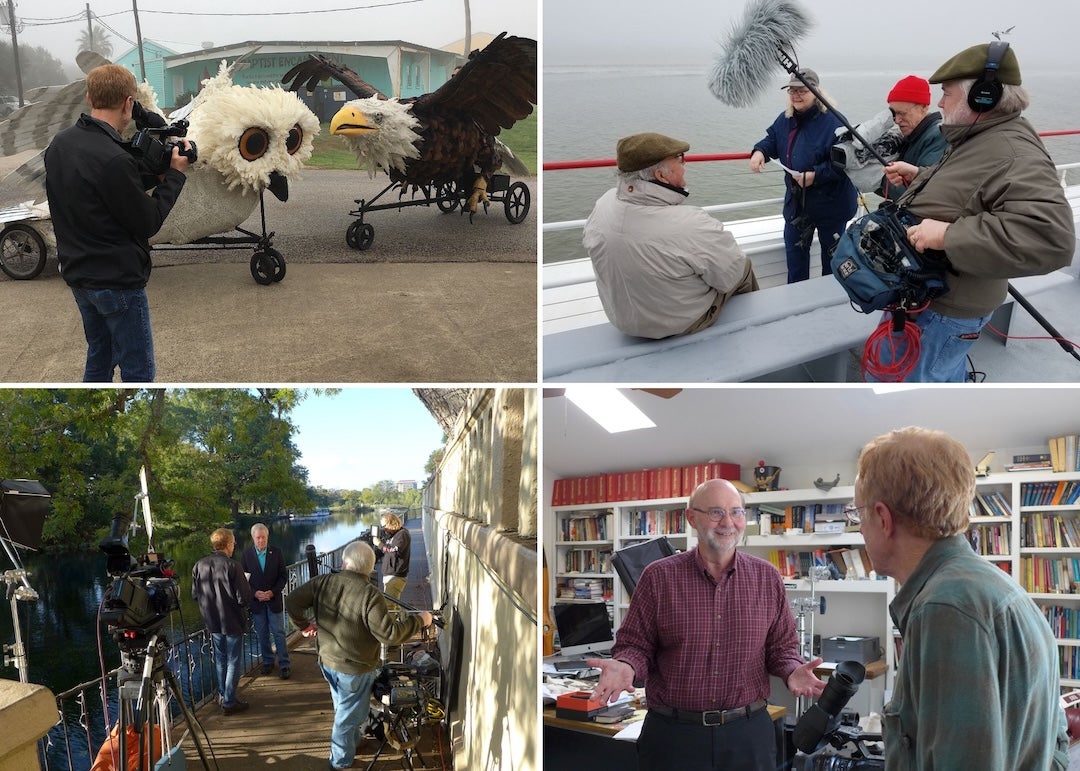
To broaden the frame beyond one career, Mills assembled a group of scholars, conservation leaders and practitioners who connect Blackburn’s story to the larger environmental movement and the distinct challenges of the Gulf Coast. Among them is Rice historian Douglas Brinkley, who situates the film within the national history of environmentalism, alongside voices such as Richard Gibbons of the National Audubon Society; University of Florida historian Jack E. Davis; Ann Hamilton, former senior grant officer for the Houston Endowment; and other legal, scientific and policy experts tied to major coastal decisions.
From the start, the film’s visual language was designed for broad audiences, pairing cinematic coastal footage with accessible explanations of complex topics including ecosystems, law, economics and the ways they intersect.
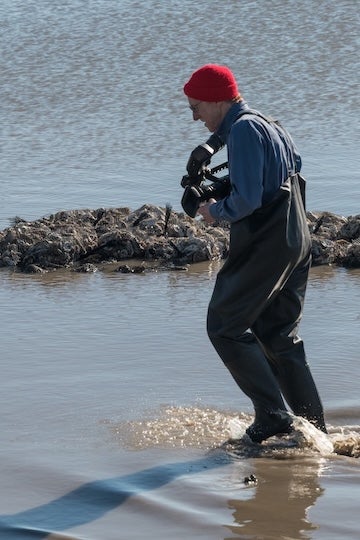
Mills leaned heavily on a recurring image — Blackburn on the water — filming from a kayak rig he built himself to capture the intimacy of that relationship.
“I honestly couldn’t keep up with him,” Mills said. “He’s an incredible kayaker. I was yelling, ‘Slow down, you’re getting too far ahead.’”
But one of the documentary’s most distinctive elements emerged after filming: an educational program developed alongside the film to bring its themes into classrooms.
The outreach effort includes workbooks designed for Texas high school classrooms, particularly Advanced Placement science courses, guiding students through the film and extending lessons on coastal systems, carbon, conservation and environmental decision-making. Blackburn sees the classroom pathway as both an extension of the film’s mission and a way to meet students where they are.
“Kids connect when they see something in video form,” he said. “It makes it feel real and accessible. That’s how you start getting young people interested in the outdoors.”
For Mills, who traces his own beginnings to a high school environmental club and a Super 8 film he shot as a kid, that early spark is exactly what “Calming the Waters” aims to ignite.
“Sometimes it’s a film, sometimes it’s a person,” he said. “But when something really connects you to an idea, it can change you.”
To learn more about the film and its upcoming premiere date, visit www.calmingthewaters.com.