
Written in collaboration with Silvia Cernea Clark
Climate change is one of the defining challenges of the 21st century, yet much of the public conversation about it still relies on charts, forecasts and policy debates. For many people, that kind of conversation can feel distant from everyday life.
At this year’s South by Southwest (SXSW) conference in Austin, Rice University researchers explored how to close that gap, whether by rethinking how climate change is communicated or by accelerating scientific discovery through artificial intelligence.
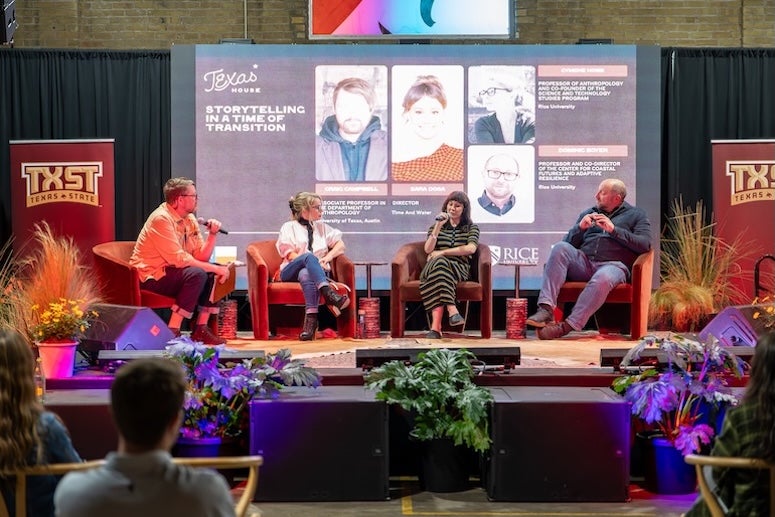
Cymene Howe and Dominic Boyer, both professors of anthropology, joined filmmakers and media creators for the panel “Storytelling in a Time of Transition.” The session featured Academy Award-nominated filmmaker Sara Dosa of the National Geographic documentary Time and Water, which premiered at SXSW. Moderated by Craig Campbell, associate professor of anthropology at the University of Texas at Austin, the conversation focused on how researchers and filmmakers can work together to turn complex environmental change into stories that audiences connect with.
SXSW is known for bringing together filmmakers, technologists, researchers and entrepreneurs to explore ideas shaping culture and society. With thousands of attendees and a program that spans film, research, technology and public policy, the conference offers a unique venue for conversations that cross disciplines.
For Howe and Boyer, the discussion centered on a key challenge: how to make people care about a crisis that can still feel far away.
“Statistics and scientific reports are effective, but they tend to reach expert audiences,” said Boyer, co-director of Rice’s Center for Coastal Futures and Adaptive Resilience. “Storytelling helps bridge that gap.
“When a good story is being told, we almost instinctively become absorbed in it,” Boyer said, adding that stories can translate research into experiences people recognize in their own lives and help motivate action.
“With energy transitions, we’ve seen how climate change mitigation efforts get operationalized,” Howe said. “With the world’s melting glaciers, we see that change is not coming quickly enough. It’s not happening deeply enough.”
She said part of the challenge lies in how climate change is framed.
“Too often the message focuses only on fears about the future,” Howe said. “Instead we must emphasize the ways we can rebalance the Earth system.”

Anthropology, she added, helps connect climate change to the relationships people have with each other and with the environments they depend on.
“Community making, ritual and ethical commitments are all ways to reach people emotionally, not just intellectually,” Howe said.
Ultimately, she hopes conversations like those at SXSW encourage people to see climate change not as a distant issue but as something tied to the places and communities they care about most.
“Most of us are very good at caring for and protecting the people we love,” Howe said. “But we need to be better at caring for and protecting the places we love.
“Every day we have a chance to make a difference, to make a change and to get engaged with saving the places we cherish. Now we need to do it.”
While conversations about climate storytelling highlighted the importance of engagement, other discussions at SXSW focused on how emerging technologies are shaping the future of discovery and innovation.
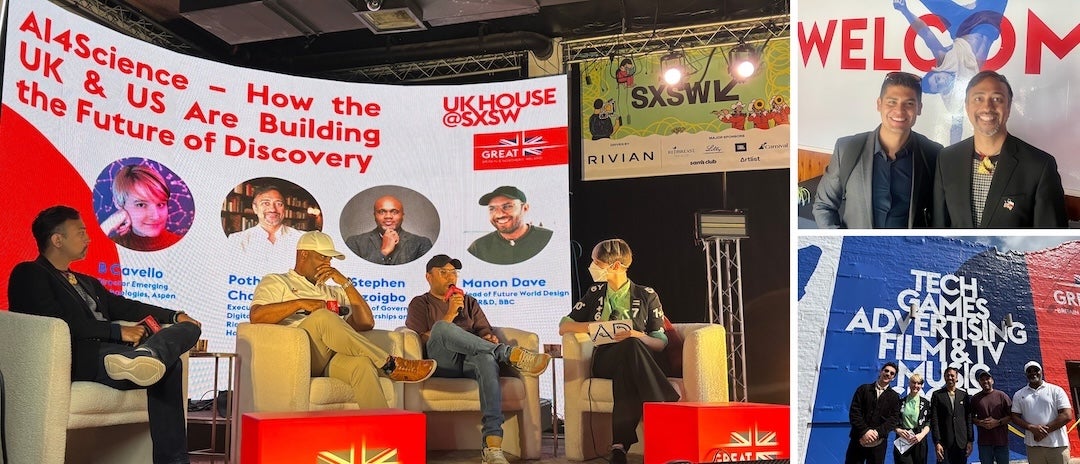
At UK House, two sessions explored the role of AI in accelerating science and the partnerships needed to move research into real-world applications.
Pothik Chatterjee, executive director of the Houston Methodist-Rice Digital Health Institute, participated in both the panel “AI for Science: How the UK and US are Building the Future of Discovery” and the roundtable “Who Funds the Future? Universities, Capital and New Wave Innovation.”
Launched in 2024 by Rice and Houston Methodist, the institute brings together engineers, clinicians and data scientists to develop digital health technologies that apply AI and advanced data systems to patient care and biomedical research.
In its first year, the institute secured about $20 million in federal and philanthropic funding, including National Science Foundation support for a digital health workforce initiative and National Institutes of Health grants supporting projects such as AI-enabled cardiovascular risk prediction.
“AI and digital health innovation are global efforts,” Chatterjee said. “The more bridges we can build between universities, health systems and startups, the faster we can move ideas into real impact.”
The discussions also highlighted international collaboration, including projects supported by the United Kingdom’s Advanced Research and Invention Agency, which funds high-risk, high-reward research programs. Four Rice laboratories are part of the agency’s inaugural cohort focused on next-generation brain technologies.
For Chatterjee, SXSW provided an opportunity to reflect on the institute’s progress and build new partnerships as it moves into its next phase.
“Now in our second year, the focus is on building partnerships with industry and international collaborators and developing solutions that reach patients and improve how health care is delivered,” he said.
One upcoming initiative is Industry Translation Day April 2 at Rice’s BioScience Research Collaborative, where companies including Samsung, Genentech, Abbott and Oracle will meet with Rice engineers and Houston Methodist clinicians in a “reverse pitch” format designed to connect industry challenges with academic research.
“We want to hear directly from companies about the pain points they are seeing in the market, so we can work together to develop solutions,” Chatterjee said. “UK House was a great opportunity to showcase DHI’s unique collaboration model and to forge and deepen connections that help advance our mission.”
Across panels and disciplines, a common theme emerged. Whether addressing climate change or advancing AI-driven health innovation, the challenge is not only generating knowledge but ensuring it reaches and resonates with the people it is meant to serve.