
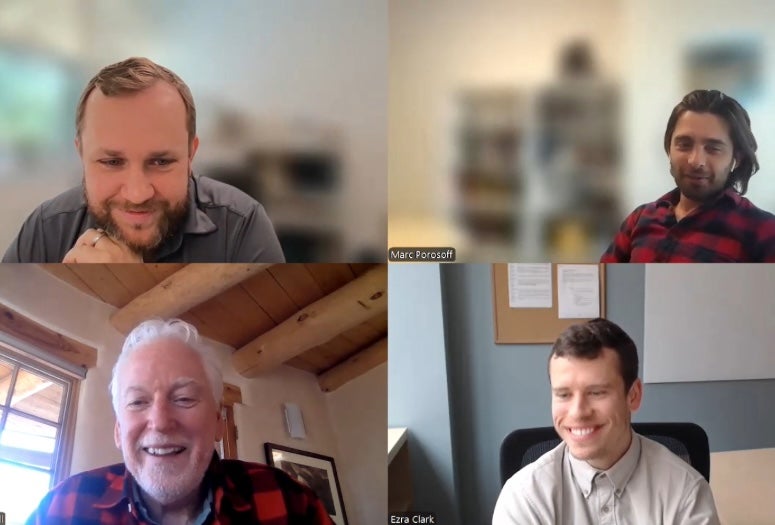
PodCAT began, as many consequential academic endeavors presumably do, over beers at a conference.
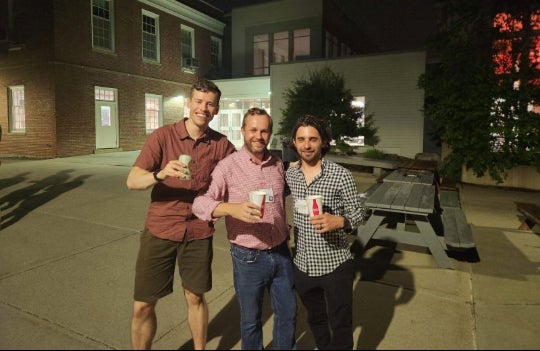
Thomas Senftle of Rice University, Marc Porosoff of the University of Rochester and Ezra Clark of Penn State University were swapping stories at a conference happy hour about the sometimes grueling process of becoming professors — the interviews, applications, unwritten rules and, especially, the mistakes. They agreed how great it would be if there were a repository where aspiring academics could learn from all those missteps. Then one of them suggested a podcast.
“It really was a joke,” Senftle said.
The next day, they kept the gag going — except their peers thought they were serious.
What eventually emerged was PodCAT, a podcast devoted to the science of catalysis, academic careers and the surprisingly personal stories of the researchers themselves. Its name is a mashup of “podcast” and “catalysis” — clever enough that, as the hosts joke, search engines sometimes assume they are either misspelling “podcast” or looking for a show about cats.
Still, what started as an experiment has developed into an increasingly popular resource for graduate students, postdoctoral researchers, young faculty members and others trying to navigate a profession in which some of the most valuable advice is rarely written down.
“There’s a tremendous amount you’re expected to know in academia that nobody formally teaches you,” Senftle said. “We wanted to make some of those conversations accessible to people who might not have the opportunity or feel comfortable enough to ask a senior researcher directly.”
The chemistry hiding in plain sight
The podcast’s subject matter may sound niche, but catalysis is anything but.
Catalysts help chemical reactions occur more efficiently and are involved in producing many of the materials and chemicals modern society depends on, from fertilizers and fuels to plastics and pollution-control technologies. Porosoff noted that roughly one-third of global economic activity involves a catalytic process.
“It’s a key technology that’s hidden to everyday people but underpins so much of modern life,” he said.
The three hosts approach the field from different directions. Clark works in electrocatalysis, using electricity — ideally from low-carbon sources — to drive chemical reactions. Porosoff studies experimental thermal catalysis. Senftle uses computational modeling to understand catalytic processes at the atomic scale.
“At its heart, catalysis is figuring out how we can manipulate materials to make and break chemical bonds the way that we want to,” Senftle said.
Those transformations can be used not only to make products but also to remove undesirable compounds. Catalytic converters in gasoline-powered vehicles, for example, use catalysts to transform harmful exhaust pollutants into less harmful substances.
Porosoff’s introduction to the field came in graduate school, when he encountered a project aimed at turning carbon dioxide into something useful.
“It sounded like magic, too good to be true,” he recalled.
That sense of possibility has endured. Better catalysts could help chemical manufacturers use cleaner feedstocks, consume less energy and rethink processes that have remained largely unchanged for generations.
“Catalysis gives us a chance to reconsider some of the enormous industrial processes that society has relied on for a century,” Clark said. “If we can understand these materials well enough to make those processes cleaner, cheaper or more efficient, the impact can be enormous.”
A podcast becomes a confessional
Despite PodCAT’s scientific focus, the hosts quickly discovered that discussions rarely stayed confined to reaction mechanisms.
“We thought it was going to be much more technical,” Senftle said.
Instead, guests started talking about their origin stories, failed research proposals, difficult job searches, recruiting students, raising money, self-doubt, imposter syndrome and what keeps them going.
The podcast, Porosoff said, became “a little bit of a confessional.”
And that turned out to be part of its appeal. In the more than 60 episodes recorded so far, even highly accomplished researchers described feeling uncertain early in their careers, a comforting revelation for scientists encountering many of the same struggles.
“Hearing that these big, famous scientists that everybody knows in our field felt the way we feel now kind of makes our own struggles at this point in time feel a little bit more manageable,” Clark said.
Sharing academia’s unwritten rules
Behind the personal stories is a serious aim: making information more accessible. Academic conferences have traditionally provided opportunities for researchers to learn informally from more established colleagues. Conversations over coffee, dinner or between sessions can reveal what universities look for in job candidates, how to structure a faculty application or what happens during an interview. But attending every conference is impossible, and approaching a prominent scientist can be intimidating for a graduate student or postdoc. A podcast can put some of those conversations within reach.
“If you weren’t at the conference, sometimes that information’s not really available to you,” Senftle said. “If, in the podcast, we talk about what to expect in an interview or we talk about what schools are looking for when they’re hiring, that information now becomes available to everybody.”
The hosts have now interviewed scientists from across the catalysis community. Once Cathleen Crudden, editor-in-chief of ACS Catalysis — widely regarded as the premier academic journal of the field —appeared on the show, the hosts figured they could aim high.
“Once we had her, then it was like, well, we can ask anybody,” Porosoff said.
It turns out, almost anybody. There remains one particularly elusive PodCAT booking: Matt Damon.
The hosts explained that Damon briefly appears in the 2021 crime thriller “No Sudden Move” where he plays a power-hungry executive trying to suppress access to catalytic converter technology. They seized on the cinematic connection, but so far, scheduling has proved difficult.
An unexpected reward since beginning the podcast is that the hosts have been getting to know their own scientific community better. Researchers whose work they had read for years became people they’ve spent an hour talking with about careers, failures and life outside a polished conference presentation.
The podcast has even generated a small degree of scientific celebrity. Clark recalled walking through an airport after a conference when someone stopped him.
“Hey, you’re the guy from PodCAT,” the person said.
“That was surreal,” Clark remembered thinking.
And also, admittedly, pretty great.
Where catalysis goes next
After dozens of conversations, the hosts are now looking across episodes for recurring ideas about both the future of catalysis and the culture surrounding it. They are developing a perspective article that will draw on themes that have surfaced through their many conversations, including thoughts on how the field is becoming increasingly interdisciplinary as new problems require a combination of expertise. They also plan to address how the field of catalysis, and science more broadly, is fundamentally a human enterprise.
“The human component is so important,” Porosoff said. “We want to encourage mentorship and collaboration and helping the younger generation along, especially with the rise of AI tools and AI in education. We really need to think about how the community evolves and ensure people are not just an addendum to the science.”
One of catalysis’ greatest challenges illustrates how much remains possible. The Haber-Bosch Process, developed more than a century ago, uses catalysts to make ammonia, a critical ingredient in fertilizer that helped make modern food production possible. But the process remains highly energy intensive, and a cleaner way to produce ammonia could have enormous benefits to the environment — it just hasn’t been developed yet.
Likewise, advances in computing could someday allow researchers like Senftle to model catalytic reactions at dramatically larger scales and design new materials far more efficiently.
It is exactly the kind of frontier the three hosts like talking about: enormous technical challenges wrapped around the very human process of trying, failing, learning and occasionally laughing at yourself.
PodCAT may have started as a joke, but the joke has developed into something the hosts themselves once wished existed — a place where scientists can talk openly about how science, and scientific careers, actually happen.