
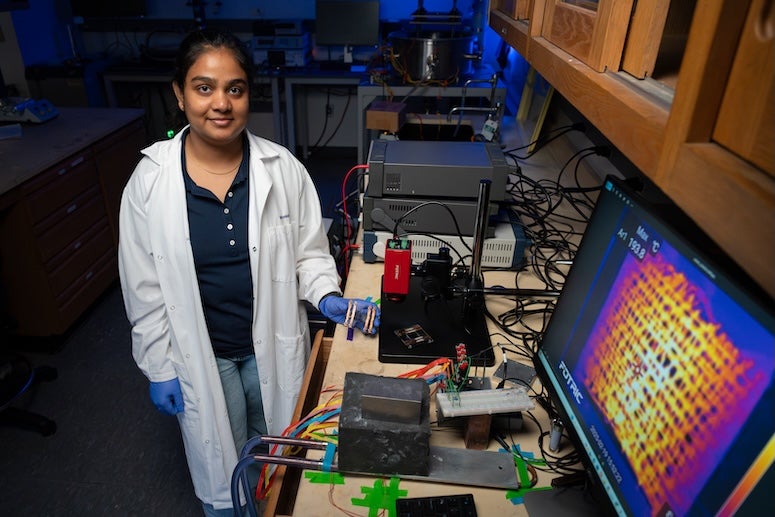
A cross-disciplinary team at Rice University has developed a new type of electric heating element — one that looks less like a traditional metal coil and more like a high-performance thread.
In a study published in Small, the researchers demonstrated that wires and fabrics made from carbon nanotube fibers (CNTFs) can deliver substantially more heating power per unit mass than conventional metal-alloy heaters when placed directly in flowing gases. The findings point to a potential new pathway for electrifying industrial heating, a critical but technically challenging step toward reducing carbon emissions.
“Electrifying industrial heat is one of the most important, and most difficult, pieces of decarbonization,” said first author Monisha Vijay Kumar, a graduate student in applied physics. “We wanted to understand whether an entirely different class of materials could expand what’s possible in gas heating.”
Industrial facilities routinely heat gases for processes ranging from chemical production and drying to thermal treatment and manufacturing. Today, that heat is typically generated by burning fuels. While electric heating may sound like a simple replacement — passing current through a resistive element — heating moving gases imposes severe demands on materials and design. Heaters must transfer energy rapidly and evenly into the gas stream while avoiding destructive hot spots, mechanical deformation and failure under extreme temperatures. Placing heating elements directly in the gas flow (a strategy known as immersion heating) improves efficiency but significantly increases stress on the material.
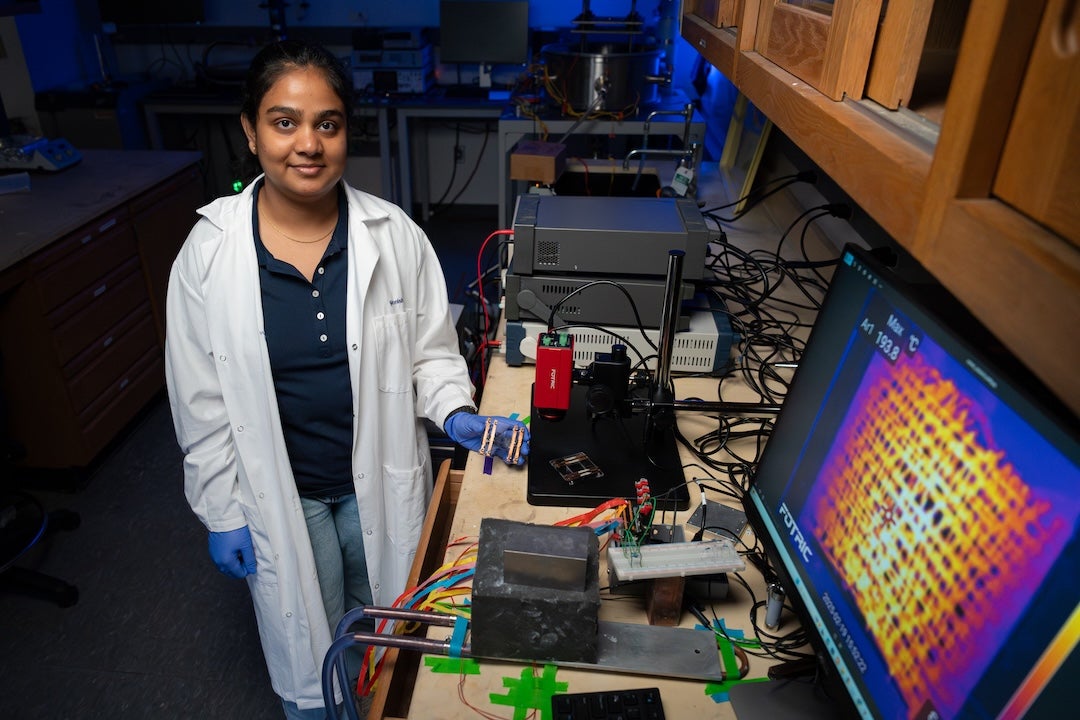
“When you immerse a heater directly into a gas stream, you gain heat-transfer efficiency, but you also create a much harsher operating environment,” said Daniel J. Preston, assistant professor of mechanical engineering, whose lab studies high-performance thermal management systems. “Geometry, stability and performance all become tightly coupled.”
One of the most stubborn constraints is size. Thinner heating elements exchange heat with gases more effectively, but conventional metal alloys are difficult to fabricate and handle at very small diameters. CNTFs offer a striking alternative; they combine electrical resistivity suitable for Joule heating with exceptional strength-to-weight ratios and unusually high thermal conductivity compared with traditional heater materials.
“Carbon nanotube fibers behave very differently from metal wires,” said Matteo Pasquali, the A.J. Hartsook Professor of Chemical and Biomolecular Engineering and director of the Carbon Hub. “They are lightweight, flexible and remarkably strong, which allows us to consider heater geometries and fabrication techniques that would be impractical with conventional materials.”
Rather than adapting CNTFs to existing heater designs, the team built devices made entirely from the fibers, including single filaments, parallel arrays and textilelike fabrics. Their key performance metric was specific power loading — the maximum heating power per unit mass a device can sustain before failure.
Across multiple configurations and operating conditions, CNTF heaters consistently achieved higher specific power loadings than comparable metal-alloy elements. The advantage was particularly pronounced in nonoxidizing environments, where carbon-based materials can withstand far higher temperatures without degradation. From a heat-transfer perspective, the fibers’ thermal properties proved especially important.
“Their high thermal conductivity helps distribute heat and suppress localized hot spots, which are a common cause of heater failure,” said Geoff Wehmeyer, assistant professor of mechanical engineering and an expert in nanoscale heat transport. “That heat spreading fundamentally changes how these devices behave under extreme conditions.”
The study highlights the fact that performance gains arise not only from material properties but also from the new architectures those properties enable. CNTFs can be produced at extremely small diameters while retaining mechanical robustness, opening design possibilities that are difficult to achieve with metal wires.
“Materials only become impactful when you can reliably build with them,” Pasquali said. “CNTFs provide unusual flexibility: For example, you can tie a knot in them and they don’t break; this expands the available design space.”
A distinctive feature of the work is its reliance on textile-inspired manufacturing techniques. CNTF yarns can be woven, knitted and assembled into lightweight, high-surface area structures — geometries that are particularly well suited for immersion heating. Vanessa Sanchez, assistant professor of mechanical engineering, contributed expertise in advanced manufacturing and textile technologies that helped translate nanoscale fibers into device-scale systems.
“Textile techniques give us extraordinary freedom in creating three-dimensional architectures,” Sanchez said. “We can design heaters that are lightweight, porous and mechanically compliant while remaining electrically functional.”
Compared with rigid metal meshes, CNTF fabrics exhibited more uniform heating behavior and reduced hot spot formation, benefits again linked to the fibers’ ability to spread heat efficiently.
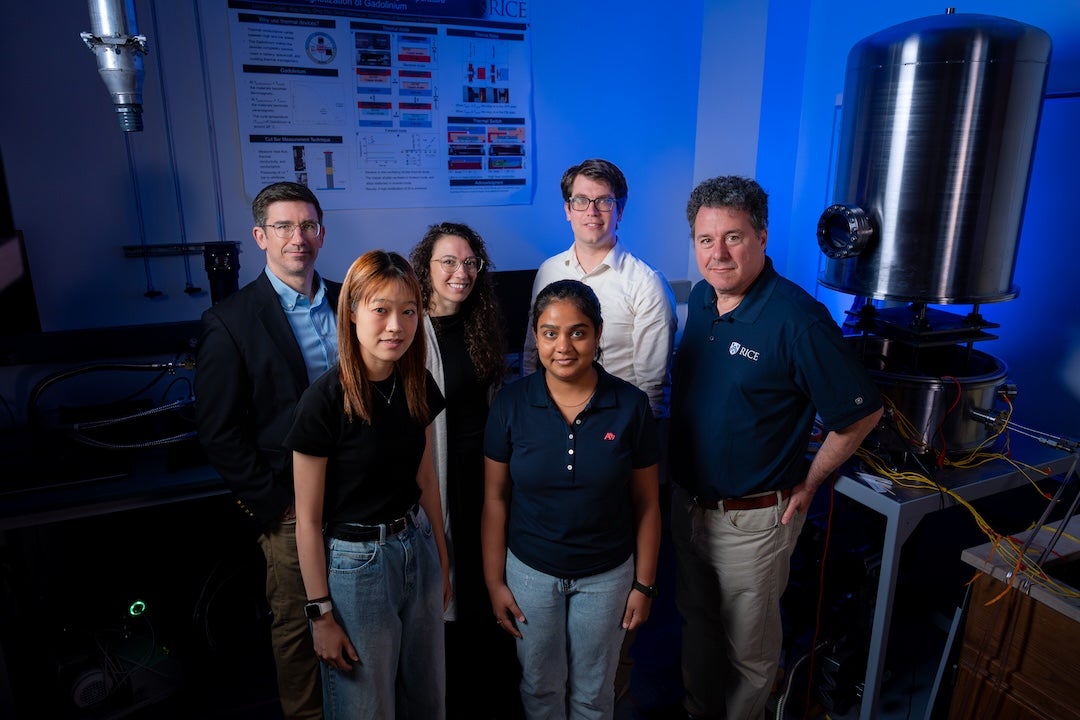
The project represents an unusual convergence of research communities, bringing together materials synthesis, nanoscale heat-transfer science, device engineering and manufacturing. The research also benefited from close collaboration with industrial researchers Robert Headrick and Dhruv Arora at Shell and with the research team at DexMat, which has commercialized and scaled up the CNTF production.
“This work required multiple layers of expertise,” Wehmeyer said. “Producing high-quality CNTFs is only the starting point. Understanding how they perform thermally and integrating them into functional devices is equally important.”
This research was supported by the National Science Foundation, the Department of Energy, Shell, the Welch Foundation, the Carbon Hub, a NASA Space Technology Graduate Research Opportunity award and a National GEM Consortium Fellowship.